

Key Takeaways: The Reality of Fire Door Compliance
- Vague Reports are Dangerous: Many Fire Risk Assessments (FRA) fail to provide the specific technical data needed to achieve compliance.
- Landlord Liability: Under the Fire Safety Act and the Fire Safety (England) Regulations 2022, the “Responsible Person” is legally liable for faulty fire doors, regardless of the quality of the report they received.
- Statutory Checks Matter: Regulation 10 and the official GOV.UK guidance set out clear points that fire door checks must cover, and missing them leaves landlords exposed.
- Precision is Mandatory: Compliance is measured in millimetres; a report that doesn’t mention gap widths, seals, hinges, glazing, and self-closing performance is practically useless for remediation.
- Professional Decoding: Elite Fire Door Installations specialises in translating thin FRA reports into comprehensive, fixed-price physical action plans.
Table of Contents
- The Legal Stakes of Non-Compliance
- Decoding Your FRA Report: The Problem with ‘Unacceptable’
- What the Government Says a Report Must Tell You
- The Elite Solution: Repair vs. Replace
- HMO Investor Preparation: Building Compliance into the Budget
- Our Certification & Professional Process
- Frequently Asked Questions
- Conclusion
1. The Legal Stakes of Non-Compliance
In the world of property management and HMO Fire Door Upgrades Sussex, ignorance is never a legal defence. Under the Regulatory Reform (Fire Safety) Order 2005, the Fire Safety Act 2021, and the Fire Safety (England) Regulations 2022, landlords and property managers are designated as the “Responsible Person.” This role carries heavy legal weight.
Regulation 10 is especially important. It requires the Responsible Person in relevant residential buildings to carry out regular fire door checks and to keep suitable records of the steps taken. The official GOV.UK guidance is clear that these checks must cover specific matters relating to the door, frame, seals, gaps, glazing, hardware, and self-closing performance. If those points are skipped, a landlord is left with a report that may sound official but does not provide a reliable basis for action.
If a fire occurs and your fire doors fail to contain the blaze, the authorities will not look at the inspector who wrote a vague report; they will look at you. We have seen a surge in enforcement policies where local authorities are issuing substantial fines and even prosecution for faulty doors. A report that simply marks a door as “failed” or “unacceptable” without detail leaves you in a legal grey area. You are aware there is a problem, but you haven’t been given the specific information required to fix it correctly. A vague report does not protect the Responsible Person from enforcement, civil exposure, insurer scrutiny, or the cost of emergency remedial works. Until that door is certified as compliant by a Certified Installer, your liability remains absolute.
2. Decoding Your FRA Report: The Problem with ‘Unacceptable’
At Elite Fire Door Installations, we spend a significant portion of our time reviewing Fire Risk Assessment reports provided by our clients. A recurring and frustrating theme has emerged: reports that are technically hollow.

When an inspector writes “unacceptable fire door” and moves on, they are leaving the landlord in the dark. To perform a valid FRA Remediation, we need to know the specifics that the inspector often misses:
- Gap Measurements: Are the gaps between the leaf and frame exceeding the mandatory 3mm or 4mm threshold?
- Seal Integrity: Are the intumescent seals damaged, painted over, or missing entirely?
- Hinge Certification: Are there at least three BS EN 1935 hinges, and do they have the correct intumescent backing?
- Closer Ratings: Does the overhead closer meet BS EN 1154 standards and successfully latch the door from any angle?
Without these data points, a landlord cannot accurately budget for fire door repairs Brighton or elsewhere. Elite Fire Door Installations acts as the bridge, taking these vague findings and conducting a physical technical survey to determine exactly what hardware and labour are required to reach British Standards BS 8214.
3. What the Government Says a Report Must Tell You
The official GOV.UK guidance supporting the Fire Safety (England) Regulations 2022, specifically Regulation 10, sets out what a proper fire door check must cover. In practical terms, if a report does not clearly address these points, the Responsible Person may still be left unable to act with confidence.
A proper report or recorded check should tell you whether:
- (a) the door has not been replaced with a non-fire-resisting door;
- (b) any letterboxes are closing properly and are not jammed open;
- (c) there is no visible damage or defects to the door, frame, or surrounding wall that could affect fire resistance;
- (d) any fire-resisting glass and glazing system remains intact and undamaged;
- (e) the hinges and other ironmongery show no defects, damage, or missing fixings;
- (f) the intumescent strips and smoke seals are present where required and are in good condition;
- (g) the gap between the door and frame does not exceed 4mm; and
- (h) the self-closing device is effective and fully closes the door into the frame.
This matters because some inspectors still skip over these statutory requirements and reduce the whole issue to one vague line: “unacceptable”. That is not enough for budgeting, scheduling, procurement, or legal defence. It does not tell a landlord whether the defect sits in the leaf, frame, glazing, seals, closer, hinges, or surrounding structure. It does not tell an investor converting a property into an HMO whether they need targeted fire door repairs Brighton, wider FRA Remediation, or a full fire door installation Sussex programme.
Elite Fire Door Installations reviews third-party FRA findings against these practical compliance points so landlords can move from vague wording to a physical action plan. That translation work is critical, because the Responsible Person remains legally liable whether the original report was helpful or not.
4. The Elite Solution: Repair vs. Replace
The common reflex for many general builders when faced with a “failed” fire door is to rip it out and start over. For a landlord with a 10-bedroom HMO, this approach is financially devastating.
Our unique selling point is our ability to evaluate failing doors and determine if they can be saved. In many cases, we can physically repair, re-lip, and upgrade existing doors. By using Certified Installers to install new intumescent seals, replace non-compliant hinges, or adjust the door leaf to meet gap requirements, we can restore the door to full compliance at a fraction of the cost of a full fire door installation Sussex.
This is not a job for a handyman. Fire door repair is a precision craft where a 2mm error can be the difference between a life-saving barrier and a failed inspection.
5. HMO Investor Preparation: Building Compliance into the Budget
For investors purchasing properties for HMO conversion, fire door compliance is often the largest unexpected expense. Local authorities are increasingly stringent regarding HMO fire door upgrades Sussex, and a vague pre-purchase survey can lead to thousands of pounds in “surprise” costs.

When factoring renovations into your budget, you must move beyond the “unacceptable” label. You need to know if the frames are fire-rated, if the walls surrounding the doors are adequately fire-stopped, and if the existing ironmongery carries the necessary CE/UKCA marks. We recommend that investors send us their initial FRA reports as early as possible so we can provide a fixed-price remediation plan before the first tenant moves in.
6. Our Certification & Professional Process
Elite Fire Door Installations follows a strict, professional step-by-step process to ensure your property moves from “unacceptable” to “certified” without the guesswork.
- Report Analysis & Survey: We take your existing FRA report and use it as a baseline for a technical survey.
- Fixed-Price Quoting: We provide a transparent, line-by-line quote that specifies exactly which seals, hinges, and closers need replacing.
- Certified Execution: Our work is carried out by qualified experts using specialised tools:
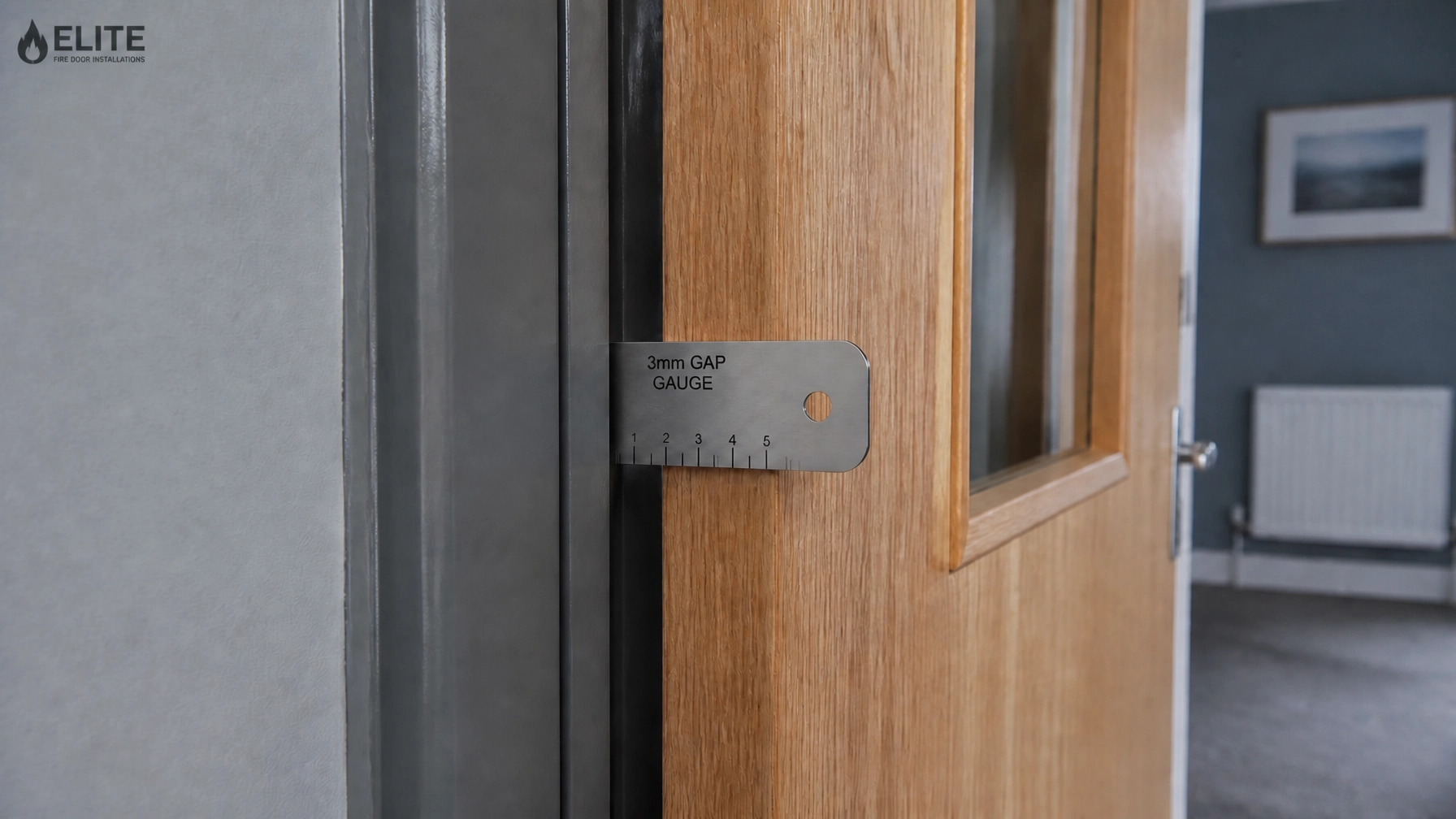
- Fire Door Gap Gauges: To ensure the 3mm standard is met with total accuracy.
- Intumescent Seal Routers: For precision fitting of new smoke seals.
- Digital Inclinometers & Force Gauges: To ensure doors meet BS 8300 opening force requirements.
- Certified Mastic/Sealant: For professional fire-stopping around the frame.
- Compliance Documentation: Upon completion, we provide the handover documentation necessary to prove to local authorities and insurers that the work was done by Certified Installers to BS 476-22 standards.

7. Frequently Asked Questions
Q1: Why did my FRA report say the door failed but didn’t tell me how to fix it?
Many Fire Risk Assessors are trained to identify risks but are not qualified installers. They can spot a potential failure (like a large gap or a missing closer) but do not have the technical expertise to specify the physical remediation required. This is why you must engage a specialist for FRA Remediation to translate the report into a work schedule.
Q2: Can I just have my regular maintenance person fix the fire doors?
No. Fire door compliance is a highly regulated field. Using non-certified labour to repair or install fire doors can void your insurance and leave you legally liable if the door fails during a fire. Only Certified Installers should handle the precision adjustments and hardware installations required.
Q3: What is the most common reason for an ‘unacceptable’ rating?
The most common failures we see involve excessive gaps (over 4mm), non-compliant self-closing devices, damaged or missing intumescent seals, and defects in hinges or glazing. These are often easy to flag but require expert precision and certified remedial work to rectify.
Q4: If I upgrade the hardware, do I still need a whole new door?
Not necessarily. One of our core services is evaluating if an existing leaf can be repaired. If the door leaf is structurally sound and of a certain thickness, we can often perform fire door repairs Brighton by upgrading the seals and ironmongery to meet current standards.
Q5: How often should I have my fire doors checked after they are fixed?
While we focus on the installation and repair, the Fire Safety (England) Regulations 2022, specifically Regulation 10, require communal fire doors in relevant buildings over 11 metres to be checked at least every three months and flat entrance doors at least every 12 months on a best endeavours basis. Having your doors initially brought to a high standard by Elite Fire Door Installations makes these ongoing checks much simpler and more likely to pass.
8. Conclusion
A vague “unacceptable” on an FRA report is not the end of the road: it’s the beginning of a process. Don’t let a lack of detail in your report lead to excessive spending or, worse, continued legal liability. The official GOV.UK guidance behind Regulation 10 makes it clear what a proper fire door check should cover, and a report that skips those points does not remove the Responsible Person’s legal exposure. By choosing Elite Fire Door Installations, you are choosing a partner that decodes the complexities of fire safety regulations and delivers a physical, certified solution. Whether you are dealing with fire door compliance for landlords Sussex or planning a large-scale renovation, our focus remains on precision, safety, and your peace of mind.
For expert remediation and certified installations, contact us today:
- Email: info@elitefiredoorinstallations.co.uk
- Specialist Support: +44 7514 898517
- Request a call back: +44 20 4511 9456
- Website: https://elitefiredoorinstallations.co.uk
Leave a Reply