

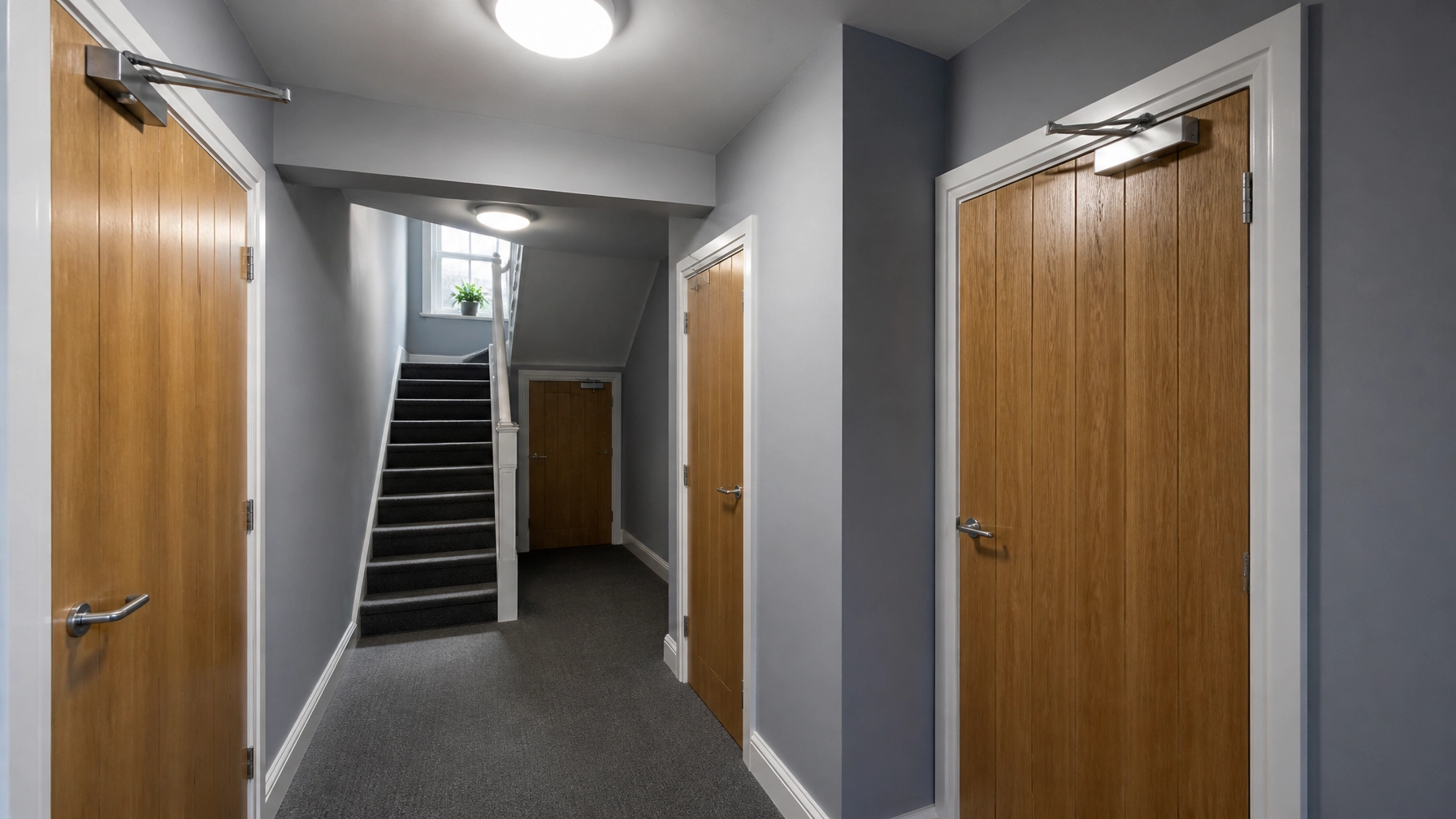
Plan professional fire door repairs, upgrades or installations around residents with a structured programme that protects privacy, reduces disruption and resolves Fire Risk Assessment findings.
1. Key Takeaways: Plan Occupied HMO Work Carefully
Fire door work in an occupied HMO requires more than arranging a contractor. Landlords and property managers must coordinate residents, access, shared routes, other trades and the responsible person’s fire safety arrangements.
- Use the Fire Risk Assessment (FRA) to identify the doors requiring priority attention.
- Communicate clearly with residents before arranging access.
- Sequence works so that disruption and any period of reduced protection are carefully managed.
- Protect resident privacy by limiting access to the agreed areas and times.
- Use qualified, certified professionals for all fire door repairs, upgrades and installations.
- Keep surveys, quotations, work records and a signed compliance file after completion.
- Treat bedroom doors, kitchens, shared corridors, stair routes and service rooms as part of one connected fire safety strategy.
Table of Contents
- 2. Review the FRA Before Scheduling Work
- 3. Communicate Clearly with Residents
- 4. Sequence Repairs to Reduce Disruption
- 5. Coordinate Contractors and Temporary Measures
- 6. Protect Privacy and Complete the Compliance Record
- 7. Answer Common Questions About Occupied HMOs
- 8. Arrange Your Professional Fire Door Survey
- 9. Conclusion: Resolve Fire Door Issues with Confidence
2. Review the FRA Before Scheduling Work
Begin with the property’s current Fire Risk Assessment. The FRA should help identify which doors protect escape routes, separate higher-risk rooms or support compartmentation.
The relevant doors may include:
- Bedroom doors opening onto shared corridors or landings.
- Doors protecting stair routes and communal escape paths.
- Kitchen doors where cooking equipment creates additional risk.
- Service rooms, boiler cupboards, electrical areas and storage spaces.
- Doors between private accommodation and shared parts.
- Entrance doors forming part of the building’s fire strategy.
The responsible person should establish the priorities before work is booked. A qualified fire door specialist can then complete a professional Fire Door Survey for Quotations to assess the complete doorset and translate the FRA findings into a practical programme.
A door leaf cannot be considered separately from its frame, hinges, closer, latch, seals and surrounding construction. The correct solution may involve professional Fire Door Repairs, an upgrade or complete Fire Door Installations.
The Regulatory Reform (Fire Safety) Order 2005 places duties on the responsible person to maintain appropriate fire safety measures. The Fire Safety Act 2021 also clarifies fire safety responsibilities in multi-occupied residential buildings.
3. Communicate Clearly with Residents
Advance communication helps residents understand why access is required and what to expect. It also gives the property manager time to identify availability, privacy concerns and any vulnerable occupants who may need additional support.
A suitable communication should explain:
- Which areas will be affected.
- The proposed dates and approximate duration.
- Whether access to bedrooms or private areas is required.
- Why the work relates to the property’s fire safety responsibilities.
- How residents can raise access or scheduling concerns.
- Which person will coordinate questions during the programme.
Provide reasonable notice and agree access arrangements wherever practicable. Residents should not be left uncertain about who will enter their accommodation or why.
The property manager should coordinate communications rather than expecting the contractor to manage tenancy relationships. This creates a clear division of responsibilities and helps preserve resident confidence.
If access is refused or repeatedly unavailable, record the attempts made and refer the matter to the responsible person or managing agent. Do not allow informal arrangements to replace proper access management.

4. Sequence Repairs to Reduce Disruption
A clear sequence can reduce inconvenience while keeping the work aligned with the FRA priorities.
Step One: Confirm the Door Schedule
List the doors requiring attention and group them by location. Bedroom doors, shared corridors, kitchens, stair routes and service rooms may require different access arrangements and working times.
Step Two: Prioritise the Most Important Routes
The responsible person and qualified fire safety professionals should determine which doors require earlier attention. Doors protecting a principal stair route or shared escape corridor may need to be prioritised over lower-risk locations.
Step Three: Group Compatible Work
Where practical, group work in nearby areas to avoid repeated access requests. This may allow several doors on one corridor to be addressed during a single planned visit.
Step Four: Coordinate Other Trades
Fire door work if planned alongside electrical, plumbing, decorating and refurbishment activities. Other contractors should not obstruct fire doors, remove hardware or alter frames without suitable qualified professional approval.
Step Five: Confirm Completion Before Moving On
The contractor and property manager should confirm that each scheduled area has been addressed before progressing to the next phase. This reduces the risk of missed doors or incomplete records.
A phased programme may be appropriate where several occupied rooms or shared routes require work. The responsible person must decide how any temporary management arrangements are controlled during the programme.
5. Coordinate Contractors and Temporary Measures
Occupied HMO work often involves more than one contractor. The person responsible for the property should ensure that every trade understands the fire door programme and does not compromise completed work.
Contractor coordination should cover:
- Access times and agreed working areas.
- Protection of floors, walls and residents’ belongings.
- Storage of materials away from escape routes.
- Communication between the fire door specialist and other trades.
- Confirmation of which doors are unavailable during work.
- Arrangements for maintaining safe building management throughout the programme.
Where work temporarily affects a fire safety arrangement, the responsible person must determine suitable interim management measures. These decisions should be based on the FRA, the scale of work and the building’s actual circumstances.
Residents must not be asked to create their own workaround, wedge doors open, remove closers or alter fire door hardware. Any temporary arrangement must be managed by the responsible person and competent professionals.
The purpose of planning is to keep any period of reduced protection controlled and as brief as reasonably practicable. Qualified installers should then complete the agreed work in accordance with the relevant specification, including applicable requirements associated with BS 476-22 and BS 8214.

6. Protect Privacy and Complete the Compliance Record
Resident privacy remains important even when access is required for statutory safety work. Contractors should enter only the agreed areas, during the agreed times and for the agreed purpose.
Property managers should consider:
- Confirming access in writing before the appointment.
- Providing a named contact for residents.
- Keeping visits focused on the scheduled doors.
- Avoiding unnecessary photographs of personal belongings.
- Storing any work photographs securely.
- Recording access issues factually and confidentially.
- Informing residents when the work in their room or area is complete.
After the work, the property owner should receive a clear record of what was addressed. The compliance file may include:
- The original FRA or relevant action schedule.
- The professional survey.
- The quotation and agreed scope.
- Door locations and work completed.
- Completion photographs where appropriate.
- Outstanding recommendations.
- Follow-up maintenance requirements.
- A signed handover record.
A complete file supports future FRA reviews, property management and communication with licensing authorities, insurers or other relevant professionals.
7. Answer Common Questions About Occupied HMOs
Should residents remain in the property during fire door repairs?
In many cases, carefully planned work can take place while residents remain in occupation. The decision depends on the work scope, building layout, affected escape routes and the responsible person’s management arrangements. A qualified specialist should advise on the practical programme, while the responsible person controls resident communication and building management.
How much notice should residents receive?
Notice should be reasonable and sufficient for the work involved. Bedroom access, shared corridor work and service room access may require different arrangements. The property manager should explain the purpose, timing and affected areas clearly and retain a record of communications.
What happens if a resident cannot provide access?
The manager should make reasonable further attempts, offer suitable alternative arrangements where practicable and document those attempts. If access remains unavailable and the matter affects fire safety, it should be escalated to the responsible person or managing agent for appropriate action.
Can a landlord ask a general contractor to repair a fire door?
Fire door work should be completed by qualified, certified fire door professionals who understand the complete doorset and its required performance. A general contractor may unintentionally alter the door, frame or hardware in a way that affects compliance.
What should happen after all repairs are completed?
The property manager should confirm that the agreed work has been completed, collect the relevant documentation and update the fire safety records. Any remaining recommendations should be assigned to a responsible person with a clear follow-up arrangement.
8. Arrange Your Professional Fire Door Survey
If your HMO remains occupied while fire door issues are being resolved, a structured plan can make the process more manageable.
Elite Fire Door Installations can review the available FRA information, complete a professional survey and recommend proportionate Fire Door Repairs, upgrades or Fire Door Installations.
Our approach focuses on:
- Clear communication.
- Practical access planning.
- Careful sequencing.
- Professional precision.
- Minimal unnecessary disruption.
- Complete handover documentation.
Visit the Elite Fire Door Installations website to arrange a professional review for your HMO.
9. Conclusion: Resolve Fire Door Issues with Confidence
Fire door repairs in an occupied HMO do not need to create unnecessary disruption. The key is to plan the work around the FRA, communicate with residents, coordinate contractors and protect privacy throughout the programme.
The responsible person must control any temporary management arrangements, while qualified and certified installers complete the physical fire door work. Once the programme is complete, a signed compliance file provides a clear record of the work and supports future property management.
With a professional survey, a clear quotation, proportionate remedial work and an organised handover, landlords, property managers and investors can resolve fire door issues while maintaining a calm and well-managed living environment.
Note: This information is intended as general guidance and does not constitute professional or legal advice. Always consult a qualified fire safety engineer for your specific property.
Contact Elite Fire Door Installations
- Email: info@elitefiredoorinstallations.co.uk
- Specialist Support: +44 7514 898517
- Request a call back: +44 20 4511 9456
- Website: https://elitefiredoorinstallations.co.uk
Leave a Reply