

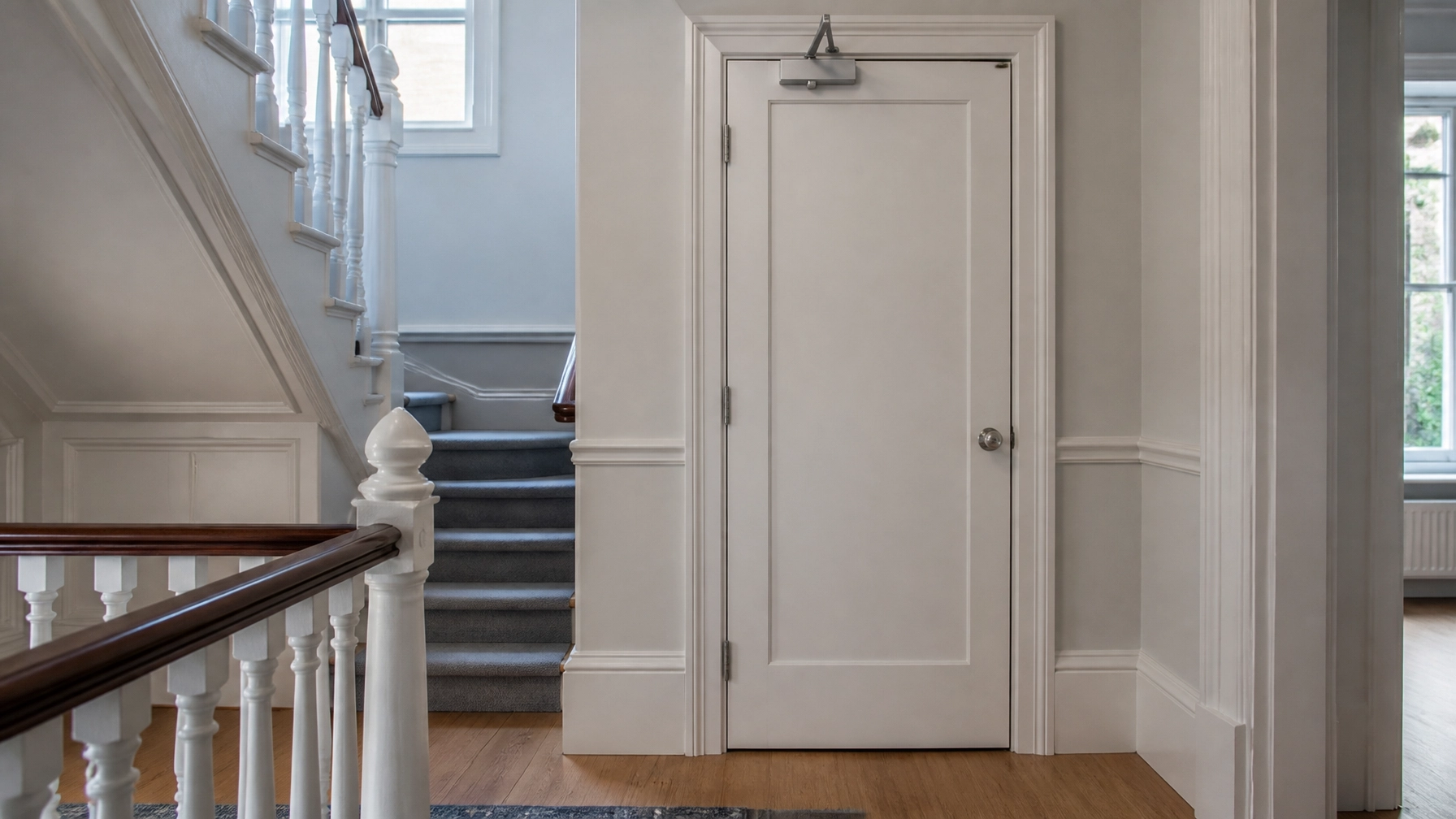
Day 3 of our seven-day conveyancing fire-door series.
A missing or poorly fitted fire door can create a conveyancing query that may need further evidence. A buyer’s surveyor, mortgage lender or solicitor may ask for clarification before exchange or completion. If the issue affects a loft conversion, third-storey bedroom, integral garage, flat entrance or HMO escape route, it is sensible to review the door condition and paperwork early so the matter can often be resolved quickly.
1. Stop Fire Door Defects From Stalling the Sale
Key Takeaways
- Resolve fire-door concerns before marketing a property, rather than waiting for a buyer’s survey or lender valuation to raise them.
- Treat loft conversions and third-storey bedrooms as a priority because they commonly depend on a protected central stair escape route.
- Do not overlook integral garage doors, flat entrance doors or HMO bedroom doors.
- A client-provided Fire Risk Assessment is useful background information, but it does not replace a physical Fire Door Survey for Quotations.
- FireQual provides evidence of the individual installer’s technical competence. It does not automatically make every installation legally compliant.
- A properly prepared signed compliance file can give solicitors, lenders and insurers clear evidence of the work completed.
For sellers and landlords, fire-door questions often arise during the normal course of a sale: after an offer has been accepted, a mortgage application has been submitted and the parties are working towards exchange.
The good news is that these queries are often manageable. Early professional advice can identify whether doors require repair, upgrading or replacement, and a clear documented response can help all parties move forward with confidence.
Table of Contents
- Stop Fire Door Defects From Stalling the Sale
- Understand Why Lenders and Insurers Care
- Translate Conveyancing Questions Into a Clear Action Plan
- Choose Repair, Upgrade or Replacement With Evidence
- Prepare HMO and Investment Properties Before Marketing
- Understand FireQual, Installer Competence and Q-Mark
- Answer Common Conveyancing Fire-Door Questions
- Arrange Professional Support Before Exchange
- Conclude With a Safer, More Saleable Property
2. Understand Why Lenders and Insurers Care
Fire doors are not decorative upgrades. They form part of a building’s fire-resisting strategy and, where required, protect people using an escape route.
The legal position depends on the building and its use. Building Regulations apply to building work such as loft conversions. The Regulatory Reform (Fire Safety) Order 2005 applies to relevant non-domestic premises, including many HMOs, B&Bs and guest houses. The Fire Safety Act also places important duties on those responsible for multi-occupied residential buildings.
In every case, the responsible owner or duty holder must take reasonable steps to manage fire risk. Where a door has been altered, damaged or poorly documented, it is often helpful to arrange a professional review so the position can be clarified and, where needed, resolved proportionately.
Resolve the Three-Storey and Loft Conversion Trap
A loft conversion that creates a third storey changes the fire-safety expectations for the dwelling. The central stair usually needs to operate as a protected escape route. Fire-resisting doors may therefore be required to rooms opening onto that route across the relevant floors.
This is where conveyancing problems arise. A property may be marketed as having an additional bedroom or loft suite, but the buyer’s surveyor may identify:
- Missing fire doors on the stair route.
- Doors that do not appear to be fire-resisting doorsets.
- Inappropriate or damaged hardware.
- Missing or discontinuous intumescent and smoke seals.
- Door frames or surrounding construction that do not match the intended specification.
- No clear evidence of Building Regulations approval or completion documentation.
The Ministry of Housing, Communities and Local Government’s Approved Document B frequently asked questions confirms that a fire doorset must be considered as a complete installed assembly. This includes the door, frame and ironmongery.
Consequently, simply replacing a door leaf may not resolve the conveyancing concern. The complete arrangement needs to be assessed against the available evidence and the requirements of the property.
Mortgage lenders, surveyors and conveyancers commonly raise questions where a third storey appears to need clearer protection to the central stair. They may request a specialist report, remedial quotation, completion certificate or evidence that the work has been carried out by a competent person. In practice, sellers are often asked follow-up questions about whether the loft conversion fire doors, third-storey room doors and the stair enclosure have been professionally surveyed and whether the final file answers lender and insurer queries clearly enough to remove conditions. These are common practical matters and can often be resolved quickly once the door condition and documentation have been reviewed properly.
Protect Integral Garages and Flat Entrances
An integral garage door is another frequent source of concern. The door between a garage and the home’s circulation space generally needs to provide suitable fire resistance, self-closing performance and smoke control. The hinges, gaps, frame, closer and seals all matter.

A flat entrance door can be equally important. It may form part of the compartmentation between a private dwelling and communal areas. If its rating, seals, closer or hardware are uncertain, a buyer’s solicitor, conveyancer, surveyor or the block’s managing agent may ask for evidence before proceeding.
Insurance is also an important consideration. If an integral garage or flat entrance lacks a compliant fire door, the insurer may ask further questions about the risk, the specification or the supporting documentation. That can also be relevant to the buyer because mortgage lenders normally require valid buildings insurance before releasing funds.
In practical terms, sellers are often asked about five recurring points:
- Whether the loft conversion and any third-storey accommodation are protected by suitable fire-resisting doors on the escape route.
- Whether the door between the dwelling and an integral garage is correctly specified and closes properly.
- Whether a flat entrance door has reliable evidence of its fire-resisting performance and compatible hardware.
- Whether any mortgage offer has been made subject to remedial works, specialist confirmation or updated compliance records.
- Whether the insurer has raised questions about altered layouts, compartmentation, shared escape routes or previous undocumented works.
These are common surveyor and conveyancer queries. In many cases, they can be dealt with efficiently once a competent specialist has reviewed the doors, confirmed the scope and prepared the right supporting file.
3. Translate Conveyancing Questions Into a Clear Action Plan
Separate an FRA From a Physical Fire Door Survey
A Fire Risk Assessment may have been prepared for an HMO, B&B or other relevant property. It may identify that fire doors require attention. However, an FRA is not necessarily a door-by-door specification for remedial work.
A client-provided FRA should be treated as an important starting document. It may explain the overall risk strategy, identify locations of concern and set priorities. It may not record every physical defect, the required repair method or whether an existing doorset can be retained.
That distinction matters during conveyancing. Surveyors and conveyancers usually need a practical, property-specific answer to clear questions about loft conversion doors, third-storey protection, integral garage separation, flat entrance performance, mortgage conditions and insurer concerns.
A professional Fire Door Survey for Quotations translates the available information into a practical schedule. The qualified specialist considers the condition and configuration of each relevant door, including:
- The door leaf and frame.
- Hinges, latches, locks and closers.
- Intumescent and smoke seals.
- The relationship between the door and the protected route.
- Available certification and manufacturer information.
- Whether the existing assembly is suitable for repair or requires replacement.
- The documentation needed for the solicitor, lender, insurer or licensing authority.
This process helps prevent vague recommendations such as “upgrade all doors” when a more precise and cost-effective solution may be available. It also gives sellers a straightforward route: arrange a professional survey, receive a clear scope, complete proportionate repairs or upgrades, and retain the signed file.
Build a Signed Compliance File
A signed compliance file should tell a clear story. It should connect the original concern to the work completed and the evidence supporting the result.
Depending on the property and scope, the file may include:
- The client-provided FRA and relevant building information.
- The specialist survey findings.
- An itemised quotation.
- Details of approved products and hardware.
- Records of completed Fire Door Repairs.
- Details of new Fire Door Installations.
- Photographic records where appropriate.
- A schedule of doors addressed.
- A signed handover statement confirming the work undertaken.
This file does not replace Building Control approval, an FRA or an insurer’s requirements. It provides organised evidence that the physical fire-door work was planned and delivered by a competent professional.
4. Choose Repair, Upgrade or Replacement With Evidence
A fire door that has attracted a query does not automatically require a full replacement. Equally, a door should not be repaired simply to reduce the quotation if its construction, frame or certification cannot support the required performance.
Elite Fire Door Installations assesses whether a failing doorset can be physically repaired, re-lipped or upgraded where its condition and evidence allow. Professional remedial options may address damaged components, unsuitable hardware, seal deterioration or other defects. Where the assembly is not suitable for reliable remediation, a replacement may be the responsible option.
The objective is not to sell the most expensive solution. It is to select a proportionate, defensible solution that supports safety, regulatory requirements and the client’s budget.
All work should be undertaken by a competent professional familiar with BS 476-22 and BS 8214. BS 8214 provides recognised guidance for timber-based fire door assemblies, while BS 476-22 relates to fire-resistance testing. The correct specification still depends on the property, doorset, fire strategy and available evidence.
5. Prepare HMO and Investment Properties Before Marketing
Property investors converting a house into an HMO should consider fire doors before finalising the renovation budget. Treating them as an end-stage snagging item can cause licensing delays and expensive changes after other finishes have been completed.
The budget should allow for a professional HMO Fire Door Upgrade where required, including consideration of:
- Bedroom doors opening onto communal escape routes.
- Doors serving kitchens, utility areas and higher-risk rooms.
- Communal corridor and stair protection.
- Riser, plant and storage cupboard doors where relevant.
- Flat entrance doors in converted or subdivided buildings.
- Integral garage doors.
- Suitable self-closing devices and compatible hardware.
- Intumescent and cold smoke seals.
- Repairs to existing doorsets where their construction permits.
- Replacement of doors that cannot provide reliable evidence of performance.
- Compliance records required for licensing, insurance and future sale.
For B&Bs and guest houses, the accommodation use and guest safety arrangements must be considered. For small offices, shops and private schools, the specification may depend on the building’s use, occupancy and fire strategy.
For flats in buildings under seven storeys and below 18 metres tall, a FireQual-certified specialist will generally be suitable for privately procured fire-door work, provided the FRA, specification, insurer and contract requirements are satisfied. The same principle applies to many HMOs, B&Bs, small commercial premises and small private schools.
6. Understand FireQual, Installer Competence and Q-Mark
UK fire-safety duties require work to be carried out by people with suitable competence, training and experience. They do not automatically require one particular logo for every private-sector property.
This is the important distinction:
- FireQual provides evidence of the personal technical competence of the actual installer carrying out the work.
- BM TRADA Q-Mark is a company-level certification scheme that may assess corporate processes, management systems and quality controls within the relevant scheme scope.
- A FireQual certificate does not, by itself, guarantee that every project is compliant. The work must still follow the correct specification, product evidence, building requirements and professional process.
- Q-Mark or an equivalent company scheme may be required by a local authority, council procurement framework, principal contractor, insurer, lender or large tender.
For a private seller, landlord or HMO investor, the practical question is often: who will actually carry out the work? A sole trader who personally holds the FireQual qualification provides direct accountability between the named competent person and the work on the property.
In practical private-sector terms, FireQual will generally be suitable for work in HMOs, B&Bs, small offices, shops, small private schools and flats in buildings under seven storeys and below 18 metres, provided the FRA, specification, insurer, lender and contract requirements are satisfied. That is often the key point when a conveyancer, surveyor or mortgage provider asks for evidence of the installer’s competence rather than broad company marketing claims.
Follow a Controlled Professional Process
Elite Fire Door Installations operates as a FireQual-certified sole trader rather than a BM TRADA Q-Mark company. The process is structured around four stages:
- Survey: Review the property, relevant paperwork and physical doors that affect the escape route or compartmentation.
- Fixed-price quotation: Provide an itemised scope showing proposed repairs, upgrades or replacements.
- Certified execution: Complete the agreed work using professional UK-standard equipment, including Fire Door Gap Gauges, Intumescent Seal Routers, Hinge Jigs, Fire-Rated Packers, Digital Inclinometers, Force Gauges, Laser Levels and certified Intumescent Mastic or Sealant.
- Compliance handover: Provide the agreed signed records and supporting documentation for the owner, solicitor, insurer or licensing process.
This approach can be particularly suitable where a high-rise corporate contractor is unnecessary, while still ensuring that competence, evidence and workmanship are treated seriously.
7. Answer Common Conveyancing Fire-Door Questions
Can a missing fire door stop a house sale?
Yes. A buyer’s surveyor, lender or solicitor may request further evidence or remedial work before exchange or completion. The impact depends on the location, building history, risk and lender requirements.
Does a loft conversion always need fire doors?
The required arrangement depends on the design, approval history and means of escape. Where a loft conversion creates a third storey, the central stair commonly needs protection. Obtain professional advice rather than relying on the appearance of the doors.
Can a client-provided FRA prove that the doors are compliant?
No. An FRA provides risk-management information, but it may not confirm the detailed condition and suitability of every doorset. A professional Fire Door Survey for Quotations can convert the FRA findings into a physical scope of work.
Does FireQual alone provide legal compliance?
No. FireQual is evidence of the individual specialist’s competence. Legal and regulatory compliance also depends on the correct doorset, hardware, installation, maintenance, building requirements, FRA, insurer conditions and contract specifications.
Can an existing fire door be repaired instead of replaced?
Sometimes. A FireQual-certified specialist must assess the doorset before recommending repair, re-lipping, upgrading or replacement. The decision depends on the door’s construction, condition and supporting evidence.
8. Arrange Professional Support Before Exchange
A helpful time to address fire-door concerns is before the property is marketed. Sellers can then answer enquiries with evidence and a clear plan if questions arise later.
Landlords and investors can also reduce delays by arranging a professional survey before purchasing or converting a property. This is especially useful for HMOs, loft conversions, third-storey bedrooms, flats and properties with integral garages.
If you are preparing a property in Royal Tunbridge Wells, elsewhere in Kent, or more widely for sale, letting or HMO conversion, contact Elite Fire Door Installations to discuss a professional survey, remediation or installation.
If you are a local property owner in East Sussex or across the wider South East, contact Elite Fire Door Installations for rapid fire door upgrades, remediation and signed compliance files before your sale stalls. We provide a calm, practical route: professional survey, clear scope, proportionate works and documented handover designed to answer surveyor, conveyancer, mortgage and insurer queries with clear supporting evidence.
9. Conclude With a Safer, More Saleable Property
A fire-door issue can affect much more than the appearance of a property. It can lead to further conveyancing questions, lender conditions or insurance queries, but these are often practical matters that can be addressed with the right review and documentation.
Loft conversions, third-storey escape routes, integral garages, flat entrances and HMO communal areas deserve early attention. The practical solution is simple: obtain a professional Fire Door Survey for Quotations, receive a clear scope, complete proportionate repairs or upgrades, and retain a signed compliance file that can answer surveyor and conveyancer queries directly.
FireQual can provide valuable evidence of the personal competence of the actual installer completing the work, while Q-Mark is a company-level certification scheme. FireQual is generally well suited to many private-sector properties under 18 metres, including private-sector HMOs, B&Bs, small offices, shops, small private schools and flats under seven storeys, subject to the FRA, specification, insurer, lender and contract requirements. It is not an automatic substitute for a suitable design, correct installation or wider compliance duties.
Note: This information is intended as general guidance and does not constitute professional or legal advice. Always consult a qualified fire safety engineer for your specific property.
Email: info@elitefiredoorinstallations.co.uk
Specialist Support: +44 7514 898517
Request a call back: +44 20 4511 9456
Website: https://elitefiredoorinstallations.co.uk
Leave a Reply