
Operating a House in Multiple Occupation (HMO) in Brighton & Hove comes with a unique set of rewards, but also a heavyweight of responsibility. As an investor, your priority is to protect your residents and your capital. However, with the stringent enforcement of the Fire Safety Act 2021 and the Fire Safety (England) Regulations 2022, the margin for error has disappeared. A single failing door is no longer just a maintenance issue; it is a significant legal liability that can lead to unlimited fines or the revocation of your HMO licence.
At Elite Fire Door Installations, we specialise in turning compliance headaches into total peace of mind. We don’t just “fit doors”; we ensure your property stands as a fortress of safety, fully aligned with BS 476-22 and BS 8214 standards.
Key Takeaways: HMO Fire Door Compliance
- Legal Obligation: Landlords are now legally “Responsible Persons” for the condition of all flat entrance and communal fire doors.
- Brighton Standards: Brighton & Hove City Council maintains a “zero tolerance” policy on non-compliant fire doors in licensed HMOs.
- Expert Restoration: Many failing doors can be restored via professional Fire Door Repair rather than full replacement.
- Precision Tools: Compliance is measured in millimetres; only certified installers using gap gauges and inclinometers can guarantee safety.
- Certification is Key: Always demand a comprehensive compliance handover pack to satisfy FRA assessors and local authorities.
Table of Contents
- The Legal Stakes of Non-Compliance
- Decoding Your FRA Report
- The Elite Solution: Repair vs. Replace
- HMO Investor Preparation: RENOVATING FOR SUCCESS
- Our Certification & Process
- Fire Door Compliance FAQ
- Free Quote & Contact Details
1. The Legal Stakes of Non-Compliance
The regulatory landscape for HMO landlords in Brighton & Hove has shifted dramatically. Under current legislation, the “Responsible Person” must ensure that fire doors are not only present but are functioning perfectly at all times. In multi-occupied buildings, this duty extends to the structure, external walls, and specifically, the entrance doors of individual letting rooms.
Failure is not an option. Local authorities and the Fire and Rescue Service have increased the frequency of inspections. If a Fire Door Survey reveals that your doors are warped, have excessive gaps, or possess non-compliant self-closing devices, the consequences are severe. Beyond the immediate safety risk to your tenants, you face:
- Hefty Financial Penalties: Fines for non-compliance are now unlimited and can reach tens of thousands of pounds.
- Licence Revocation: A failed inspection can lead to the loss of your mandatory or additional HMO licence.
- Criminal Prosecution: In cases of extreme negligence, landlords can face custodial sentences.
Compliance is not a “nice to have”, it is the bedrock of your business as a property investor.

2. Decoding Your Fire Risk Assessment (FRA) Report
Most landlords first realise they have a problem when they receive a failed Fire Risk Assessment (FRA). These reports can be dense, technical, and frankly, overwhelming. You might see terms like “excessive perimeter gaps,” “faulty hardware,” or “lack of cold smoke seals.”
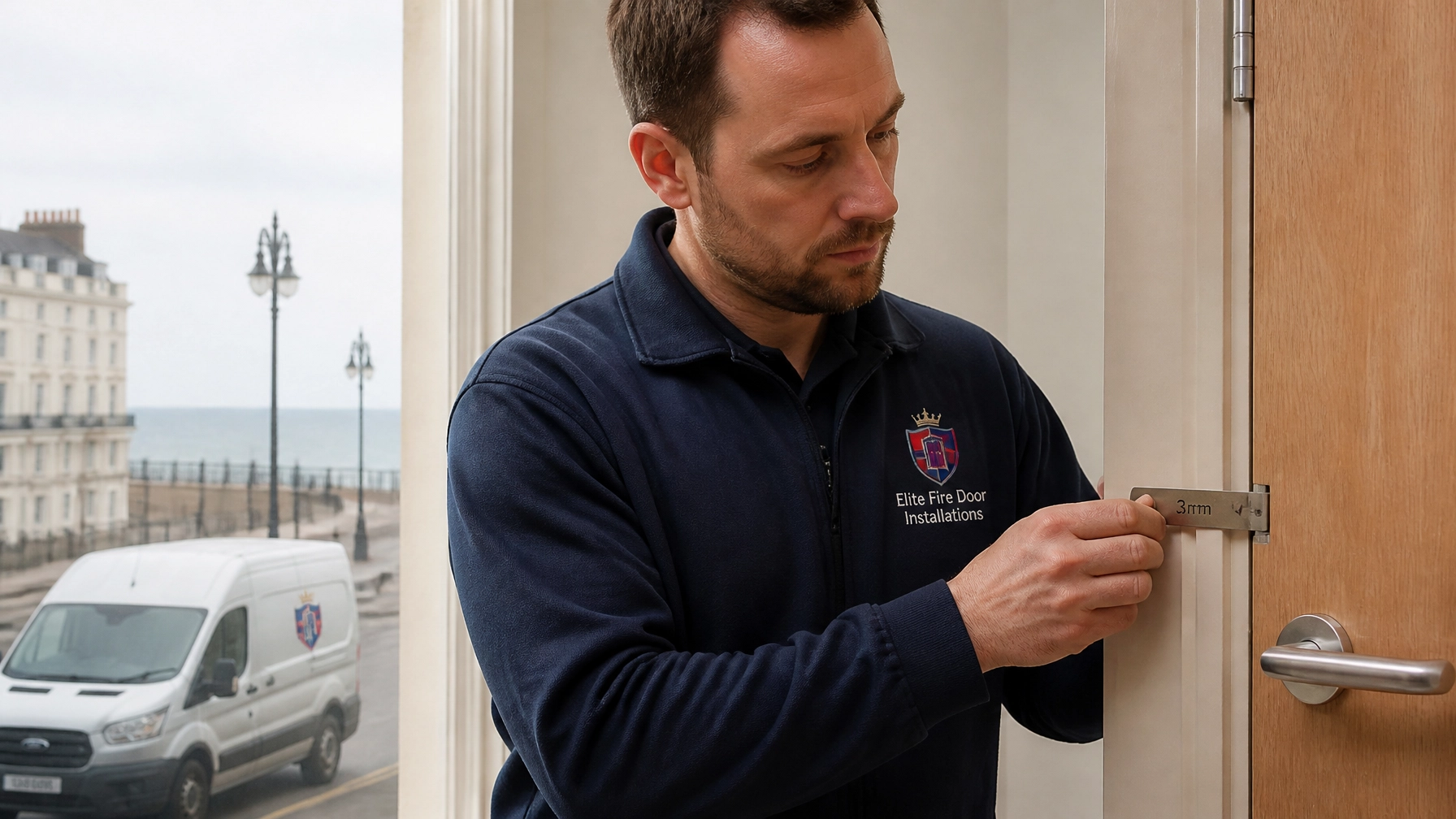
At Elite Fire Door Installations, we act as the bridge between that technical report and a fully compliant building. We take your FRA Remediation requirements and translate them into a physical action plan. We don’t just point out the problems; we deploy certified technicians to solve them. Our team understands exactly what the Brighton & Hove licensing officers are looking for, from the precise 3mm gap at the head and jambs to the specific closing force required to ensure a door latches reliably against resistance.
3. The Elite Solution: Repair vs. Replace
One of the biggest concerns for HMO investors is the cost of a full Fire Door Installation across an entire portfolio. This is where Elite Fire Door Installations provides a unique advantage.
We don’t always default to replacement. If the core of your existing door remains structurally sound, our expert craftsmen can often perform advanced Fire Door Repair. This includes:
- Professional Re-Lipping: Restoring the edges of a door to correct excessive gaps.
- Hardware Upgrades: Replacing substandard domestic hinges with BS EN 1935 rated fire hinges.
- Intumescent Restoration: Using professional routers to install fresh intumescent strips and cold smoke seals.
By physically upgrading and repairing failing doors, we save landlords thousands of pounds while ensuring the finished product meets the exact same safety standards as a brand-new set. However, this is a delicate task that must only be handled by “Certified Installers.” Attempting this without the correct accreditation is a breach of safety protocols and will likely fail your next survey.

4. HMO Investor Preparation: Renovating for Success
For investors buying properties in Brighton & Hove with the intention of converting them into HMOs, fire door preparation must be at the top of your renovation budget. It is far more cost-effective to integrate compliance at the start than to retro-fit after a failed council inspection.
When planning your renovation, you must factor in:
- Protected Escape Routes: Every door leading onto the escape route (bedrooms and kitchens) must be a certified FD30 or FD30S door.
- Thumb-Turn Locks: Security is vital, but so is escape. All letting room doors must allow for key-free exit from the inside.
- Frame Integrity: Domestic door frames are rarely sufficient for fire doors. Ensure your renovation team understands the need for fire-rated frames and intumescent mastic sealing.
5. Our Certification & Process
How does Elite Fire Door Installations guarantee compliance? We follow a strict, professional four-step process that leaves nothing to chance.
- Comprehensive Survey: We begin with a detailed Fire Door Survey, documenting every defect using digital inclinometers and laser levels for absolute precision.
- Fixed-Price Quoting: No hidden fees. We provide a transparent breakdown of what needs to be repaired and what needs to be replaced.
- Certified Execution: Our technicians use specialised UK-standard compliance tools. This includes Fire Door Gap Gauges to ensure gaps are within the 2mm-4mm tolerance, Hinge Jigs for perfect placement, and Digital Force Gauges to confirm the door closer meets BS 8300 standards. Every installation is sealed with certified Intumescent Mastic.
- Compliance Handover: Once the work is complete, we provide a full documentation pack. This is your proof of “due diligence” and is the key to passing your HMO licensing inspection.

6. Fire Door Compliance FAQ
Q: Can I just add a self-closer to my existing bedroom doors to pass the HMO licence?
A: No. A fire door is a complete assembly. Adding a self-closer to a standard domestic door will not provide the 30 minutes of fire resistance required by law. You need a certified FD30 door, frame, and hardware set installed by a professional.
Q: My FRA says my gaps are 6mm. Is this a major fail?
A: Yes. The standard requirement is a gap of 2mm to 4mm (ideally 3mm). Anything over 4mm allows fire and smoke to bypass the door before the intumescent strips can expand. This is a critical failure that needs immediate remediation.
Q: Do I need fire doors on bathrooms in my HMO?
A: Generally, no: unless the bathroom contains a high-risk ignition source like a boiler. However, every bedroom and kitchen door leading to the hallway must be a fire door.
Q: Why can’t my general builder fit the fire doors?
A: Fire door installation is a specialist skill. General builders often lack the calibrated tools and specific knowledge of BS 8214 standards. If the door is hung slightly out of square, or the wrong mastic is used, the door will fail a survey, and you will have to pay twice to have it fixed.
Q: How often do I need to check my fire doors?
A: For buildings over 11 metres, communal doors must be checked every 3 months. For smaller HMOs, regular monthly checks are the industry “best practice” to ensure self-closers haven’t been tampered with or wedged open.
7. Take Action: Ensure Your Compliance Today
Don’t wait for a council inspector to highlight your property’s weaknesses. Protect your tenants, your investment, and your legal standing by choosing the experts in Brighton & Hove.
At Elite Fire Door Installations, we provide the technical precision and certified expertise required to make your HMO fully compliant. Whether you need a full suite of new doors or surgical repairs to your existing ones, we are ready to help.
Request your free, professional quote today via our secure portal:
Request a Free Quote at app.elitefiredoorinstallations.co.uk
For more information on our services, visit our main website: https://elitefiredoorinstallations.co.uk
Elite Fire Door Installations
Email: info@elitefiredoorinstallations.co.uk
Specialist Support: +44 7514 898517
Request a call back: +44 20 4511 9456
Website: https://elitefiredoorinstallations.co.uk
8. Conclusion
Achieving HMO fire door compliance in Brighton & Hove is a journey that requires professional guidance. By following these five steps: understanding the law, decoding your FRA, choosing repair over replacement where possible, preparing during renovations, and insisting on certified execution: you can secure your property for the long term. Trust Elite Fire Door Installations to deliver the precision and peace of mind you deserve.
Leave a Reply