
Key Takeaways
- Compliance is Non-Negotiable: Faulty fire doors in Crawley HMOs can lead to severe legal penalties and voided insurance.
- Gap Precision: Gaps exceeding 4mm are the most common cause of inspection failure.
- Certified Hardware Only: Using non-fire-rated hinges or closers renders the entire installation non-compliant.
- Professional Surveys: A failed Fire Risk Assessment (FRA) requires expert translation into physical remediation.
- Repair Over Replace: Many failing doors can be restored through specialist re-lipping and hardware upgrades.
Table of Contents
- The Legal Stakes of Non-Compliance
- Decoding Your FRA Report
- The Elite Solution: Repair vs. Replace
- HMO Investor Preparation
- Our Certification & Process
- 7 Common Installation Mistakes
- Frequently Asked Questions
- Final Call to Action
- Conclusion
1. The Legal Stakes of Non-Compliance
For property owners in Crawley, fire safety is no longer a “tick-box” exercise; it is a rigorous legal mandate. Under the Fire Safety Act 2021 and the Regulatory Reform (Fire Safety) Order 2005, the ‘Responsible Person’ holds the weight of legal liability for every fire door within a multi-occupied building.
Non-compliance is not a minor oversight: it is a criminal offence. Local authorities and fire services have ramped up enforcement, with the power to issue substantial fines, prohibition notices, and even pursue custodial sentences in cases of extreme negligence. If a fire door fails to perform during an incident because it was improperly fitted or maintained, insurance providers are highly likely to void your policy, leaving you personally liable for damages and life-altering legal costs.
Elite Fire Door Installations understands the gravity of these regulations. Ensuring your Fire Door Installations meet BS 476-22 standards is the only way to protect your tenants and your assets.
2. Decoding Your FRA Report
Receiving a Fire Risk Assessment (FRA) can be an overwhelming experience for a landlord. These documents are often filled with technical jargon and a long list of failures that seem impossible to navigate. At Elite Fire Door Installations, we specialise in translating these complex reports into a clear, physical action plan.
An FRA might note “inadequate compartmentation” or “non-compliant leaf-to-frame gaps.” We take these high-level findings and perform detailed Surveys to identify exactly which hinges need replacing, which frames require intumescent stripping, and where a door leaf has dropped. We don’t just tell you what’s wrong; we provide the certified expertise to rectify every point on that report, ensuring your property is ready for its next inspection.
3. The Elite Solution: Repair vs. Replace
One of the biggest misconceptions in fire safety is that a failed door must always be replaced. This can be a costly mistake for Crawley property investors. Our philosophy at Elite Fire Door Installations is built on expert precision: Repair where possible, Replace when necessary.
Many fire doors fail due to wear and tear or poor initial fitting. Our Fire Door Repairs involve sophisticated techniques such as re-lipping door edges, installing fire-rated packers, and upgrading hardware to modern BS EN standards. By physically restoring the integrity of the door, we can often save landlords thousands of pounds while still providing full compliance documentation. However, this is a highly technical process that must only be performed by certified installers to ensure the fire rating remains intact.

4. HMO Investor Preparation
Investors moving into the Crawley market to convert properties into Houses in Multiple Occupation (HMO) face unique challenges. Fire safety is often the largest variable in a renovation budget. To pass initial licensing inspections, HMO fire door upgrades must be factored into the project from the earliest stages.
HMO regulations are significantly more stringent than standard residential requirements. You must consider:
- Self-Closing Mechanisms: Every bedroom door in an HMO must reliably self-close and latch.
- Smoke Sealing: FD30S doors are typically required to prevent the spread of lethal cold smoke.
- Hardware Compatibility: All ironmongery must be fire-rated and compatible with the specific door leaf.
Ignoring these requirements during the “strip-out” phase often leads to expensive remedial work later. Engaging with certified professionals early ensures your renovation meets all building regulations first time.
5. Our Certification & Process
At Elite Fire Door Installations, we follow a strict, professional workflow to guarantee compliance. We do not guess; we measure with precision.
- Survey: We conduct a comprehensive assessment of every door set, checking for structural integrity and hardware compliance.
- Fixed-Price Quoting: We provide transparent, itemised quotes so there are no surprises in your budget.
- Certified Execution: Our installers are trained to FireQual standards, utilizing specialist UK-standard tools including:
- Fire Door Gap Gauges: To ensure the critical 2mm-4mm tolerances.
- Intumescent Seal Routers: For precision fitting of heat-expanding seals.
- Hinge Jigs: To ensure BS EN 1935 hinges are perfectly aligned.
- Digital Inclinometers & Force Gauges: To verify BS 8300 compliance for door closing forces.
- Handover: We provide a full compliance pack, documenting that the work meets BS 8214 standards.

6. 7 Common Installation Mistakes
1. Excessive Gaps (The 4mm Rule)
The most common failure we see in Crawley is gaps between the door and frame exceeding 4mm. A fire door is designed to work as a system; if the gap is too wide, the intumescent seal cannot bridge the distance in time to stop fire and smoke.
2. Non-Fire-Rated Hardware
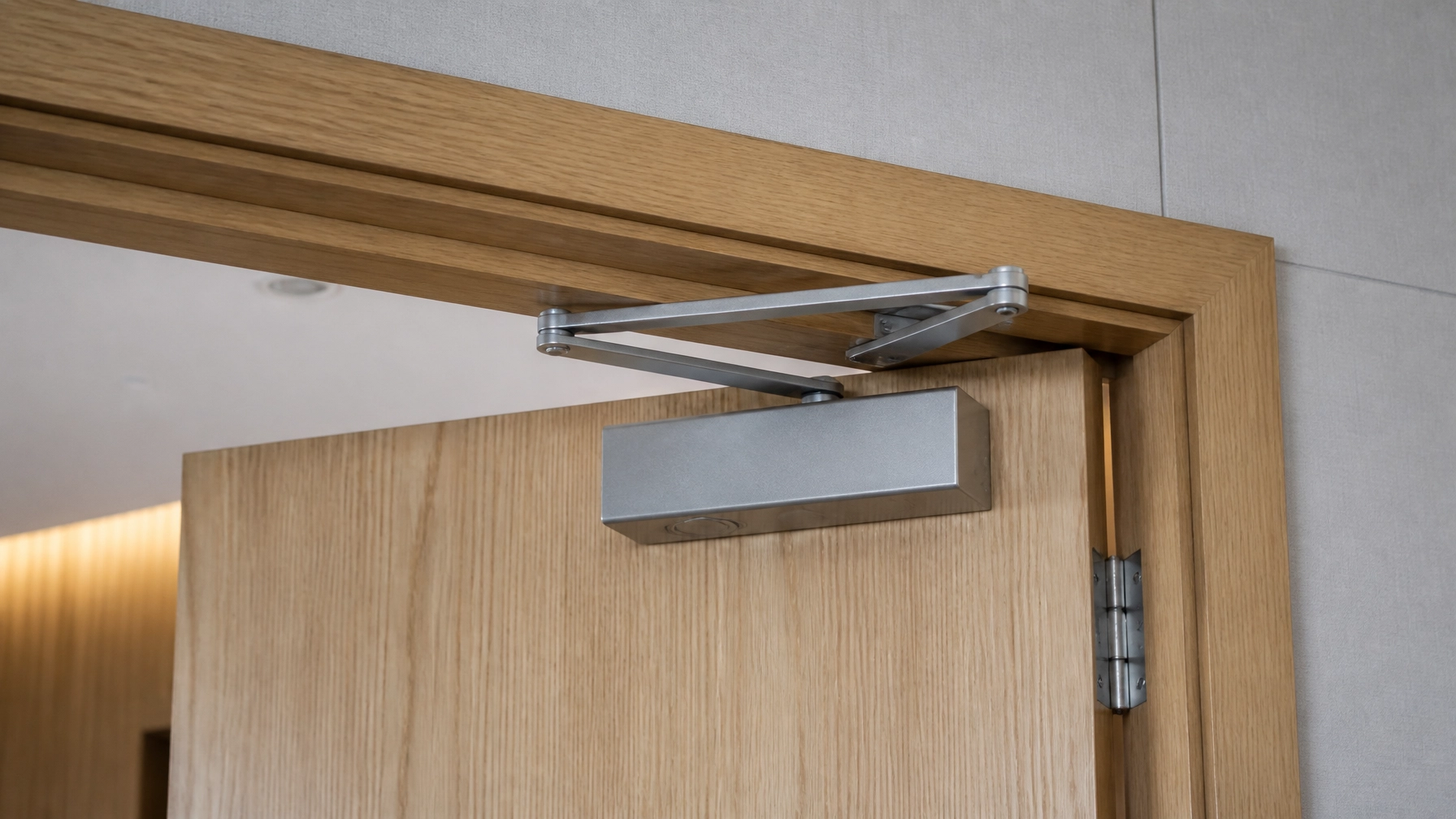
Using standard domestic hinges or “off-the-shelf” closers is a recipe for disaster. All hardware must carry the appropriate fire rating and be fitted with intumescent gaskets where required.
3. Incorrect Intumescent Strip Installation
Many installers fail to route the seals correctly or use the wrong size. If the strip is painted over or missing from the hinge side, the door will fail an inspection instantly.
4. Poor Frame Packing
The gap between the door frame and the wall must be packed with certified fire-rated mastic or mineral wool. Using standard “pink” expanding foam is not a compliant solution.
5. Over-Trimming the Door
Fire doors have a maximum “trim allowance.” Trimming more than a few millimetres off the bottom or sides can remove the internal hardwood stiles and void the door’s fire certification entirely.
6. Misaligned Self-Closers
If a door closer is not tensioned correctly, the door may not latch properly against the seals. In an HMO, a door that doesn’t latch is effectively useless in a fire.
7. Painting Over Seals and Hardware
Applying thick layers of paint over smoke seals or hinge leaves can impede their function. Seals must remain flexible and free of debris to perform.

7. Frequently Asked Questions
Can I install a fire door myself to save money?
No. Fire door installation is a specialized life-safety task. Without professional certification and the correct tools (like gap gauges and force gauges), you cannot prove the door will perform in a fire. This leaves you legally vulnerable and puts lives at risk.
What is the difference between FD30 and FD30S?
FD30 provides 30 minutes of fire resistance. FD30S includes an additional smoke seal to prevent the passage of cold smoke, which is the leading cause of death in domestic fires. Most HMO licenses in Crawley require FD30S doors.
How often should my fire doors be checked?
Current legislation recommends that communal fire doors in multi-occupied residential buildings should be checked at least every three months. For individual flat entrance doors, an annual check is standard.
Why do you use intumescent mastic instead of standard foam?
Standard expanding foam is highly flammable. Certified fire-rated mastic or specific fire-rated foams are tested to withstand high temperatures and maintain the integrity of the partition between the frame and the wall.
Can a “regular” carpenter fix my fire door?
Unless that carpenter is a certified fire door installer with specific training in BS 8214, they likely lack the tools and knowledge to ensure the door remains compliant. A fire door is a piece of engineered safety equipment, not just a piece of joinery.
8. Final Call to Action
Don’t wait for a failed inspection or, worse, a fire incident to find out your doors are non-compliant. Elite Fire Door Installations provides the certified expertise you need to ensure every property in your portfolio is safe and legal.
For more information on our full range of safety services, visit our website: https://elitefiredoorinstallations.co.uk/
Contact our expert team today:
- Email: info@elitefiredoorinstallations.co.uk
- Specialist Support: +44 7514 898517
- Request a call back: +44 20 4511 9456
- Website: https://elitefiredoorinstallations.co.uk
9. Conclusion
Navigating the complexities of Fire Door Installations in Crawley requires more than just a toolkit; it requires a deep understanding of British Standards and local HMO licensing requirements. By avoiding the common mistakes of DIY fitting and non-certified repairs, property owners can ensure long-term compliance and, most importantly, the safety of their residents. Whether you are translating a failed FRA report or preparing a new HMO for the rental market, Elite Fire Door Installations is your partner in professional fire safety.
Note: Summarised by artificial intelligence technology. This is not professional or legal advice.
Leave a Reply