

Key Takeaways
- Identify Vague Findings: Lazy reports often use “copy-paste” phrases like “satisfactory condition” without providing specific door measurements or locations.
- Understand Legal Risks: A generic fire risk assessment report can leave landlords liable under the Fire Safety Act 2021, risking heavy fines or voided insurance.
- Demand Precision: Professional Fire Door Surveys must include specific data on gaps, seals, and hardware to be legally valid.
- HMO Compliance: Investors must ensure their reports account for high-usage shared housing requirements and local authority standards.
- Remediation is Key: Elite Fire Door Installations specializes in translating failed assessments into certified FRA Remediation action plans.
Table of Contents
- The Legal Stakes of Non-Compliance
- Decoding Your FRA Report: Action Plan vs. Vague Findings
- The ‘Unacceptable Door’ Trap: Spotting Vague Wording
- Missing Data: The 3mm Gap Rule and Seal Condition
- The Elite Solution: Repair vs. Replace
- HMO Investor Preparation: Budgets and Renovation Checklist
- Our Certification & Process: From Survey to Compliance
- Frequently Asked Questions
- Conclusion
The Legal Stakes of Non-Compliance
For property owners and HMO managers, a fire risk assessment is not just a box-ticking exercise; it is a critical legal document. Under the Fire Safety Act 2021 and the Regulatory Reform (Fire Safety) Order 2005, the “Responsible Person” (landlord or manager) has a non-delegable duty to ensure the safety of occupants.
In Sussex, local authorities are increasingly strict regarding fire door compliance for landlords Sussex. A “lazy” report that fails to identify specific defects can lead to enforcement notices, massive financial penalties, and even criminal prosecution. Furthermore, if a fire occurs and your fire risk assessment report is found to be generic or incomplete, your building insurance may be rendered void. Professional fire door installation Sussex and maintenance are the only ways to mitigate these severe legal and financial risks.
Decoding Your FRA Report
A high-quality Fire Risk Assessment (FRA) should read like a roadmap to safety, not a generic brochure. When reviewing your report, you should see a clear translation from “risk identified” to “physical action plan.”
Lazy reports often lack a detailed fire door inspection checklist, failing to specify which doors need attention. A professional report will list each door by its location (e.g., “Third Floor, Flat 4 Entrance”) and provide a unique ID. If your report simply says “Check all fire doors,” it is fundamentally flawed. We specialise in taking these vague documents and conducting comprehensive Fire Door Surveys to determine exactly what physical work is required to meet BS 476-22 and BS 8214 standards.
The ‘Unacceptable Door’ Trap

One of the biggest red flags in a lazy FRA is the use of the “Unacceptable” label without justification. An inspector might mark a door as “non-compliant” but fail to explain why. Was it the leaf, the frame, or the hardware?
Vague wording such as “door requires maintenance” or “ensure door is fit for purpose” is a trap for landlords. Without knowing the specific failure point, you cannot effectively budget for Fire Door Repair or replacement. Professional remediation requires knowing whether the issue is a failed self-closer, missing intumescent strips, or structural warping. Elite Fire Door Installations decodes these mysteries, providing clear, fixed-price quotes for the necessary physical works.
Missing Data: The 3mm Gap Rule and Seal Condition
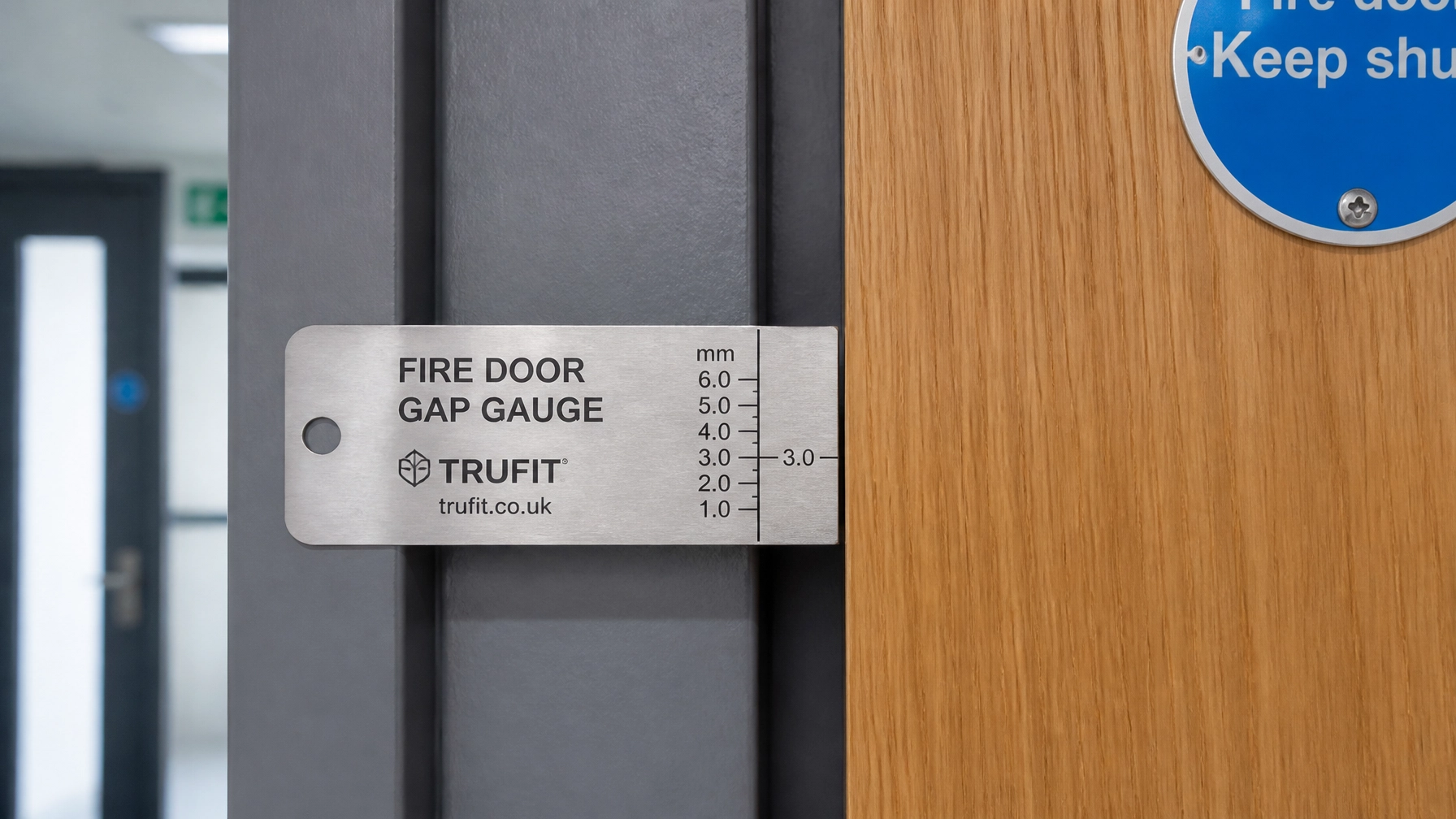
A definitive sign of a lazy report is the total absence of physical measurements. For a fire door to function correctly, the gap between the door leaf and the frame should ideally be 3mm (within a 2mm to 4mm range).
If your report does not mention gap measurements or the condition of the intumescent seals, it hasn’t been done correctly. Intumescent seals are designed to expand in heat, sealing the room and preventing the spread of smoke and flame. A proper inspection must verify that these seals are present, continuous, and not damaged or over-painted. Our team uses precision Fire Door Gap Gauges to ensure every door we service meets these stringent tolerances.
The Elite Solution: Repair vs. Replace

Many inspectors, perhaps due to a lack of technical knowledge, will simply recommend a full Fire Door Installation whenever a defect is found. This is a costly and often unnecessary approach for landlords.
At Elite Fire Door Installations, our unique selling point is our ability to physically repair, re-lip, and upgrade existing doors to restore their certified status. By evaluating the structural integrity of the door leaf and frame, we can often perform Fire Door Repair that saves landlords significant capital while ensuring total compliance. This work is strictly carried out by certified professionals who understand how to maintain the fire-rating of the assembly.
HMO Investor Preparation
For those purchasing properties for HMO conversion, fire safety is the most significant hurdle in the licensing process. HMO fire door upgrades Sussex must be factored into the initial renovation budget to avoid costly delays.
Investors should look for an assessment that specifically addresses the high-usage nature of shared housing. Doors in HMO corridors are subject to much higher wear and tear than domestic doors. Therefore, your report should focus on robust hardware, such as BS EN 1935 hinges and BS EN 1154 door closers. Before renting out your property, ensure you have a certified action plan for HMO fire safety compliance.
Our Certification & Process

Elite Fire Door Installations follows a rigorous, professional process to move your property from “at risk” to “fully compliant”:
- Detailed Survey: We conduct on-site Surveys using professional UK-standard tools to identify every non-compliance point.
- Fixed-Price Quoting: You receive a transparent breakdown of costs for either repair or replacement.
- Certified Execution: Our installers work to FireQual standards, utilizing specialist equipment such as Intumescent Seal Routers, Hinge Jigs, and Digital Inclinometers to ensure perfect alignment and force.
- Compliance Documentation: Upon completion, we provide a full handover of documentation, including certificates of compliance for your records and local authority inspections.
FAQ
Q1: Can I just fix the fire door gaps myself using standard wood filler?
No. Fire door compliance is strictly a job for certified professionals. Standard materials like wood filler are not fire-rated and will fail in a fire, potentially leading to a breach of compartmentation. We use certified Intumescent Mastic and Fire-Rated Packers to ensure the integrity of the door set.
Q2: My FRA report says “all doors satisfactory,” but I can see gaps at the top. Should I be worried?
Yes. A blanket “satisfactory” statement without measurements is a hallmark of a lazy report. If gaps exceed 4mm, the door will not hold back smoke or fire as intended. You should book a professional Fire Door Survey immediately to verify the safety of your property.
Q3: Is it always cheaper to repair a fire door than to install a new one?
Often, yes. We specialise in Fire Door Repair, such as re-hanging doors on new hinges or installing new seals. However, if the core of the door is damaged or the frame is severely warped, a new Fire Door Installation may be required to guarantee safety.
Q4: Do HMO fire doors need different hardware than standard flat doors?
HMO doors often require specific upgrades to meet local authority licensing standards, such as thumb-turn locks for easy egress and heavy-duty self-closers. Our HMO fire door upgrades Sussex are designed specifically to meet these stringent requirements.
Q5: How often should fire doors be inspected in a high-rise Sussex block?
Under current UK regulations, fire doors in communal areas of residential buildings over 11 metres must be inspected at least every three months, while flat entrance doors should be checked annually.
Conclusion
A vague or “lazy” fire risk assessment is a liability that no landlord can afford. By demanding precision in your reports: specifically regarding gap measurements, seal condition, and hardware certification: you protect your residents, your property, and your legal standing. Whether you need FRA Remediation for an existing property or are planning HMO fire door upgrades Sussex for a new investment, Elite Fire Door Installations provides the expert precision and certified service you need for total peace of mind.
For professional assistance with your fire door compliance, contact our team today:
- Email: info@elitefiredoorinstallations.co.uk
- Specialist Support: +44 7514 898517
- Request a call back: +44 20 4511 9456
- Website: https://elitefiredoorinstallations.co.uk
Leave a Reply