

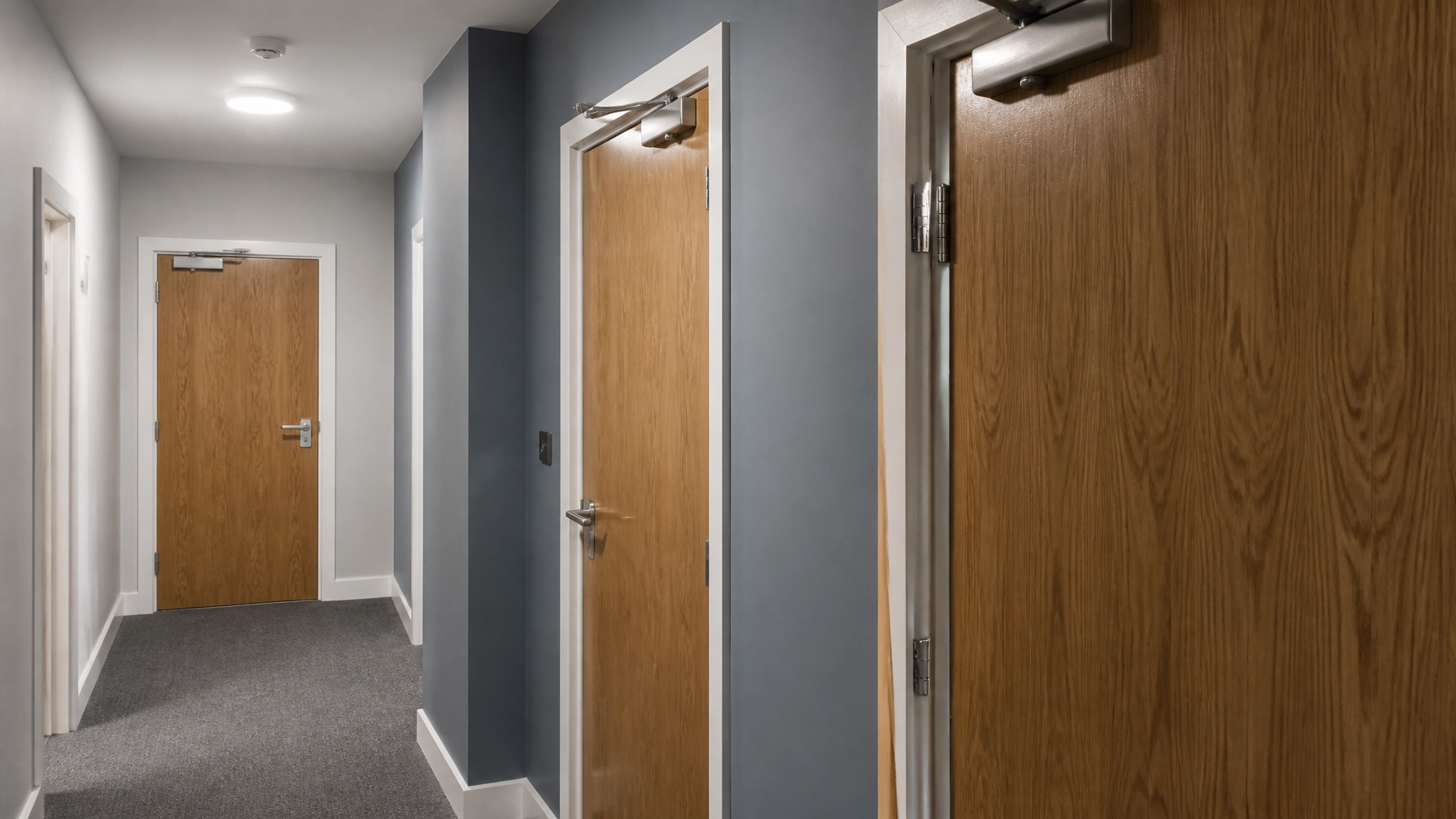
Fire door compliance does not end when an HMO opens its doors to residents. Shared homes remain active environments, and everyday use can gradually affect doors, closers, seals, hinges and frames.
Residents may wedge doors open for convenience. Furniture may strike a door leaf. A closer may become damaged through repeated use, or a tenant alteration may affect the original fire-resisting specification. These issues require a managed professional response.
For landlords, investors and property managers, the objective is straightforward: maintain the fire strategy, respond to defects promptly and retain clear evidence that suitable action has been taken.
Key Takeaways
- Maintain fire doors throughout the tenancy, not only before a property is occupied.
- Prevent wedging, unauthorised alterations and interference with closers or seals.
- Include bedrooms, communal routes, kitchens, stair enclosures and service areas within the property’s fire safety arrangements where identified by the Fire Risk Assessment.
- Use qualified FRA assessors and Certified Installers for professional decisions and remedial works.
- Arrange a professional Survey, receive a clear quotation, complete proportionate works and retain the signed compliance file.
- Ensure fire door work supports BS 476-22 and BS 8214 requirements where applicable to the specification.
Table of Contents
- Understand the Legal Responsibility During a Tenancy
- Decode What Your FRA Requires
- Control Common Fire Door Problems
- Choose the Right Remedial Solution
- Prepare an HMO for Ongoing Occupation
- Follow a Professional Compliance Process
- Answer Frequently Asked Questions
- Arrange Professional Support
- Confirm Your Next Steps
1. Understand the Legal Responsibility During a Tenancy
The responsible person must keep fire safety measures in efficient working order and good repair. For HMO landlords and managers, that responsibility continues while residents are living in the property.
The Regulatory Reform (Fire Safety) Order 2005 provides the core legal framework for fire safety in relevant premises. The Fire Safety Act 2021 also clarified the importance of external walls, flat entrance doors and structure within the responsible person’s duties in multi-occupied residential buildings.
Fire doors form part of the wider fire safety system. If a door no longer closes properly, has damaged seals or has been altered without professional approval, the intended level of compartmentation may be affected.
Landlords and property managers should therefore:
- Keep fire door arrangements aligned with the current Fire Risk Assessment.
- Respond to resident reports and visible defects without unnecessary delay.
- Coordinate access carefully so that professional work can be completed safely.
- Record the issue, the action taken and the resulting compliance position.
- Use qualified professionals rather than relying on informal repairs or unverified alterations.
Where relevant, the Fire Safety (England) Regulations 2022 fire door guidance sets out additional duties for certain multi-occupied residential buildings. A qualified FRA assessor or Certified Installer can help identify which requirements apply to the specific building.
2. Decode What Your FRA Requires
A Fire Risk Assessment should do more than identify that “fire doors are required”. It should help establish where doors are needed, what risks they control and what condition is expected.
Depending on the layout and fire strategy, attention may be required for:
- Bedroom doors opening onto protected communal routes.
- Kitchen and cooking-area doors.
- Doors serving stair enclosures and protected escape routes.
- Communal entrance and corridor doors.
- Plant rooms, electrical cupboards, boiler areas and other service spaces.
- Store rooms or higher-risk utility areas.
- Flat or unit entrance doors where the building arrangement requires them.
The specification will depend on the building, its construction, occupancy, escape arrangements and the findings of the FRA. A professional Survey translates that information into a practical action plan.
The Survey should help determine whether each relevant doorset requires:
- Fire Door Repairs.
- Seal or hardware renewal.
- Frame or door-edge remedial work.
- A compliant upgrade.
- A complete Fire Door Installation.
- Further review by the FRA assessor or fire safety engineer.
This avoids treating every defect in the same way. It also gives the landlord a documented basis for deciding what work is appropriate.
3. Control Common Fire Door Problems
Fire doors in occupied HMOs experience frequent use. Good management means anticipating the problems that arise during a tenancy and dealing with them through a controlled process.
Stop Wedging and Propping
Residents may wedge doors open to improve ventilation, make moving around easier or prevent a closer from operating. This can defeat the door’s intended function by allowing fire and smoke to pass more freely between areas.
House rules and tenancy information should clearly explain that fire doors must not be wedged, hooked or obstructed. Where a repeated problem occurs, the landlord or manager should communicate with residents, document the concern and arrange professional support if the door or closer is contributing to the behaviour.
Respond to Damaged Closers
A closer that is damaged, loose or unable to bring the door securely into its frame requires professional attention. Residents should not disconnect, adjust or remove the device.
A Certified Installer can assess whether the closer, hinges, latch, frame or door leaf is contributing to the problem. The appropriate response may involve a component repair, a hardware upgrade or a wider doorset solution.
Address Worn or Damaged Seals
Intumescent and smoke seals can become loose, painted over, cut, damaged or displaced. They can also deteriorate following decorating work or repeated impact.
Do not remove seals simply because a door is difficult to operate. The correct remedy must be determined by a qualified professional so that the fire-resisting specification is not compromised.
Manage Impact and Tenant Alterations
Door leaves and frames may suffer impact damage from furniture, bicycles, deliveries or general HMO use. Tenants may also install hooks, locks, access devices or other fittings without understanding their effect on the doorset.
Any alteration should be authorised and assessed professionally. Drilling, trimming, replacing hardware or changing glazing can affect the tested performance of a fire door assembly.

4. Choose the Right Remedial Solution
A failed fire door does not automatically require complete replacement. The correct solution depends on the type, extent and location of the defect, as well as the available evidence for the doorset.
Elite Fire Door Installations assesses whether a door can be physically repaired, re-lipped, upgraded or returned to a suitable condition by a Certified Installer. In other cases, replacement or a new Fire Door Installation may be the responsible option.
The decision should consider:
- The door leaf and frame condition.
- The existing rating and specification.
- The suitability of the hinges, latch and closer.
- The condition and compatibility of seals.
- The relationship between the door and the fire strategy.
- Whether the repair can be supported by appropriate evidence.
- Whether the completed work can be recorded in the compliance file.
This proportionate approach helps landlords avoid unnecessary disruption while ensuring that safety remains the priority. All work should be completed by qualified professionals familiar with BS 476-22 and BS 8214 requirements.
5. Prepare an HMO for Ongoing Occupation
Investors converting a property into an HMO should plan for fire door management after the first residents move in. Initial completion is only the beginning of the property’s compliance cycle.
Before occupation, investors and managers should confirm that they have:
- A current Fire Risk Assessment and clear fire strategy.
- A schedule identifying relevant bedroom, communal, kitchen, stair and service-area doors.
- Suitable fire-rated doorsets and compatible hardware.
- A plan for resident communication and reporting defects.
- An access process for professional Surveys and remedial works.
- A register of contractors and completed works.
- A signed Compliance Documentation file.
Flats in buildings under seven storeys and below 18 metres tall may generally be suitable for a specialist solution, provided the arrangement meets the Fire Risk Assessment, specification, insurer and contract requirements. Height alone does not determine the correct fire door provision.
Once the HMO is occupied, planned professional maintenance should be integrated into property management. Routine communication, prompt reporting and organised records make it easier to protect residents and demonstrate responsible management.
6. Follow a Professional Compliance Process
Elite Fire Door Installations uses a clear process designed to minimise disruption and provide landlords with a reliable record of action.
Step One: Review Available Information
We begin by reviewing the FRA, fire strategy, existing schedules, previous reports and any known resident or contractor concerns. This establishes the background before the professional Survey takes place.
Step Two: Complete a Professional Survey
A professional Survey for Quotations considers the physical condition and suitability of the relevant doorsets. Certified Installers use appropriate UK-standard equipment, which may include:
- Fire Door Gap Gauges.
- Intumescent Seal Routers.
- Hinge Jigs.
- Fire-Rated Packers.
- Digital Inclinometers.
- Force Gauges.
- Laser Levels.
- Certified Intumescent Mastic and Sealant.
Tools are only part of the process. Competence, product compatibility and accurate records are equally important.
Step Three: Provide a Clear Quotation
Following the Survey, the landlord receives a clear quotation setting out the recommended repair, upgrade or installation works. The scope should explain the intended outcome and identify any matters requiring further FRA or fire engineering input.
Step Four: Complete and Document the Work
Certified Installers complete suitable works with attention to the door leaf, frame, hardware, seals and surrounding building conditions. On completion, the landlord receives a signed compliance file containing relevant records for future management.

7. Answer Frequently Asked Questions
Can tenants alter or remove a fire door closer?
No. Residents should not remove, disconnect or adjust a closer. Any difficulty with the door should be reported to the landlord or manager, who should arrange review by a Certified Installer.
What should a landlord do if residents repeatedly wedge doors open?
The landlord should communicate the fire safety requirement clearly, record the concern and consider whether the door’s operation is contributing to the behaviour. A professional Survey can identify suitable remedial action. Persistent non-compliance should also be managed under the tenancy agreement and applicable legal processes.
Do all HMO bedroom doors need the same fire rating?
Not necessarily. Requirements depend on the Fire Risk Assessment, fire strategy, building construction, escape arrangements and applicable specification. A qualified FRA assessor and Certified Installer should determine the correct provision.
Can a damaged fire door always be repaired?
No. Some doors can be repaired, re-lipped or upgraded, while others may require replacement. The decision must be based on the doorset’s condition, evidence and intended performance. Unauthorised patching or alteration can create further compliance concerns.
How should fire door maintenance be recorded?
Keep a dated record of the door location, reported issue, professional Survey, recommended action, completed work and supporting documentation. A signed compliance file provides a structured record for landlords, managers, insurers and relevant authorities.
8. Arrange Professional Support
When residents are already living in an HMO, fire door work must be organised carefully. We coordinate access, communicate the scope clearly and aim to complete suitable works with minimal disruption.
Elite Fire Door Installations supports landlords and property managers with:
Arrange a professional review or installation through our company website.
9. Confirm Your Next Steps
Maintaining fire doors during a tenancy is a practical part of responsible HMO management. The most effective approach is calm, organised and evidence-led.
Review the available FRA and fire strategy information. Arrange a professional Survey. Receive a clear quotation. Complete suitable repair, upgrade or installation work through Certified Installers. Finally, retain the signed compliance file and keep the arrangements under review as the property continues to operate.
With the right process, landlords can protect residents, support legal adherence and manage their property with greater confidence.
Note: This information is intended as general guidance and does not constitute professional or legal advice. Always consult a qualified fire safety engineer for your specific property.
Contact Elite Fire Door Installations
- Email: info@elitefiredoorinstallations.co.uk
- Specialist Support: +44 7514 898517
- Request a call back: +44 20 4511 9456
- Website: https://elitefiredoorinstallations.co.uk
Leave a Reply