

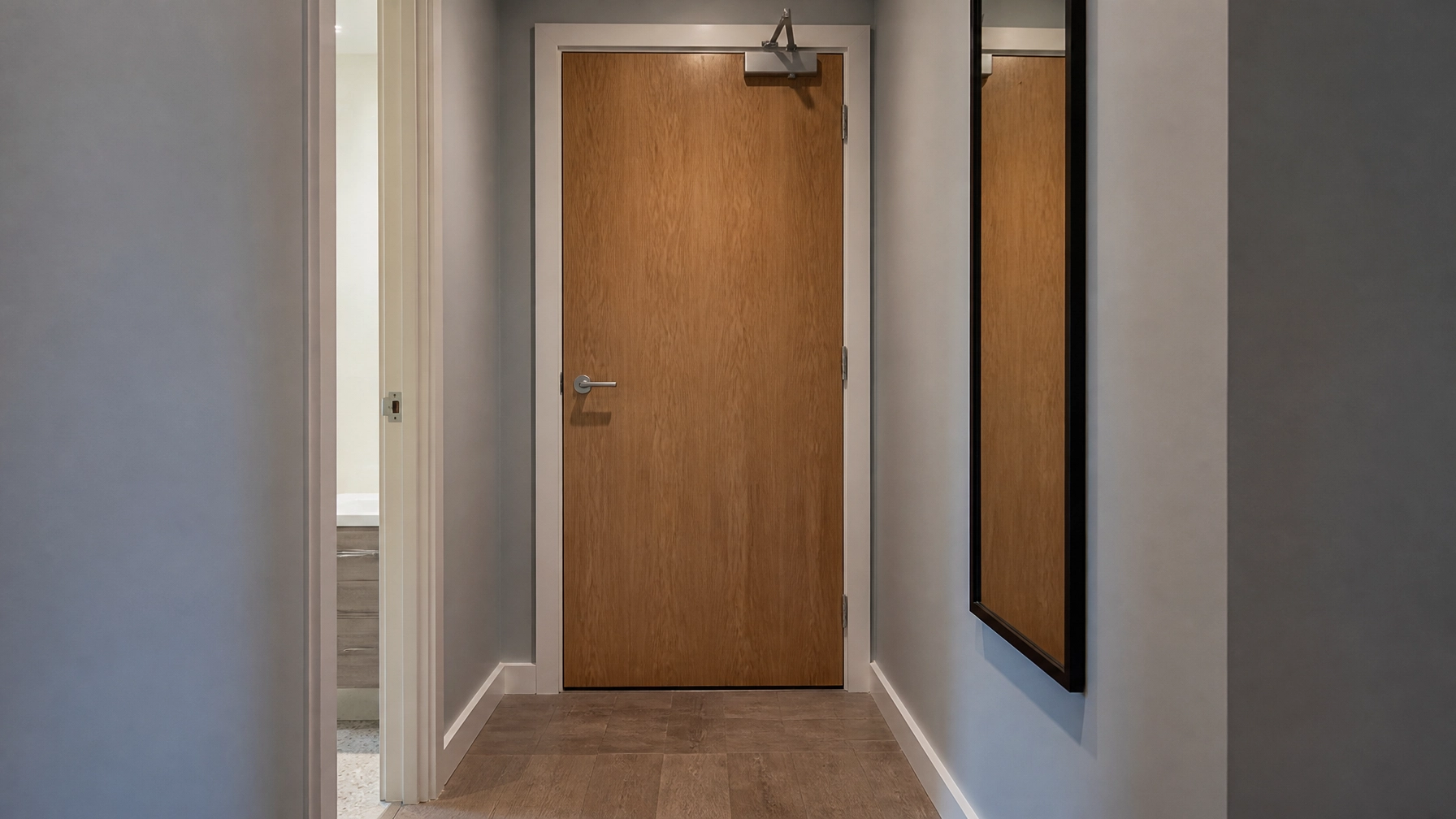
A calm, practical guide to reviewing fire doors, arranging proportionate works and preparing your rental property for a safe new tenancy.
Key Takeaways
- Confirm that your current Fire Risk Assessment (FRA) reflects the property’s layout and use.
- Review fire doors before a new tenancy begins, particularly in HMOs and multi-occupied buildings.
- Look for common concerns such as poor closing, damage, worn seals, unsuitable hinges and excessive gaps.
- Do not assume that every defective door needs complete replacement. A professional review may identify suitable repair or upgrade options.
- Use qualified fire door professionals for surveys, remedial work and compliance documentation.
- Keep a clear record of the review, quotation, completed works and signed compliance file.
Table of Contents
- Understand Why Fire Doors Matter
- Review the Property Before a New Tenancy
- Turn Findings into a Practical Action Plan
- Choose Repair, Upgrade or Replacement
- Prepare an HMO for Its First Tenancy
- Follow a Clear Professional Process
- Answer Common Landlord Questions
- Arrange Your Professional Review
- Conclusion
Understand Why Fire Doors Matter
Fire doors are an important part of a property’s passive fire protection. When correctly specified, installed and maintained, they help slow the spread of fire and smoke. This can protect escape routes and give residents more time to leave the building safely.
Fire doors are especially important in HMOs, converted properties and buildings where several households share corridors, stairways or other common areas. The correct requirements depend on the building’s design, occupancy, fire strategy and FRA.
Protect Escape Routes and Compartments
A fire door only performs as intended when the complete door set works together. This includes the door leaf, frame, hinges, latch, self-closing device, intumescent seals and any glazing or other fitted hardware.
A door that is damaged, held open or unable to close properly may not provide the expected level of protection. This is why landlords should consider the condition and operation of every required fire door, rather than focusing only on whether the door appears visually sound.
Fire doors should also be suitable for their location. A door leading onto a shared escape route may have different requirements from an internal room door. A professional survey helps establish whether the existing arrangement remains appropriate.
Meet Your Landlord Responsibilities
Under the Regulatory Reform (Fire Safety) Order 2005, the responsible person must take suitable precautions to keep people safe from fire. In a rented property, this responsibility may involve the landlord, freeholder, managing agent or another appointed person, depending on the building and management arrangements.
Before a new tenancy begins, landlords should be able to demonstrate that:
- The FRA is current and relevant to the property.
- Required fire doors are present in the correct locations.
- Identified defects have been addressed appropriately.
- Residents will receive suitable fire safety information.
- Records are available to show what has been reviewed and completed.
For multi-occupied residential buildings, additional fire door duties may apply under the Fire Safety (England) Regulations 2022. The exact obligations depend on the building, so professional advice is worthwhile where there is uncertainty.
Review the Property Before a New Tenancy
A change of tenant is a sensible point to review fire doors. It provides an opportunity to address defects before residents move in and before small problems become more disruptive or expensive.
Confirm the FRA and Door Schedule
Start by reviewing the current FRA and any existing fire door schedule. This should help you understand:
- Which doors are required to provide fire resistance.
- Whether doors serve bedrooms, shared corridors, stairways or other compartments.
- The required performance specification for each location.
- Whether previous remedial actions have been completed.
- Whether any alterations to the property have changed the fire strategy.
If the property has been converted, refurbished or prepared for HMO use, check that the current door arrangements match the approved design and the FRA recommendations.
Recognise Common Fire Door Concerns
Landlords commonly encounter the following issues before a new tenancy:
- Poor closing: The door does not close fully, latch securely or return consistently to the frame.
- Physical damage: The leaf, frame, edges, glazing or hardware shows signs of impact, swelling or deterioration.
- Worn seals: Intumescent strips or smoke seals are missing, damaged, painted over or no longer continuous.
- Unsuitable hinges: Hinges may be inappropriate for the door, damaged or unable to support reliable operation.
- Excessive gaps: Uneven or excessive gaps around the door may affect the performance of the complete door set.
- Closer problems: A self-closing device may be missing, damaged, disconnected or unsuitable for the door.
- Inappropriate alterations: Letterboxes, viewers, locks or other fittings may have been installed without confirming their suitability.
- Obstructions: Carpets, flooring, furniture or building movement may prevent the door from closing correctly.
These concerns should not be resolved through guesswork. A qualified professional can assess the complete arrangement and identify the correct next step.

Record Issues Without Attempting DIY Repairs
Landlords can note visible concerns and gather relevant records, but fire door repairs and adjustments should be left to competent professionals. Altering a fire door without understanding its tested construction may affect its performance and create further compliance difficulties.
Avoid cutting, drilling, replacing hardware or adjusting a closer based only on online instructions. Instead, arrange a professional Fire Door Survey for Quotations so the work can be specified correctly.
Turn Findings into a Practical Action Plan
A failed FRA recommendation or pre-tenancy concern should lead to a clear physical action plan. This normally involves:
- Matching each reported defect to a specific door and location.
- Establishing whether the door set can be retained.
- Identifying the required repair, upgrade or replacement.
- Confirming any related frame, hardware or seal requirements.
- Setting a realistic completion date before the tenancy begins.
- Producing a signed compliance file when the work is complete.
This approach helps landlords avoid vague quotations and unnecessary replacement costs. It also creates a clear record for future property management, licensing discussions and maintenance planning.
Choose Repair, Upgrade or Replacement
Not every issue requires a new fire door. Depending on the door’s condition, construction, history and location, a professional may recommend a suitable repair or upgrade.
Possible solutions may include improving the door edge, renewing compatible seals, upgrading hardware, addressing frame defects or carrying out carefully specified remedial work. In other cases, replacement may be the most appropriate option.
Elite Fire Door Installations assesses the physical condition of the door before recommending a solution. Our approach is proportionate: retain suitable doors where possible, complete necessary Fire Door Repairs or upgrades where appropriate, and specify new Fire Door Installations when the existing door set cannot provide the required performance.
All work should be completed by qualified fire door professionals and documented clearly. We work with the principles of BS 476-22 and BS 8214 when specifying and completing relevant fire door work.
Prepare an HMO for Its First Tenancy
Property investors converting a building into an HMO should include fire door preparation in the renovation budget from the outset. This avoids treating fire safety as a last-minute item after decoration and furnishing are complete.
Before letting rooms, allow for:
- A professional review of the proposed fire door locations.
- Appropriate bedroom, corridor, stairway and compartment door arrangements.
- Correct door frames, closers, hinges, latches and intumescent seals.
- Potential remedial work to existing doors and frames.
- Replacement of unsuitable or heavily altered door sets.
- Coordination with the FRA, building design and licensing requirements.
- A signed file containing quotations, completed works and relevant documentation.
A tailored HMO Fire Door Upgrade can help investors prepare the property properly before the initial tenancy and reduce the likelihood of disruptive remedial work later.
Follow a Clear Professional Process
Our process is designed to keep landlord decisions simple, transparent and proportionate.
Step One: Arrange a Professional Survey
We review the relevant fire doors, frames, hardware and surrounding conditions. We consider the FRA, property layout and intended use rather than assessing a door in isolation.
Where appropriate, professional tools may include Fire Door Gap Gauges, Intumescent Seal Routers, Hinge Jigs, Fire-Rated Packers, Digital Inclinometers, Force Gauges and Laser Levels. These tools support precise work without relying on assumptions.
Step Two: Receive Clear Pricing
We provide a clear quotation based on the findings. The quotation identifies which doors require repair, upgrade or replacement and explains any related works that may be necessary.
This gives landlords a reliable budget before authorising work and helps property investors make informed decisions during an HMO conversion.
Step Three: Complete Proportionate Works
Our qualified professionals complete the agreed works with care and minimal disruption. This may involve repair, re-lipping, compatible hardware upgrades, seal renewal or complete installation, depending on the door set.
Materials such as fire-rated packers and suitable intumescent mastic or sealant are selected for the application rather than used as a general-purpose substitute.

Step Four: Receive Compliance Documentation
At handover, landlords receive a clear record of the completed work. A signed compliance file can support ongoing property management and provide useful evidence for future reviews.
Keeping this documentation with the FRA and maintenance records makes it easier to demonstrate a consistent, organised approach to fire safety.
Answer Common Landlord Questions
1. Does every rented property need fire doors?
The requirement depends on the property’s design, occupancy, escape routes and FRA. HMOs and multi-occupied buildings commonly require fire doors in several locations. A professional survey can clarify which doors are necessary for your property.
2. Can an existing fire door be repaired?
Often, a suitable repair or upgrade may be possible. However, this depends on the door’s construction, condition, frame, hardware and location. A qualified professional should assess it before any work is approved.
3. What should I do if a fire door does not close properly?
Do not wedge it open or attempt to adjust the closer yourself. Arrange a professional review so the cause can be identified and the correct remedial work specified.
4. Should I replace doors before converting a property into an HMO?
Not necessarily. Some existing doors may be suitable for retention after professional review, while others may require upgrading or replacement. Include a fire door survey and realistic remedial allowance in the conversion budget.
5. What documents should I keep before a new tenancy?
Keep the current FRA, door schedule, survey findings, quotation, records of completed works and signed compliance documentation. These records help demonstrate that fire door responsibilities have been managed properly.
Arrange Your Professional Review
A pre-tenancy fire door review gives landlords a practical opportunity to resolve concerns before residents move in. Elite Fire Door Installations provides professional surveys, clear quotations, proportionate remedial works and tailored HMO support across East Sussex and the wider South East.
You can also visit Elite Fire Door Installations to arrange a professional survey or discuss an upcoming installation.
Conclusion
Fire doors do not need to be complicated. Landlords need to understand which doors are required, recognise when something appears wrong and arrange qualified professional support before a new tenancy begins.
Poor closing, damage, worn seals, unsuitable hinges and excessive gaps should all be addressed through a structured review. In many cases, proportionate repair or upgrading may be possible instead of complete replacement.
By reviewing the property, receiving clear pricing and keeping a signed compliance file, landlords can manage their obligations with greater confidence and provide residents with a safer home.
Contact Elite Fire Door Installations
- Email: info@elitefiredoorinstallations.co.uk
- Specialist Support: +44 7514 898517
- Request a call back: +44 20 4511 9456
- Website: https://elitefiredoorinstallations.co.uk
Note: This information is intended as general guidance and does not constitute professional or legal advice. Always consult a qualified fire safety engineer for your specific property.
Leave a Reply