

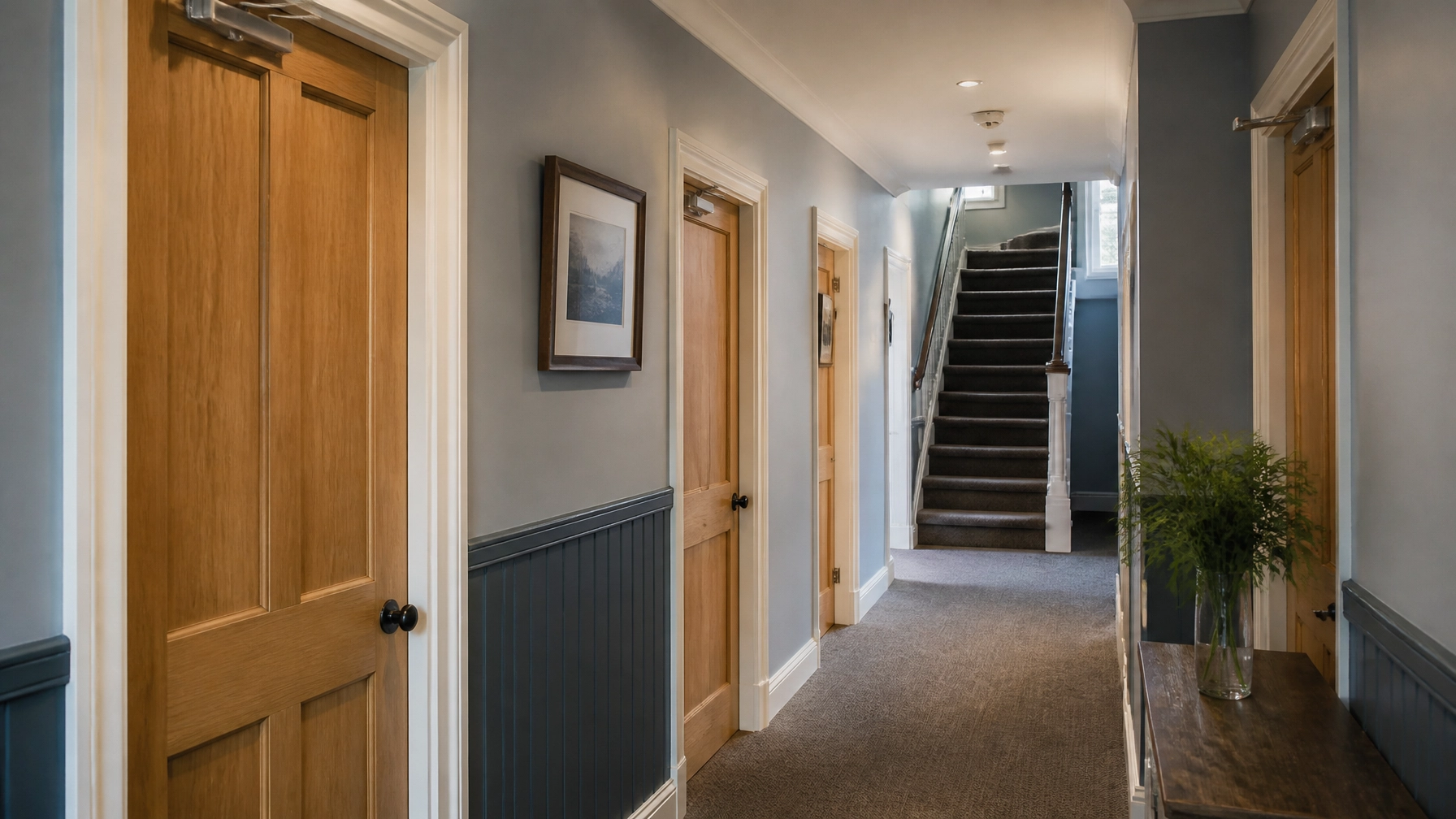
Running or buying a B&B or guest house involves more than providing comfortable accommodation. Owners and operators must also demonstrate that guests can evacuate safely and that the building’s fire precautions remain suitable for its layout, occupancy and use.
Fire doors may be important in guest bedrooms, shared corridors, stairways, kitchens, laundry rooms, storage areas and other protected parts of the building. The exact requirements depend on the building and its Fire Risk Assessment (FRA). A professional review can identify where proportionate repair, upgrading or replacement is required.
Table of Contents
- Key Takeaways
- Section One: Identify the Legal Responsibility
- Section Two: Decode Your Fire Risk Assessment
- Section Three: Distinguish Repair from Replacement
- Section Four: Prepare a B&B for Sale, Refinance or Licensing Review
- Section Five: Plan Fire Door Requirements Before Buying
- Section Six: Follow a Certified Professional Process
- Section Seven: Answer Common Fire Door Questions
- Section Eight: Request Professional Support
- Section Nine: Confirm the Next Step
Key Takeaways
- Establish fire door requirements through a suitable and sufficient FRA.
- Protect bedrooms, escape routes, stairways and higher-risk rooms where the building design requires it.
- Use qualified FRA assessors and Certified Installers for all compliance decisions and physical work.
- Choose proportionate repair, re-lipping, hardware upgrades or replacement following professional assessment.
- Maintain a signed compliance file to support owners, buyers, lenders, insurers and licensing discussions.
- Never rely on appearance alone when deciding whether a fire door is suitable.
Section One: Identify the Legal Responsibility
The Regulatory Reform (Fire Safety) Order 2005 places responsibility on the person who controls non-domestic premises, usually the owner, operator or managing agent. B&Bs and guest houses providing paid sleeping accommodation fall within this framework.
The responsible person must ensure that general fire precautions are suitable for the people using the premises. This includes considering how guests will leave the building if a fire occurs, particularly when they may be unfamiliar with the layout or asleep when an incident starts.
The official government guidance for small paying guest accommodation recognises that smaller premises may have different arrangements from larger hotels. However, this does not remove the need for professional judgement.
Depending on the FRA, fire doors may be needed to:
- Separate guest bedrooms from corridors and stairways.
- Protect escape routes and stair enclosures.
- Reduce the spread of fire from kitchens and food-preparation areas.
- Separate laundry rooms, boiler areas and storage spaces.
- Protect plant rooms, service areas and other higher-risk locations.
- Divide longer corridors or different parts of the building.
Faulty or unsuitable doors can lead to enforcement action, licensing difficulties, insurer questions and increased liability. A calm, documented approach helps owners address issues before they become more serious.
Section Two: Decode Your Fire Risk Assessment
An FRA should not sit in a file without being translated into practical action. For a B&B or guest house, the report should help identify which doors require attention and why.
A qualified FRA assessor may consider:
- The number of storeys and guest bedrooms.
- The position and protection of stairways.
- Travel distances to final exits.
- Whether there is one escape route or more than one.
- The expected occupancy and the needs of guests.
- The relationship between kitchens, laundries, stores and sleeping areas.
- Existing compartmentation and building alterations.
- The condition, construction and suitability of each relevant doorset.
- The standard of the fire detection and warning arrangements.
The result should be a clear schedule of actions rather than a general instruction to “improve fire doors”. Elite Fire Door Installations can use a professional Fire Door Survey for Quotations to review the physical requirements identified by the FRA and prepare a defined scope of work.
The purpose is to connect the written assessment with the physical building. This gives owners a clearer route from identified issue to completed remedial work and signed documentation.
Section Three: Distinguish Repair from Replacement
A failed or damaged fire door does not automatically require complete replacement. A Certified Installer should assess whether the doorset can be professionally repaired, re-lipped or upgraded while retaining suitable fire performance.
Depending on the findings, the appropriate solution may involve:
- Professional repair to the door leaf or frame.
- Re-lipping where the edges have been damaged and the construction permits it.
- Replacement or upgrading of unsuitable hardware.
- Correcting defective closing arrangements.
- Renewing compatible intumescent components.
- Replacing a door where its construction or condition cannot support reliable remediation.
This decision must not be based solely on convenience or visual appearance. Fire doors operate as complete doorsets. The leaf, frame, hinges, latch, closer, seals, glazing and surrounding construction must work together.
Our Fire Door Repairs service focuses on proportionate professional solutions. Where repair is not appropriate, a compliant Fire Door Installation can provide a reliable replacement.
Only qualified professionals should decide whether a fire door can be retained. Unauthorised alterations may affect performance and create further compliance uncertainty.

Section Four: Prepare a B&B for Sale, Refinance or Licensing Review
Owners preparing to sell or refinance may face questions about fire safety arrangements. Buyers, lenders, insurers and licensing bodies may want to understand whether identified works have been completed and whether records support the property’s current use.
A fire door issue does not automatically prevent a sale or refinancing. However, unclear records can make questions harder to answer and may lead to delays while information is gathered.
A professional compliance file can include:
- The relevant FRA and action schedule.
- A door schedule identifying completed works.
- Survey findings and photographs where appropriate.
- Details of repairs, upgrades or replacements.
- Product and hardware information.
- Completion records signed by the responsible professional.
- Recommendations for future maintenance and review.
A signed compliance file demonstrates a controlled process. It gives the next owner or professional adviser a clearer understanding of what was reviewed, what work was completed and what remains subject to the building’s FRA.
For owners preparing a property transaction, completing professional FRA Remediation can provide useful evidence of responsible management without making unsupported claims about the outcome of a transaction.
Section Five: Plan Fire Door Requirements Before Buying
Buyers should consider fire doors before purchasing a property for B&B or guest-house use. This is particularly important where a residential building is being adapted to provide sleeping accommodation for paying guests.
Before committing to a purchase, request and review:
- The current FRA.
- Any fire authority or licensing correspondence.
- Existing fire door schedules and completion records.
- Details of previous building alterations.
- Information about kitchens, laundries, storage rooms and boiler areas.
- The proposed occupancy and room arrangement.
- Any planned changes to escape routes or compartmentation.
Factor professional fire door requirements into the renovation plan from the start. This does not mean assuming every door needs the same specification. It means allowing time for a qualified FRA assessor and Certified Installer to establish the correct approach before the property opens to guests.
Apply the Quick Compliance Cheat Sheet
- Treat guest bedrooms opening onto protected routes as a priority for professional review.
- Review doors serving kitchens, storage areas, laundries and plant spaces.
- Confirm that escape-route doors are suitable for the building’s risk profile.
- Consider the effect of additional storeys, longer travel distances and increased occupancy.
- Flats in buildings under 7 storeys and below 18 metres tall may generally be suitable for a specialist, provided they meet FRA, specification, insurer and contract requirements.
- Record all completed works in a signed compliance file.
This checklist supports early planning but does not replace an FRA or professional survey.
Section Six: Follow a Certified Professional Process
Elite Fire Door Installations applies a structured process designed to keep decisions clear and documentation consistent.
Step One: Complete the Survey
A qualified professional reviews the relevant doors, frames, hardware and surrounding arrangements against the FRA and the building’s use. The survey identifies whether each item requires repair, upgrade or replacement.
Step Two: Issue Clear Fixed-Scope Quotation
The findings are translated into a clear written scope. Each recommended action is linked to the relevant door or area, reducing uncertainty for owners and property managers.
Step Three: Complete Certified Execution
Certified Installers carry out the agreed work using professional UK-standard equipment and suitable components. Depending on the project, this may include Fire Door Gap Gauges, Intumescent Seal Routers, Hinge Jigs, Fire-Rated Packers, Digital Inclinometers, Force Gauges, Laser Levels and certified Intumescent Mastic/Sealant.
Work is completed with attention to BS 476-22 and BS 8214 requirements where applicable to the specification and building circumstances.
Step Four: Handover the Compliance Documentation
The completed project is handed over with a signed compliance file. This provides a useful record for ongoing management, future professional reviews, licensing queries, refinancing and property sale discussions.

Section Seven: Answer Common Fire Door Questions
1. Does every guest-bedroom door need to be a certified FD30 fire door?
Not necessarily. Requirements depend on the building’s size, layout, construction, occupancy and FRA. Smaller premises may have different suitable arrangements, while taller or more complex buildings may require certificated fire-resisting doors with self-closing devices. A qualified FRA assessor and Certified Installer must determine the appropriate specification.
2. Can an existing solid timber door be retained?
Possibly, but the decision requires professional assessment. Construction, condition, frame compatibility, hardware and the surrounding escape strategy all matter. A solid-looking door should not be assumed to provide suitable fire performance. A Certified Installer can advise whether professional repair, re-lipping, upgrading or replacement is appropriate.
3. Which areas should B&B owners prioritise?
Prioritise doors protecting sleeping accommodation, shared corridors, stairways and final escape routes. Also review kitchens, laundries, storage rooms, boiler areas and other locations where a fire could develop or spread more rapidly. The FRA should establish the final priorities.
4. Why is a signed compliance file important when selling or refinancing?
It provides an organised record of the professional process. Buyers, lenders, insurers and licensing advisers can see what was reviewed, what work was completed and which recommendations remain under review. It cannot guarantee a transaction, but it can make responsible fire safety management easier to demonstrate.
5. Can a general contractor carry out fire door alterations?
Fire door work should be assigned to qualified professionals with appropriate competence and experience. Incorrect alterations, unsuitable components or poor fitting can affect the doorset’s performance. Use a qualified FRA assessor for risk decisions and Certified Installers for physical remedial work.

Section Eight: Request Professional Support
If your B&B or guest house requires clearer fire door records, arrange a professional Fire Door Survey for Quotations. Elite Fire Door Installations can help establish a proportionate route from review to repair, upgrade or Fire Door Installation.
For general information about our professional services, visit Elite Fire Door Installations.
Section Nine: Confirm the Next Step
Fire doors form part of a wider fire safety strategy for B&Bs and guest houses. Their suitability depends on the building, the people using it and the findings of a suitable and sufficient FRA.
Owners and buyers can take a straightforward approach: review the assessment, arrange a professional survey, receive a clear scope, complete proportionate work and retain a signed compliance file. This supports legal adherence, responsible property management and greater peace of mind for owners, guests and future stakeholders.
Note: This information is intended as general guidance and does not constitute professional or legal advice. Always consult a qualified fire safety engineer for your specific property.
Contact Elite Fire Door Installations
- Email: info@elitefiredoorinstallations.co.uk
- Specialist Support: +44 7514 898517
- Request a call back: +44 20 4511 9456
- Website: https://elitefiredoorinstallations.co.uk
Leave a Reply