

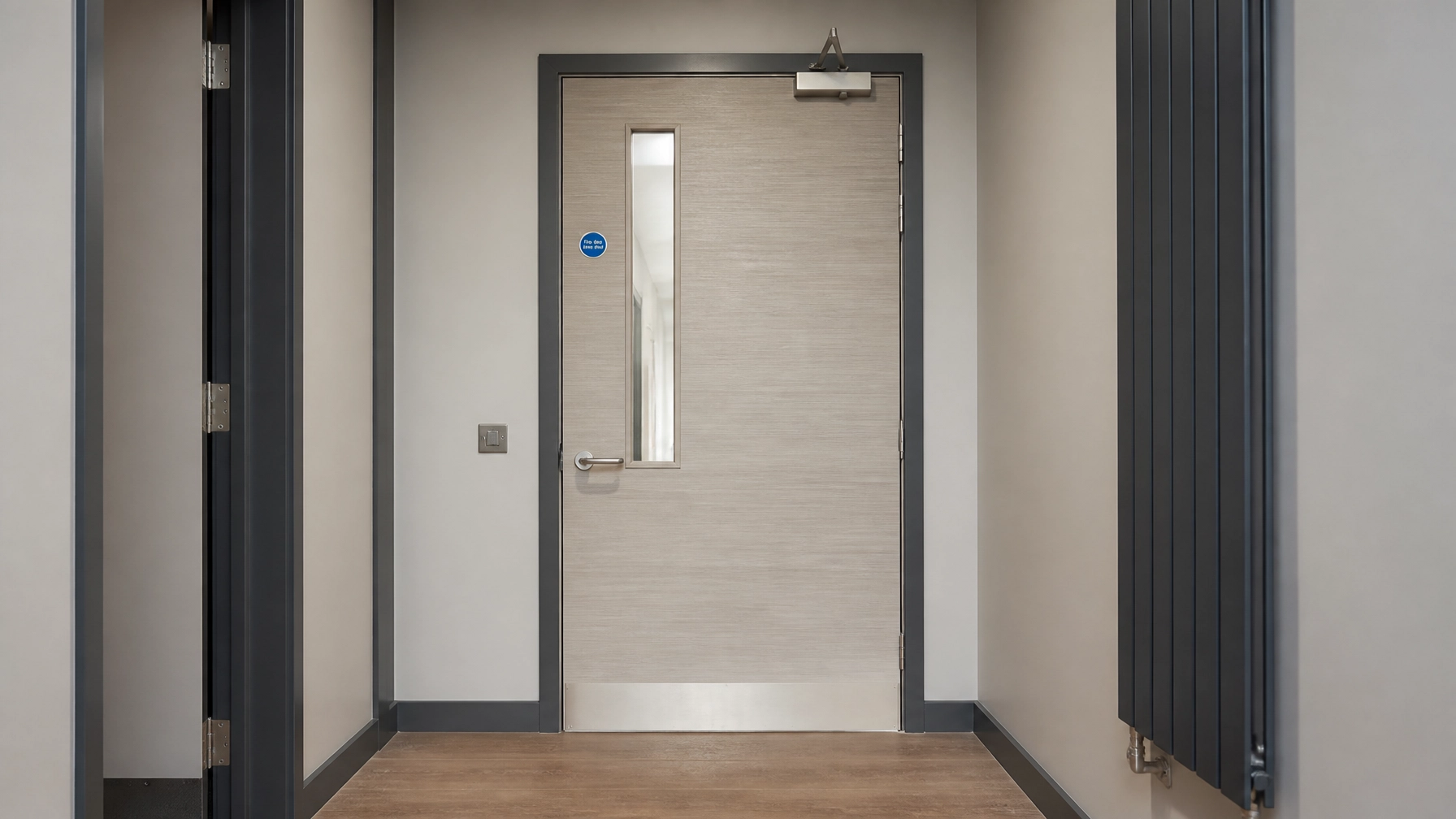
Key Takeaways
- The Compartmentation Crisis: National estimates highlight a multi-billion-pound shortfall in passive fire protection, with failing or improperly repaired fire doors serving as the weakest link in building safety.
- The Danger of Handyman Quick-Fixes: Uncertified repairs: such as shaving doors incorrectly, installing unrated hardware, or applying standard decorators’ caulk: completely invalidate fire certification.
- Strict Legal Liability: Under the Regulatory Reform (Fire Safety) Order 2005 and Fire Safety (England) Regulations 2022, property owners face severe penalties, unlimited fines, and prosecution for compromised compartmentation.
- Certified Expertise Required: Comprehensive FRA Remediation and Fire Door Repair must always be executed by certified professionals operating strictly to British Standards.
- Protecting HMO Investments: Property investors must budget for rigorous HMO Fire Door Upgrades and professional Fire Door Surveys for Quotations prior to tenant occupancy.
Table of Contents
- Introduction: The Hidden Vulnerability in Modern Properties
- The Legal Stakes of Non-Compliance
- Decoding Your FRA Report
- The Elite Solution: Precision Repair Versus Costly Replacement
- HMO Investor Preparation: Building Compliance from Day One
- Our Certification & Rigorous Procedural Process
- Frequently Asked Questions
- Final Call to Action & Compliance Contact Details
- Conclusion
1. Introduction: The Hidden Vulnerability in Modern Properties
Across the United Kingdom, millions of pounds are poured into building maintenance every year, yet a staggering compartmentation gap persists. Passive fire protection relies entirely on an unbroken chain of fire-resisting barriers: walls, floors, ceilings, and crucially, fire doorsets. When a fire door fails its inspection or undergoes an uncertified patch-job, the entire compartmentation strategy collapses.
For property owners and landlords, understanding the true nature of fire safety compliance is not merely a box-ticking exercise; it is a critical safeguard for human life and a legal obligation. At Elite Fire Door Installations, we see firsthand how well-intentioned maintenance errors leave properties fatally exposed. This guide explores the financial and legal realities of the £3 billion compartmentmentation gap and why only qualified specialists should ever touch your fire-resisting doorsets.
2. The Legal Stakes of Non-Compliance
The regulatory landscape for landlords has shifted dramatically. Under the Regulatory Reform (Fire Safety) Order 2005 (FSO) and the Fire Safety (England) Regulations 2022, the “Responsible Person” is held to account with zero tolerance for negligence.
Recent enforcement trends show local authorities and fire and rescue services actively prosecuting landlords whose properties feature compromised fire doors. When an uncertified repair leaves gaps exceeding permitted tolerances, or when self-closing mechanisms fail to engage, the legal consequences are severe. Unlimited fines, prohibition notices, and custodial sentences await those who fail to maintain their passive fire protection systems. Relying on general contractors or unqualified maintenance staff is an unacceptable gamble that exposes your entire property portfolio to catastrophic liability.
3. Decoding Your FRA Report
When a fire risk assessor inspects your building, the resulting report often lists complex technical jargon regarding door leaves, frames, gaps, and intumescent seals. Translating a failed Fire Risk Assessment into an actionable compliance plan requires expert insight.
Assessing a doorset involves evaluating whether it meets BS 476-22 or BS 8214 standards. Common red flags in FRA reports include perimeter gaps exceeding 4mm, missing cold smoke seals, damaged glazing beads, or non-compliant hinges. A failed report is an urgent warning sign that demands immediate intervention by qualified professionals who understand how to restore the integrity of the doorset without compromising its original fire test evidence.

4. The Elite Solution: Precision Repair Versus Costly Replacement
One of the most persistent myths in property management is that a failing fire door must always be ripped out and replaced entirely. Full replacement is frequently disruptive and expensive. However, many failing doorsets can be expertly restored through specialised remediation.
Our specialist approach to Fire Door Repair focuses on precision engineering. Rather than discarding a heritage or heavy-duty doorset, our certified technicians evaluate the asset to perform structural timber repairs, re-lipping, hinge realignment, and thermal upgrade works. This targeted methodology saves landlords significant capital expenditure while ensuring full regulatory compliance. Every adjustment is handled strictly by certified experts who understand the delicate balance between mechanical function and fire resistance.
5. HMO Investor Preparation: Building Compliance from Day One
For property investors acquiring residential properties to convert into Houses in Multiple Occupation (HMO), fire door preparation must be factored into the initial renovation budget from day one. Local housing licensing teams enforce rigorous standards before granting an HMO licence.
Investors cannot afford delays caused by sub-standard fire doors discovered during final licensing audits. Ensuring that every communal entrance, corridor door, and bedroom door meets FD30 or FD30S specifications is paramount. Partnering with specialists in HMO Fire Door Upgrades ensures that your conversion meets local authority expectations seamlessly, protecting your investment yield and allowing tenants to move in without regulatory friction.

6. Our Certification & Rigorous Procedural Process
Achieving absolute compliance leaves no room for guesswork. At Elite Fire Door Installations, our workflow is governed by strict quality controls and accredited standards, including FireQual benchmarks. When our technicians arrive on-site, they deploy industry-leading diagnostic and installation equipment to guarantee absolute precision:
- Step One: Comprehensive Surveys – We begin with detailed Fire Door Surveys for Quotations, measuring exact compliance parameters.
- Step Two: Precision Calibration – Using calibration instruments such as Fire Door Gap Gauges (to verify the critical 3mm perimeter tolerances), Digital Inclinometers, and Force Gauges (ensuring compliance with BS 8300 operational forces), we identify every structural deviation.
- Step Three: Expert Execution – We utilise specialised tools including Intumescent Seal Routers, Hinge Jigs, Laser Levels, Fire-Rated Packers/Shims, and certified Intumescent Mastic/Sealant to fit or repair doorsets alongside compliant ironmongery (BS EN 1935 hinges and BS EN 1154 door closers).
- Step Four: Complete Documentation – Upon completion, we provide full certification documentation and compliance handovers for your property records.
7. Frequently Asked Questions
Can a standard carpenter or handyman repair my fire doors?
No. Fire doors are certified engineered assemblies tested as complete units. Altering a fire door requires certified knowledge of third-party accreditation schemes. Using an uncertified handyman invalidates the door’s fire rating and leaves the landlord legally liable.
What is the acceptable gap size around a fire door?
Industry standards and official guidance dictate that perimeter gaps (head and sides) should be strictly maintained between 2mm and 4mm (ideally 3mm). Bottom gaps depend on smoke-control ratings (typically ≤3mm for smoke doors or up to 8mm for fire-only doors, provided no light is visible).
How often should HMO fire doors be checked?
Under the Fire Safety (England) Regulations 2022, communal fire doors in multi-occupied residential buildings above 11 metres must be checked quarterly, and flat entrance doors inspected annually. Routine professional audits are recommended for all HMOs.
Can fire-rated glass be replaced independently?
Only with exact, certified like-for-like replacement glazing systems that match the original fire door test evidence. Never install standard glass into a fire-resisting doorset.
What happens if my fire doors fail an inspection?
You will be issued an action plan or enforcement notice by local authorities or fire officers. Immediate FRA Remediation is required to rectify defects and prevent potential prosecution.
8. Final Call to Action & Compliance Contact Details
Protect your tenants, safeguard your property investment, and eliminate legal risk by partnering with accredited fire safety specialists. Whether you require comprehensive Fire Door Installations or targeted repairs, our expert team is ready to assist.
Explore our professional range of services at Elite Fire Door Installations.
- Email: info@elitefiredoorinstallations.co.uk
- Specialist Support: +44 7514 898517
- Request a call back: +44 20 4511 9456
- Website: https://elitefiredoorinstallations.co.uk
9. Conclusion
The £3 billion compartmentmentation gap represents a sobering reminder of the risks associated with compromised passive fire protection. Landlords and property investors cannot afford to cut corners when it comes to fire doors. By relying on professional surveys, certified installations, and expert remediation rather than uncertified quick-fixes, you ensure total legal compliance and provide ultimate peace of mind for everyone who steps inside your property.
Leave a Reply