

Key Takeaways
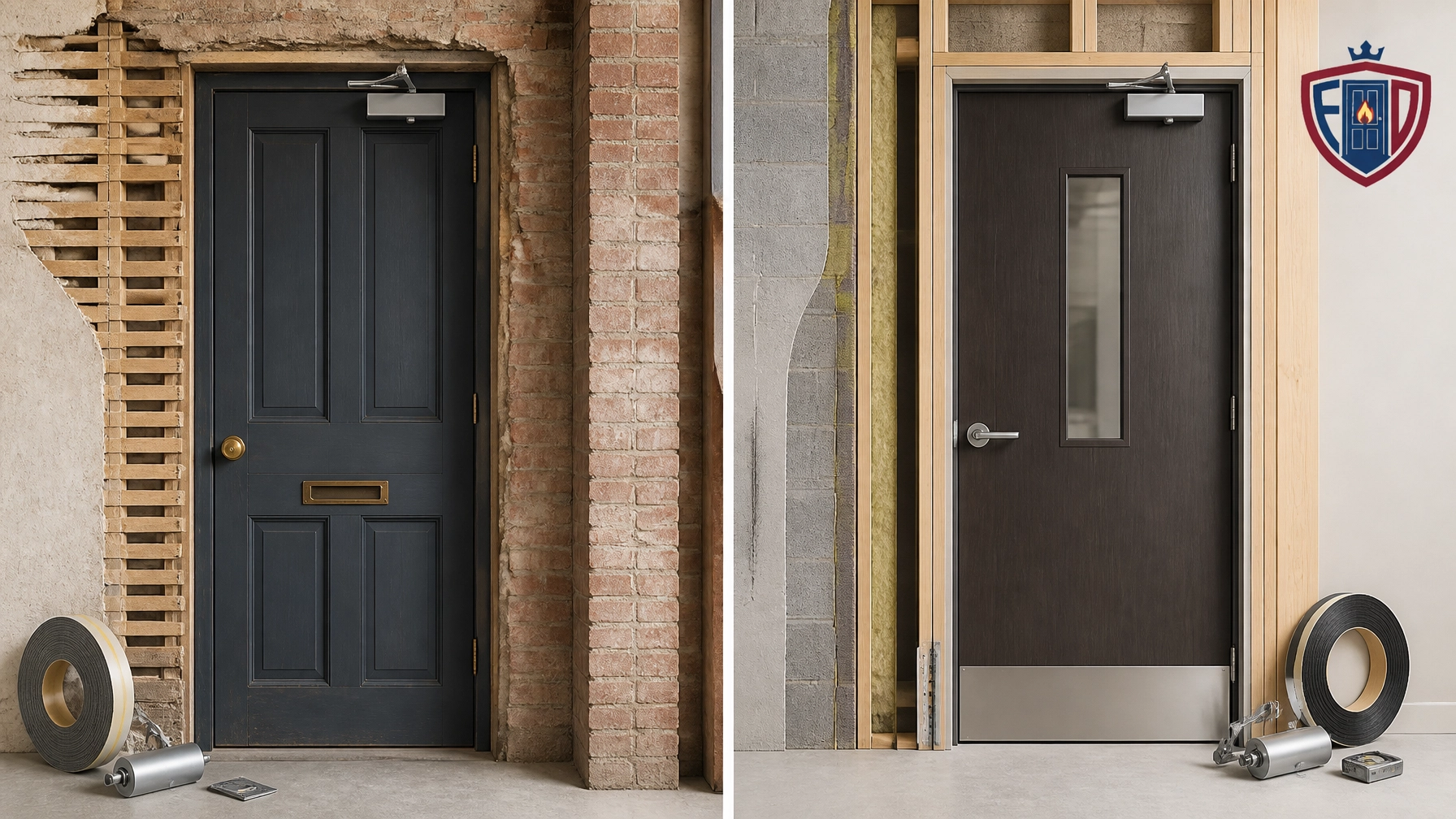
- Structural Diversity: Victorian and Edwardian properties feature irregular openings and soft lime mortar, requiring specialised fixing techniques that modern “off-the-shelf” methods cannot accommodate.
- Modern Precision: New builds offer standardised openings but introduce complexities regarding cavity barriers, air-tightness, and acoustic performance.
- Legal Compliance: Regardless of age, every fire door must meet stringent BS 8214 standards; failure to adapt installation to the building fabric can lead to immediate FRA failure.
- Cost Efficiency: Expert Fire Door Repair can often save historic doors, whereas new builds typically require full, certified doorset replacements.
- Professional Necessity: Compliance is not a DIY task. Only Certified Installers can guarantee the life-saving performance of a fire door in diverse construction environments.
Table of Contents
- The Legal Stakes of Non-Compliance
- Decoding Your FRA Report
- The Elite Solution: Repair vs Replace
- Old Builds: Navigating the Irregularities of the Past
- New Builds: Modern Precision and Hidden Challenges
- HMO Investor Preparation
- Our Certification & Process
- Frequently Asked Questions
- Conclusion
1. The Legal Stakes of Non-Compliance
For property owners and HMO landlords, fire safety is not a suggestion: it is a strict legal mandate. Under the Fire Safety Act 2021 and the Regulatory Reform (Fire Safety) Order 2005, the “Responsible Person” carries the full weight of liability.
If a fire door is fitted incorrectly: perhaps because the installer didn’t account for the crumbling lime mortar in a Victorian terrace or the cavity gaps in a modern block: the consequences are severe. Local authorities and fire services are increasingly conducting unannounced inspections. A single non-compliant door can lead to:
- Prohibition Notices: Effectively shutting down your rental business overnight.
- Unlimited Fines: Courts are no longer lenient with landlords who cut corners.
- Criminal Prosecution: In the event of a fire, “I didn’t know the wall was soft” is not a legal defence.
Ensuring your property meets these standards requires more than a handyman; it requires Fire Door Installation by accredited professionals who understand the physical fabric of your building.
2. Decoding Your FRA Report
A Fire Risk Assessment (FRA) is your roadmap to safety, but for many investors, it reads like a list of expensive failures. “Non-compliant gaps,” “unsuitable fixings,” or “lack of intumescent strips” are common citations.
At Elite Fire Door Installations, we specialise in translating these technical failures into a physical action plan. We don’t just point out what is wrong; we look at why it failed. Often, a door fails because the building has settled over 100 years, or because modern cavity barriers were omitted during the initial build. Our Fire Door Surveys provide a fixed-price remediation strategy that bridges the gap between a “failed” report and a fully compliant building.

3. The Elite Solution: Repair vs Replace
The common industry default is to rip out and replace. At Elite Fire Door Installations, we take a more sophisticated approach.
For historic properties, the original timber frames are often high-quality but have shifted. We evaluate these failing doors to physically repair, re-lip, and upgrade them. This “repair-first” philosophy can save landlords thousands of pounds while maintaining the character of the property. However, this is a highly technical process involving Intumescent Seal Routers and precision engineering.
In contrast, modern properties often utilise integrated doorsets. If these are damaged or incorrectly fitted, a full Fire Door Installation is usually the only way to guarantee the FD30 or FD60 rating is maintained.
4. Old Builds: Navigating the Irregularities of the Past
Properties from the Victorian and Edwardian eras present a unique set of challenges. These buildings were constructed long before modern fire safety regulations existed.
- Non-Standard Openings: You will rarely find a square door frame in an old building. Walls are often bowed, and openings are non-standard sizes.
- Material Volatility: Fixing a heavy fire door into original brick or stone requires specialised anchors. Using standard screws in soft lime mortar is a recipe for catastrophic failure.
- The “Notional” Door: Many old buildings have thick timber doors that look like fire doors but lack intumescent seals. We provide HMO fire door upgrades that bring these classic features up to modern standards without losing their aesthetic value.
5. New Builds: Modern Precision and Hidden Challenges
New builds might seem straightforward, but they present hidden risks that an untrained eye will miss.
- Cavity Barriers: In modern cavity wall construction, the fire door frame must be integrated with cavity barriers to prevent fire from “looping” around the door through the wall itself.
- Air-Tightness & Sound: Modern building regs require high levels of acoustic and thermal performance. A fire door must be fitted with precision to ensure these secondary seals are not compromised.
- Substrate Consistency: Modern blockwork or steel frames require specific fire-rated packers and sealants to ensure the integrity of the fire partition.

6. HMO Investor Preparation
If you are an investor buying a property for HMO conversion, fire door compliance should be at the top of your renovation budget.
- Pre-Purchase Surveys: Before you sign, understand the cost of FRA Remediation. Converting a Victorian house requires a different budget for fire safety than a 1990s block.
- Renovation Sequencing: Fire doors should be one of the final elements installed to prevent damage by other trades, yet the frames must be perfectly squared during the structural phase.
- HMO Licensing: Local authorities in Sussex have specific requirements for self-closing devices and thumb-turn locks. Factor these “hidden” hardware costs into your initial projections.
7. Our Certification & Process
We follow a strict, professional four-step process to ensure your property is legally watertight:
- Survey: A comprehensive assessment of your current door sets and building fabric.
- Fixed-Price Quoting: No hidden “old building” surcharges. You get a transparent cost for compliance.
- Certified Execution: Our technicians, trained to FireQual standards, use specialised UK-standard tools including Fire Door Gap Gauges, Hinge Jigs, Digital Inclinometers, and Laser Levels.
- Compliance Handover: You receive full documentation for your O&M manual, providing proof of professional installation for insurers and fire officers.

8. Frequently Asked Questions
Can I just add intumescent strips to my old Victorian doors?
Not necessarily. While adding strips is part of an upgrade, the door itself must have sufficient “nominal” fire resistance, and the gaps must be within the 2mm-4mm tolerance. Only a certified professional can determine if an old door is suitable for an upgrade.
Why do new-build fire doors feel so heavy to open?
This is often due to the self-closing force required to overcome modern acoustic seals. We use Force Gauges to ensure doors comply with BS 8300 for accessibility while still maintaining a fire-positive close.
What is the most common reason for a new build fire door to fail an audit?
Incorrect gap tolerances and the use of non-fire-rated expanding foam instead of certified Intumescent Mastic/Sealant.
Do I need to replace the entire frame in an old building?
Not always. If the frame is structurally sound and can be modified to accept modern seals and hardware, we can often perform a high-level Fire Door Repair.
How often do HMO fire doors need to be surveyed?
In high-occupancy buildings, quarterly checks are recommended, but a professional survey should be conducted at least annually or upon a change of tenancy to ensure no unauthorised DIY repairs have occurred.
9. Conclusion
The physical construction of your property: whether it is a century-old Victorian terrace or a sleek modern apartment: dictates every aspect of a fire door installation. There is no “one size fits all” in fire safety. The complexity of material fixings, wall integrity, and regulatory tolerances means that compliance is a job strictly for Certified Installers.
Don’t wait for a failed FRA or a council fine to address your fire safety. Whether you need a full suite of Fire Door Installations for a new development or sensitive HMO fire door upgrades for an older property, Elite Fire Door Installations provides the precision and certification you need for total peace of mind.
Secure Your Compliance Today
Ensure your property meets all fire safety standards with a professional survey.
For more information on our full range of services, visit our main website: https://elitefiredoorinstallations.co.uk
Contact Elite Fire Door Installations:
- Email: info@elitefiredoorinstallations.co.uk
- Specialist Support: +44 7514 898517
- Request a call back: +44 20 4511 9456
- Website: https://elitefiredoorinstallations.co.uk
Leave a Reply