

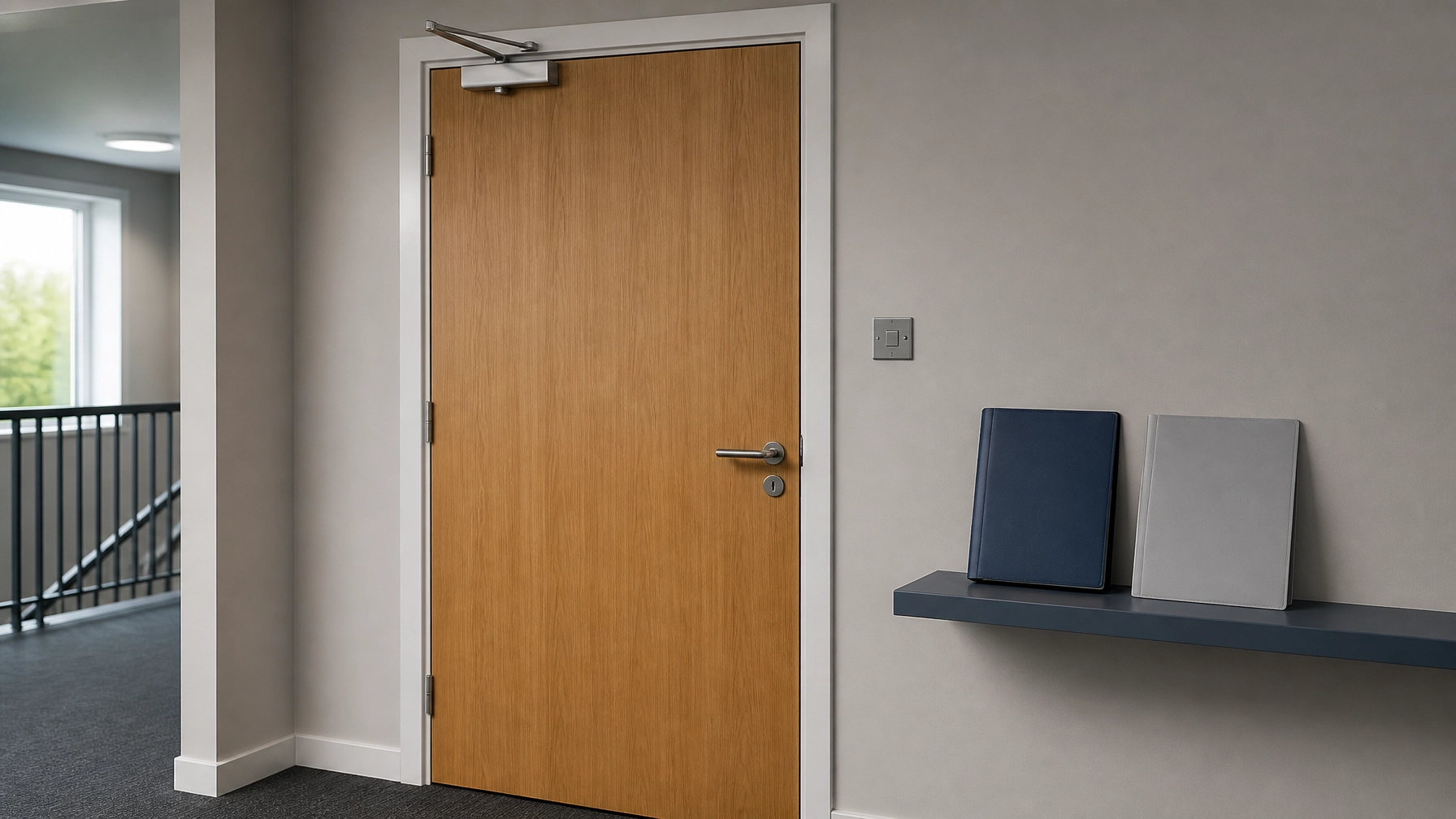
Turn a fire-door concern into a clear, managed action plan. From reviewing an existing Fire Risk Assessment to completing proportionate works and retaining signed handover records, Elite Fire Door Installations helps property owners address fire-door issues with confidence.
Key Takeaways
- Review the client-provided Fire Risk Assessment or fire-door report before arranging remedial works.
- Use a professional Fire Door Survey for Quotations to identify each relevant doorset and its specific issue.
- Choose proportionate Fire Door Repairs, upgrades or a new Fire Door Installation based on competent advice.
- Retain a signed compliance file containing the scope, completed works, photographs and handover records.
- Keep documentation available for property sales, HMO licensing, insurance discussions, management reviews and future maintenance.
Table of Contents
- Respond to a Fire-Door Concern with a Clear Process
- Understand the Legal Importance of Fire-Door Records
- Translate the FRA Report into a Practical Action Plan
- Choose Proportionate Repair, Upgrade or Replacement
- Prepare Different Property Types for Compliance
- Follow Our Professional Survey and Handover Process
- Answer Common Fire-Door Compliance Questions
- Request a Professional Survey and Compliance Solution
- Conclusion: Retain Clear Evidence of Completed Works
1. Respond to a Fire-Door Concern with a Clear Process
A concern may be raised during a Fire Risk Assessment, a property purchase, a licensing review, a management check or preparation for a sale. The correct response is not to make assumptions or commission isolated remedial work without understanding the wider fire strategy.
Begin by gathering the available information:
- The current Fire Risk Assessment.
- Any fire-door schedule or previous report.
- Building plans and door locations.
- Information about recent alterations.
- Existing certificates, maintenance records or handover documents.
- Details of the building’s use, occupancy and escape arrangements.
This information gives a competent professional a useful starting point. It does not replace a physical survey of the relevant doorsets.
A professional Fire Door Survey for Quotations provides a structured review of the doors identified in the report. It helps connect written findings with the actual condition, specification and use of each doorset.

2. Understand the Legal Importance of Fire-Door Records
The Regulatory Reform (Fire Safety) Order 2005 places duties on the Responsible Person to manage fire precautions and maintain relevant safety measures in efficient working order.
The Fire Safety Act 2021 also clarifies the importance of fire safety measures relating to the structure and common parts of multi-occupied residential buildings, including flat entrance doors where applicable.
For certain residential buildings, the Fire Safety (England) Regulations 2022 guidance sets out further duties relating to fire-door checks and record keeping.
A signed compliance file does not guarantee a licensing, insurance, sales or regulatory outcome. However, it creates a clear record of what was identified, what action was agreed and what work was completed. This can help responsible property owners demonstrate a considered approach to fire safety management.
Records can support:
- Discussions with a buyer or conveyancer during a property sale.
- HMO licensing and management reviews.
- Communications with insurers or risk surveyors.
- Evidence of completed remedial actions.
- Future maintenance planning.
- Continuity when a property changes owner or manager.
Without organised records, even completed works can be difficult to explain later.
3. Translate the FRA Report into a Practical Action Plan
Fire Risk Assessment wording can be broad. A report may refer to defective fire doors, inadequate self-closing devices, damaged frames, missing seals, unsuitable hardware or concerns about compartmentation.
Elite Fire Door Installations translates those findings into a doorset-by-doorset action plan.
Identify Each Relevant Doorset
The survey should establish:
- Where each relevant door is located.
- Whether it protects a bedroom, flat entrance, staircase, kitchen, plant room, storage area or escape route.
- The apparent fire-resistance requirement.
- The condition of the leaf, frame, hinges, closer, latch, glazing and seals.
- Whether the door’s current use has changed since installation.
- Whether further evidence is required before a solution can be confirmed.
The purpose is to avoid treating every door in the building as identical. A house converted into an HMO may require a different approach from a restaurant back-of-house corridor or a flat entrance door opening onto a communal area.
Convert Findings into Written Actions
Following the survey, the property owner should receive a clear written scope. This should distinguish between:
- Items requiring attention.
- Doors suitable for proportionate repair or upgrade.
- Doors requiring replacement.
- Evidence still needed.
- Work that should be prioritised.
- Documentation to be provided at handover.
This structure allows owners, landlords and managers to make informed decisions without relying on unclear verbal recommendations.
4. Choose Proportionate Repair, Upgrade or Replacement
A failed doorset does not automatically require complete replacement. Depending on its construction, condition, evidence and intended use, a competent Certified Installer may be able to carry out proportionate remedial work.
Potential solutions may include:
- Professional adjustment or replacement of compatible hardware.
- Renewal of damaged or missing intumescent seals.
- Suitable frame or edge remedial work.
- Re-lipping where technically appropriate.
- Hardware upgrades.
- Closer replacement or improvement.
- Complete doorset replacement where the existing door cannot provide reliable evidence of suitability.
All work must be assessed and completed by qualified professionals. Fire doors form part of a tested assembly, so individual components cannot be selected casually or treated as interchangeable.
Elite Fire Door Installations works to relevant UK standards, including BS 476-22 and BS 8214, while considering the specific building, doorset and fire strategy. Our approach is to restore or improve suitable doors where this is technically defensible, while recommending replacement where the existing assembly cannot be relied upon.
5. Prepare Different Property Types for Compliance
Property owners should consider fire-door requirements early, particularly before purchasing, converting, selling or re-letting a building.
Houses and Flats
For houses and flats, attention may focus on doors protecting escape routes, communal areas, plant spaces and flat entrances. Alterations such as loft conversions, open-plan changes or new partitions can affect the original fire strategy.
Flats in buildings under 7 storeys and below 18 metres tall may generally be suitable for a specialist, provided the arrangement meets the requirements of the Fire Risk Assessment, specification, insurer and contract.
HMOs
HMO owners and investors should consider fire doors before works begin. The property may require:
- Fire doors to sleeping accommodation.
- Protected routes between bedrooms and exits.
- Suitable doors to shared kitchens.
- Reliable self-closing arrangements.
- Correctly specified hardware and seals.
- A clear compliance file for licensing discussions.
A qualified FRA assessor should establish the wider fire strategy. Certified Installers should then complete any specified fire-door works.
B&Bs and Guest Accommodation
B&Bs may combine guest bedrooms, kitchens, storage areas and owner accommodation. Door use, guest circulation and escape routes should all be considered. A professional survey can identify whether existing doors remain appropriate after refurbishment or changes in layout.
Restaurants
Restaurants often contain higher-risk kitchen areas, storage rooms, service corridors and mixed-use spaces. Where residential accommodation or flats are located above, the separation between uses becomes especially important. Fire-door works should be coordinated with the building’s wider fire precautions and operational requirements.

6. Follow Our Professional Survey and Handover Process
Elite Fire Door Installations uses a straightforward four-stage process.
Step One: Review and Survey
We review the available Fire Risk Assessment or report, discuss the property’s use and arrange a professional Fire Door Survey for Quotations. The survey records the relevant doorsets and identifies the issues requiring professional attention.
Step Two: Issue a Clear Written Scope
We provide a written quotation and scope describing the recommended repair, upgrade or Fire Door Installation. The scope is tailored to the doorset rather than based on a blanket assumption.
Step Three: Complete Certified Works
Certified Installers complete the agreed work using appropriate UK-standard equipment and compatible components. Depending on the project, this may include Fire Door Gap Gauges, Intumescent Seal Routers, Hinge Jigs, Fire-Rated Packers, Digital Inclinometers, Force Gauges, Laser Levels and certified Intumescent Mastic/Sealant.
These tools are used as part of professional workmanship. They are not a substitute for competence, tested specifications or a suitable fire strategy.
Step Four: Provide Signed Handover Records
At completion, we provide relevant documentation for the property file. This may include:
- The completed work scope.
- Doorset references and locations.
- Details of works completed.
- Product or component information where relevant.
- Completion photographs where appropriate.
- Outstanding recommendations, if any.
- Signed handover records.
The completed file can then be retained with the property’s wider fire safety documentation.
7. Answer Common Fire-Door Compliance Questions
What should I do if my Fire Risk Assessment identifies defective fire doors?
Arrange a professional Fire Door Survey for Quotations with a qualified provider. Share the report, allow the relevant doorsets to be surveyed and request a written scope. Do not attempt to resolve technical defects without a qualified FRA assessor or Certified Installer.
Does every failed fire door need to be replaced?
No. A competent Certified Installer may identify a suitable repair, re-lipping or upgrade option where the doorset’s construction and available evidence support that approach. Replacement may be necessary where the assembly cannot be reliably brought into compliance.
Why is a signed compliance file useful when selling a property?
It provides an organised record of the concern, agreed works and completed actions. Buyers, advisers and managers may request fire safety information, particularly for HMOs, flats and mixed-use properties. The file supports due diligence but cannot guarantee a sale or a particular professional opinion.
What should HMO investors consider before buying a property?
Investors should review the existing Fire Risk Assessment, fire-door arrangements, escape routes, licensing position and available documentation before committing to a conversion. A professional survey should be included in the pre-letting preparation process, with any required HMO fire door upgrades completed by Certified Installers.
Can my existing maintenance records be used?
They may be useful if they clearly identify the doorsets, dates, findings and completed actions. A professional provider can review the available information and explain whether further surveying or documentation is required.
8. Request a Professional Survey and Compliance Solution
A clear process makes fire-door remediation easier to manage. Whether you are preparing an HMO, selling a house, managing flats, operating a B&B or running a restaurant, start by gathering the available report and arranging a professional survey.
Elite Fire Door Installations can help you progress from review to written scope, proportionate Fire Door Repairs, upgrades, installation and signed handover documentation.
For general information about our services, visit Elite Fire Door Installations.
9. Conclusion: Retain Clear Evidence of Completed Works
A fire-door concern should lead to a managed professional process rather than uncertainty. Review the Fire Risk Assessment, arrange a Fire Door Survey for Quotations, identify each relevant doorset, agree a clear written scope and use Certified Installers for the work.
Proportionate repair, upgrade or replacement may be appropriate depending on the evidence and condition of each doorset. Once the work is complete, retain signed handover records with the wider fire safety file.
This approach supports better property management, clearer communication and greater peace of mind for owners, landlords, sellers, managers and operators across East Sussex and the wider South East.
Note: This information is intended as general guidance and does not constitute professional or legal advice. Always consult a qualified fire safety engineer for your specific property.
Email: info@elitefiredoorinstallations.co.uk
Specialist Support: +44 7514 898517
Request a call back: +44 20 4511 9456
Website: https://elitefiredoorinstallations.co.uk
Leave a Reply