

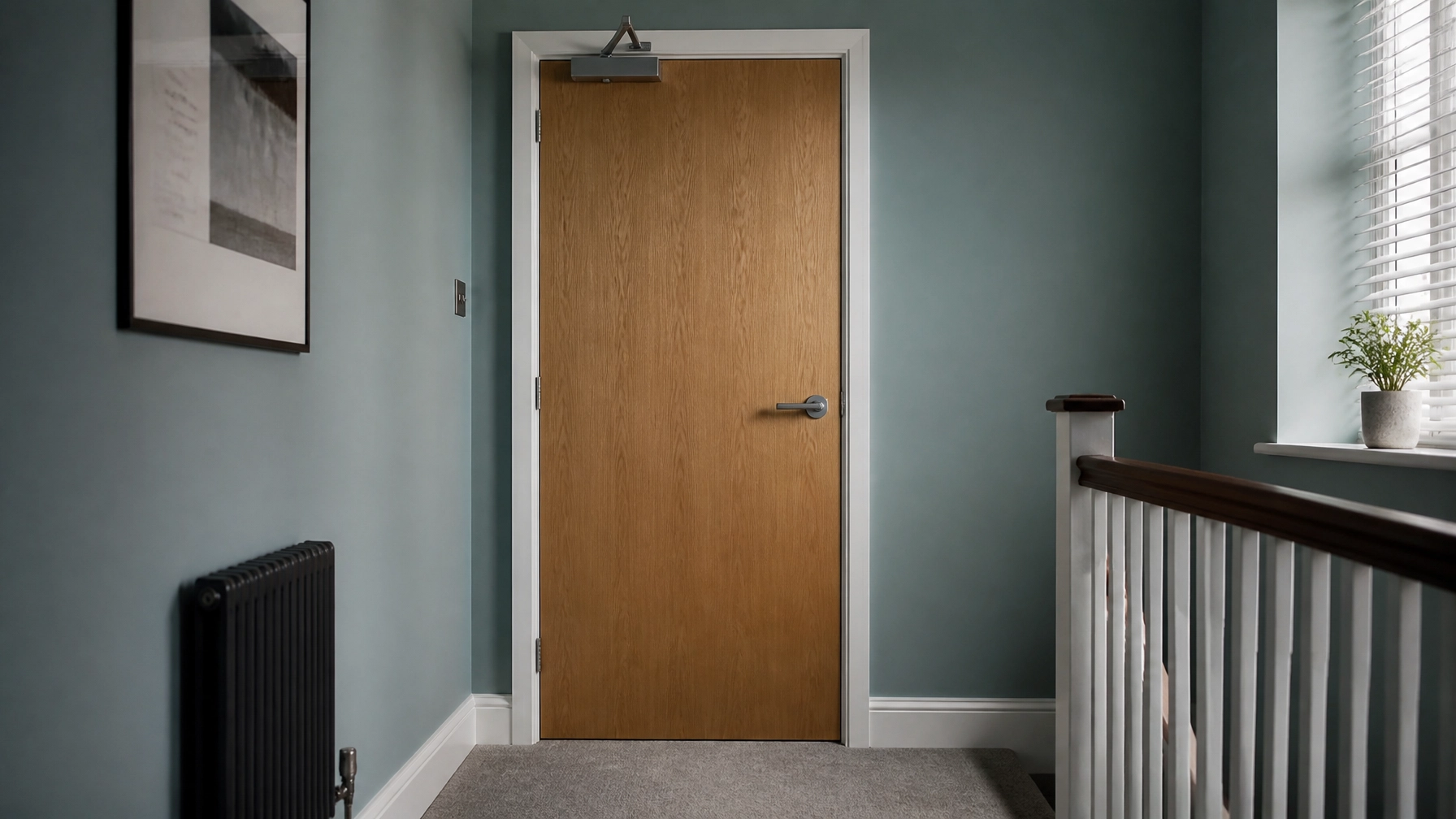
1. Understand Why Fire Doors Matter
Fire doors are an essential part of a building’s fire safety arrangements. They are designed to slow the spread of fire and smoke, protect escape routes and give occupants more time to leave safely.
For landlords, HMO managers, guest-house owners, business operators and flat owners, maintaining suitable fire doors is an important responsibility. A fire door is not simply a heavy internal door. It forms part of a tested door set that can include the door leaf, frame, hinges, closer, latch, intumescent seals and other fire-rated hardware.
Key Takeaways
- Fire doors help protect shared corridors, stairways and other escape routes.
- Damage, poor closing, worn seals, unsuitable hinges and excessive gaps can affect performance.
- A problem does not always mean the complete door needs replacing.
- A professional survey can identify proportionate repairs, upgrades or replacement.
- Qualified FRA assessors and Certified Installers should manage fire-door compliance work.
- Elite Fire Door Installations provides clear quotations, careful workmanship and useful compliance records.
2. Protect Your Legal Position
Property owners and landlords have a legal responsibility to manage fire risks within their premises. The Fire Safety Act 2021 and wider fire safety duties place clear expectations on those responsible for residential and commercial buildings.
For HMOs, these responsibilities are particularly important because several unrelated occupants may share corridors, stairways and entrance routes. A faulty fire door can affect more than one room. It may reduce the protection available to everyone using the escape route.
Enforcement bodies may consider fire doors as part of wider fire safety reviews, licensing decisions and follow-up action. Where significant issues are identified, landlords may face remedial requirements, delays to licensing, financial penalties or increased liability following an incident.
This does not mean every concern should create unnecessary alarm. It does mean that concerns should be dealt with promptly and professionally. If an FRA identifies defective or unsuitable fire doors, the safest approach is to obtain advice from a qualified FRA assessor and arrange work through Certified Installers.
For general government guidance, property owners can review the Approved Document B fire safety FAQs.
3. Translate Your FRA into a Clear Plan
A Fire Risk Assessment may identify fire-door concerns using concise professional terminology. For a property owner, the next question is usually straightforward: what needs to happen, how much will it cost and how quickly can the work be completed?
Elite Fire Door Installations helps translate available FRA comments and survey information into a practical action plan. This may involve reviewing references to:
- Damaged door leaves, frames or edges
- Doors that do not close or latch correctly
- Worn, missing or damaged intumescent seals
- Hinges or other hardware that may not be suitable
- Excessive or inconsistent gaps
- Missing or unsuitable self-closing devices
- Doors that have been altered without suitable evidence
A professional review considers the condition of the complete door set rather than focusing on one component in isolation. The aim is to establish whether the door can be repaired or upgraded appropriately, or whether replacement is the more suitable option.
Review Available Information
Start by gathering the relevant FRA, previous survey comments, building information and any records relating to earlier work. This gives the installer useful context before arranging a professional Fire Door Survey for Quotations.
Where the information is incomplete or the condition has changed, an on-site survey may be appropriate. This should be carried out by suitably qualified professionals rather than treated as a DIY task.
4. Choose Repair, Upgrade or Replacement
One of the most important advantages of a professional assessment is that it avoids an automatic replacement decision.
Some failing fire doors may be suitable for proportionate remedial work. Depending on the door set and its condition, a Certified Installer may be able to repair, re-lip or upgrade specific elements while retaining suitable components. In other cases, replacement will be necessary to provide the required level of protection and reliability.
Elite Fire Door Installations provides tailored advice through:
- Fire Door Repairs where proportionate remedial work is suitable
- HMO Fire Door Upgrades for shared residential properties
- Fire Door Installations where a new compliant door set is required
The decision should be based on the physical condition of the door, the surrounding frame, the hardware, the fire strategy and the relevant specification. Only qualified professionals should decide whether a repair is appropriate.
Our work is planned with reference to relevant standards, including BS 476-22 and BS 8214, together with the requirements of the specific door set and the property’s fire safety documentation.

5. Prepare Your HMO Investment Properly
If you are buying a property to convert into an HMO, fire-door costs should be included in the renovation budget from the beginning. Treating them as a final-stage expense can create delays, unexpected costs and difficulties before occupation or licensing.
Before committing to the purchase or finalising the conversion design, consider:
- The number of bedrooms and shared rooms opening onto escape routes
- The condition and layout of existing door frames
- The likely need for self-closing fire doors
- The condition of hinges, closers, latches and intumescent seals
- Whether existing doors can be proportionately upgraded
- Whether new door sets may be required
- The documentation needed for handover and future management
- The time required to complete work without disrupting other trades
A professional survey for quotations can help investors understand the likely scope of work before the renovation programme is fixed. This supports more accurate budgeting and reduces the risk of discovering unsuitable doors after decorating, flooring or other finishing work has been completed.
The same approach applies to flats, guest houses, B&Bs and small commercial premises. Early planning supports safer buildings, clearer costs and a smoother handover.
6. Follow a Simple Professional Process
Elite Fire Door Installations keeps the client journey clear and proportionate.
Step One: Review and Survey
We review the available FRA information and arrange a professional fire-door survey where appropriate. The survey considers the door set, surrounding frame, hardware and visible condition.
Step Two: Receive a Clear Quotation
We explain the recommended work in straightforward terms. The quotation separates suitable repairs, upgrades and replacement requirements wherever possible, helping property owners make an informed decision.
Step Three: Complete the Agreed Work
Qualified professionals complete the agreed Fire Door Installations, Fire Door Repairs or HMO upgrades with care and minimal disruption.
Professional UK-standard tools may include Fire Door Gap Gauges, Intumescent Seal Routers, Hinge Jigs, Fire-Rated Packers, Digital Inclinometers, Force Gauges, Laser Levels and certified Intumescent Mastic or Sealant. These tools support precision; they are not a substitute for professional judgement.
Step Four: Retain the Compliance File
Once the work is complete, we provide useful records relating to the agreed scope. Keeping quotations, photographs, product information and completion records together can make future reviews and property management easier.

7. Get Clear Answers to Common Questions
Do all fire-door concerns mean the door must be replaced?
No. The correct solution depends on the condition of the complete door set and the relevant specification. A Certified Installer may identify suitable repair or upgrade options. If the door cannot provide reliable fire resistance, replacement may be necessary.
Can a landlord repair a fire door personally?
Fire-door work should not be treated as a DIY project. Incorrect alterations, unsuitable hardware or poorly fitted seals may affect the door’s performance and create compliance problems. Use a qualified professional and follow the recommendations of the FRA assessor.
Why are intumescent seals important?
Intumescent seals are designed to expand when exposed to heat and help close the gaps around a fire door. If they are missing, damaged or unsuitable, the door may not perform as intended. A qualified installer should assess their condition and specify any remedial work.
What happens if a fire door does not close properly?
A door that remains open, fails to latch or closes unevenly may not protect the escape route effectively. The cause could involve the door, frame, hinges, closer or other hardware. A professional survey is needed to identify the issue safely and recommend suitable work.
Should HMO investors arrange fire-door advice before buying?
Yes. Early advice can help investors include realistic fire-door allowances in their renovation budgets. It can also identify whether existing doors are likely to need repair, upgrading or replacement before the property is occupied or submitted for licensing.
8. Take the Next Step with Confidence
Fire-door compliance does not need to be confusing. A clear review, transparent quotation, proportionate work and organised documentation provide a straightforward route forward.
Elite Fire Door Installations supports property owners, landlords, HMO managers, B&B and guest-house operators, small businesses and residential flat owners across East Sussex and the wider South East. We combine specialist HMO knowledge, careful workmanship, practical advice and responsive service to help maintain safer properties with minimal disruption.
You can also visit Elite Fire Door Installations to learn more or arrange a professional survey or installation.
9. Conclude with Confidence
Fire doors help slow fire and smoke, protect escape routes and give occupants more time to leave safely. Their condition should be managed as part of the wider fire safety responsibilities of the property owner.
If an FRA or existing survey has raised concerns, do not assume that every door requires complete replacement. Arrange a professional review so a qualified FRA assessor and Certified Installer can identify the appropriate solution.
With clear advice, proportionate repairs or upgrades and useful compliance records, property owners can take practical action without unnecessary disruption.
Note: This information is intended as general guidance and does not constitute professional or legal advice. Always consult a qualified fire safety engineer for your specific property.
Email: info@elitefiredoorinstallations.co.uk
Specialist Support: +44 7514 898517
Request a call back: +44 20 4511 9456
Website: https://elitefiredoorinstallations.co.uk
Leave a Reply