

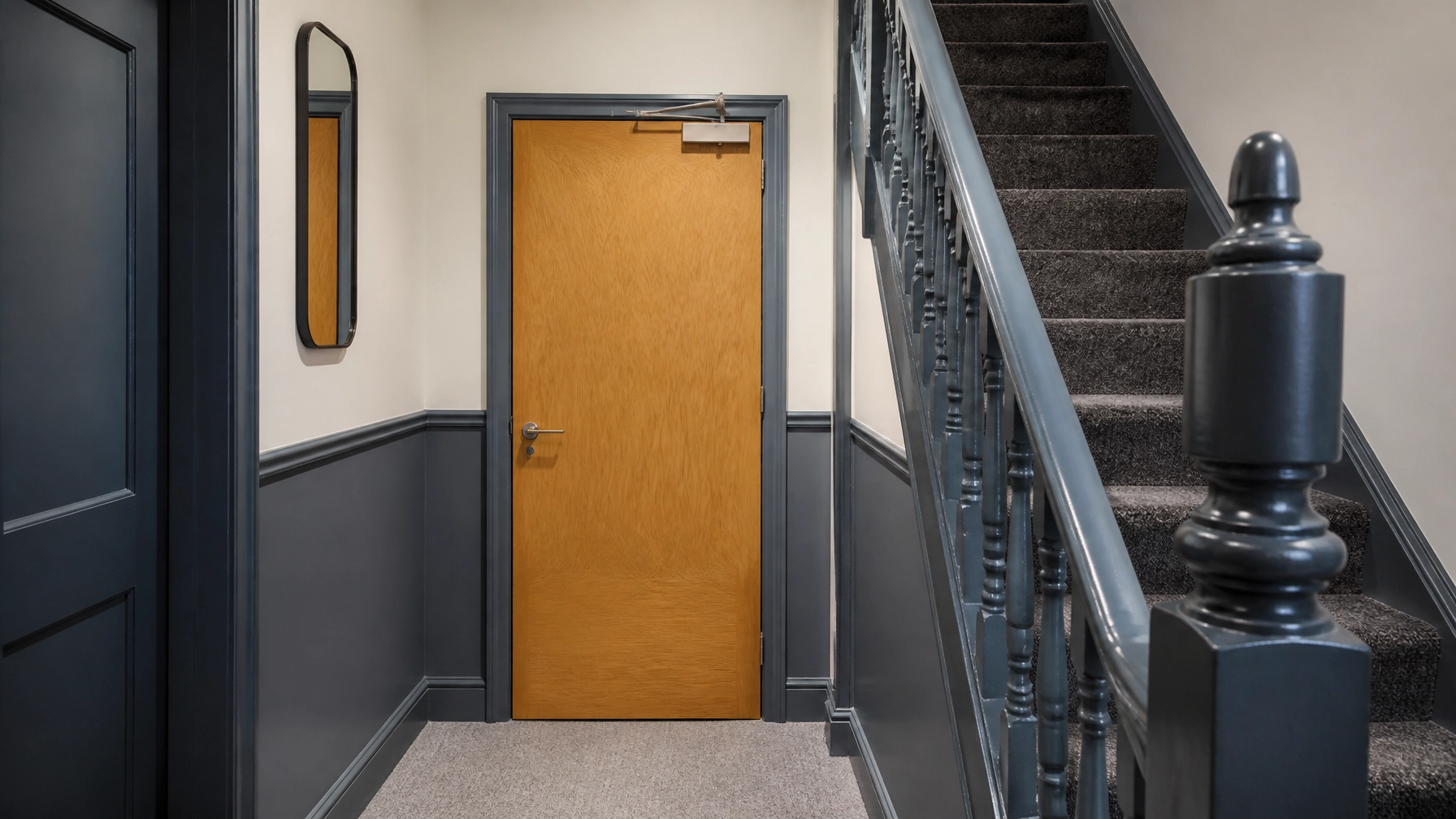
Fire doors form an important part of fire safety in Houses in Multiple Occupation. They help slow the spread of fire and smoke, protect communal escape routes and provide occupants with more time to leave safely.
For HMO landlords, investors and property managers, effective fire door management is both a safety responsibility and an important part of maintaining a compliant, well-run property. The correct approach is proportionate and practical: review the available Fire Risk Assessment, understand the priorities, arrange professional work and retain clear records.
Key Takeaways
- Fire doors help protect bedrooms, kitchens, communal routes, plant areas and entrance routes where required by the property’s risk assessment.
- A door’s performance depends on the complete doorset, including the frame, seals, hinges, closer, latch and surrounding construction.
- A failed door does not automatically mean that an HMO cannot operate, but it should be addressed through a suitable professional action plan.
- Landlords should budget for surveys, proportionate repairs, upgrades, replacements and follow-up maintenance when converting or acquiring an HMO.
- Elite Fire Door Installations provides tailored Fire Door Surveys for Quotations, Fire Door Installations, repairs and HMO upgrades across East Sussex and the wider South East.
Table of Contents
- Understand the Role of Fire Doors in HMOs
- Translate FRA Findings into a Clear Action Plan
- Choose Proportionate Repairs or Replacement
- Prepare Your HMO Investment Before Letting
- Follow a Professional Survey and Compliance Process
- Answer Common HMO Fire Door Questions
- Arrange Your HMO Fire Door Review
- Conclusion: Maintain Safer, Better-Prepared Shared Homes
2. Understand the Role of Fire Doors in HMOs
Fire doors support compartmentation. In practical terms, they help separate higher-risk rooms from shared circulation areas and can reduce the movement of fire and smoke while occupants evacuate.
The exact requirements depend on the building layout, occupancy, escape strategy, construction and findings of the Fire Risk Assessment. Landlords should therefore avoid relying on a generic checklist or assuming that every HMO has the same specification.
The Regulatory Reform (Fire Safety) Order 2005 places duties on the responsible person to take suitable fire safety measures. The Fire Safety Act 2021 also clarifies the application of fire safety duties to important parts of multi-occupied residential buildings, including certain entrance doors leading to communal areas.
Protect Bedroom Doors and Communal Escape Routes
Bedroom doors opening onto shared hallways, landings or stairways are commonly included within an HMO fire strategy. Their purpose is to help protect the communal escape route if a fire starts within a private room.
Communal routes require particular care because several residents may depend on the same corridor or staircase. Doors leading onto these routes may need suitable fire resistance, smoke control features and reliable self-closing arrangements, depending on the FRA specification.
The complete doorset matters. The door leaf alone cannot provide the intended protection if the frame, hinges, seals, closer or latch are unsuitable, damaged or poorly matched.
Manage Kitchens, Plant Areas and Entrance Doors
Kitchens are often treated as higher-risk areas because of cooking equipment, electrical appliances and combustible materials. Where a kitchen opens onto a shared route, the FRA may require a fire-resisting doorset with suitable smoke seals and self-closing hardware.
Plant rooms, boiler cupboards, electrical intake areas and storage spaces may also require additional protection. The appropriate rating will depend on the risk and building design. Some areas may need a higher level of fire resistance than standard bedroom doors.
Entrance doors require careful consideration where they form part of a protected route. The property’s FRA and relevant building guidance should establish the correct specification.
3. Translate FRA Findings into a Clear Action Plan
A Fire Risk Assessment may identify several fire door-related actions. These could include damaged doors, missing or unsuitable components, poor closing performance, gaps, altered frames or doors that do not match the documented fire strategy.
The important next step is to translate those findings into a physical plan. Elite Fire Door Installations can review the available FRA information alongside the condition and arrangement of the doors.

A practical action plan should:
- Review the available FRA findings and identify which doors are linked to escape routes or higher-risk rooms.
- Prioritise the work according to safety importance, building use and the urgency recorded in the assessment.
- Arrange a professional survey to establish whether each door can be repaired, upgraded or requires replacement.
- Confirm the specification for the doorset, hardware and associated work.
- Retain the completed records in the property’s fire safety file.
- Plan follow-up maintenance so that improvements remain effective over time.
This approach gives landlords a clearer route forward. It also helps prevent unnecessary replacement where a suitable professional repair or upgrade is possible.
4. Choose Proportionate Repairs or Replacement
Not every defective fire door requires complete replacement. The correct decision depends on the condition of the door leaf, frame, hardware, seals, installation and available evidence about the doorset’s specification.
Our qualified specialists assess whether a door may be physically repaired, re-lipped, adjusted or upgraded. Where appropriate, Fire Door Repairs can restore the door’s function and improve its relationship with the frame and hardware.
In other cases, replacement is the more reliable option. This may apply where the door is severely damaged, substantially altered, poorly matched to the frame or unsuitable for the required fire strategy.
A proportionate approach can help landlords:
- Control renovation costs.
- Reduce disruption for residents.
- Avoid replacing doors that remain suitable for professional remediation.
- Address the highest-priority issues first.
- Create a consistent and properly documented fire door schedule.
All work should be completed by qualified professionals who understand fire-resisting doorsets, HMO layouts and the relevant requirements of BS 476-22 and BS 8214.
5. Prepare Your HMO Investment Before Letting
Investors converting a property into an HMO should consider fire door requirements before finalising the renovation budget. Fire doors are not an item to leave until the final stage of a project, because changes to frames, linings, hardware and communal routes may affect other works.

Allow for the following areas during acquisition and planning:
- Initial professional survey: Establish the likely condition of existing doors before committing to a purchase or conversion programme.
- FRA-led specifications: Confirm which bedroom, kitchen, living room, cupboard, plant area and entrance doors require protection.
- Complete doorsets: Budget for compatible leaves, frames, hinges, closers, latches, intumescent strips and smoke seals where required.
- Repair and upgrade options: Ask whether suitable existing doors can be remediated before assuming that all doors need replacement.
- Communal route protection: Consider corridors, landings and stairways as part of one connected escape strategy.
- Access and resident arrangements: Plan professional work around occupancy, contractors and other renovation activities.
- Compliance documentation: Retain surveys, quotations, work records and follow-up recommendations in a structured file.
- Future maintenance: Include periodic reviews and remedial work in the ongoing property management budget.
Flats in buildings under seven storeys and below 18 metres may generally be suitable for a FireQual-certified specialist where the FRA, specification, insurer and contract requirements are satisfied. However, this article does not discuss certification, and property owners should always confirm the appropriate professional requirements for their specific building.
6. Follow a Professional Survey and Compliance Process
Elite Fire Door Installations uses a clear process designed to give HMO landlords confidence from the initial review through to handover.
Step One: Arrange a Survey
We review the available FRA information and assess the relevant doors, frames, hardware and surrounding areas. The survey identifies priorities without assuming that replacement is the only solution.
Step Two: Receive Clear Quotation
We explain the recommended work and provide a clear quotation. Where suitable, the quotation separates repairs, upgrades and replacements so that investors can make informed budget decisions.
Step Three: Complete the Agreed Work
Our qualified specialists carry out the required Fire Door Installations, HMO Fire Door Upgrades or repairs with precision. Professional UK-standard tools may include Fire Door Gap Gauges, Intumescent Seal Routers, Hinge Jigs, Fire-Rated Packers, Digital Inclinometers, Force Gauges and Laser Levels.
Appropriate fire-rated intumescent mastic and sealant may also be used where specified. The work is planned around the doorset and the documented requirements, rather than relying on isolated adjustments.
Step Four: Receive Compliance Documentation
At handover, we provide relevant work records and recommendations for future maintenance. This signed compliance file can support property management, communication with other professionals and future FRA reviews.
7. Answer Common HMO Fire Door Questions
Do all bedroom doors in an HMO need to be fire doors?
Not necessarily. The requirement depends on whether the door opens onto a communal escape route and what the FRA determines is necessary. In many HMOs, bedroom doors opening onto shared corridors or stairways require fire-resisting protection. A qualified specialist should review the layout and documented fire strategy.
Does a failed door always need to be replaced?
No. Some doors may be suitable for professional repair, re-lipping or upgrading. Others may be unsuitable because of extensive damage, alteration or lack of compatibility. A proper survey should establish the most proportionate solution.
What should I do if my FRA identifies fire door issues?
Arrange a professional survey and provide the FRA findings to the contractor. The specialist can convert the recommendations into a prioritised quotation and work programme. Avoid making unqualified alterations, as an unsuitable change may affect the doorset’s performance.
How often should HMO fire doors be reviewed?
The frequency should reflect the property’s risk, occupancy, building height and FRA recommendations. BS 8214 provides guidance on the management and maintenance of fire doors. Landlords should also respond to damage, repeated closing problems, changes in occupancy or alterations to the building.
What records should an HMO landlord retain?
Keep the FRA, professional survey, quotation, work records, product information where available, photographs, signed handover documents and future maintenance recommendations. Clear records help demonstrate that fire safety responsibilities are being actively managed.
8. Arrange Your HMO Fire Door Review
If you are preparing an HMO for letting, reviewing an existing shared property or responding to FRA findings, Elite Fire Door Installations can provide a straightforward route forward.
Start with a professional Fire Door Survey for Quotations, then receive clear advice on proportionate repair, upgrade or replacement options.
For general information about our services, visit the Elite Fire Door Installations website.
9. Conclusion: Maintain Safer, Better-Prepared Shared Homes
Fire doors are an essential part of an HMO’s wider fire safety strategy. They help protect communal escape routes, separate higher-risk areas and support safer evacuation when properly specified, installed and maintained.
For landlords and investors, the most effective approach is organised and proportionate. Review the FRA, identify priorities, arrange qualified professional work, retain a signed compliance file and plan follow-up maintenance.
With expert support from Elite Fire Door Installations, property owners can address fire door issues clearly and prepare shared homes for safer, more reliable operation.
Contact Elite Fire Door Installations
- Email: info@elitefiredoorinstallations.co.uk
- Specialist Support: +44 7514 898517
- Request a call back: +44 20 4511 9456
- Website: https://elitefiredoorinstallations.co.uk
Note: This information is intended as general guidance and does not constitute professional or legal advice. Always consult a qualified fire safety engineer for your specific property.
Leave a Reply