

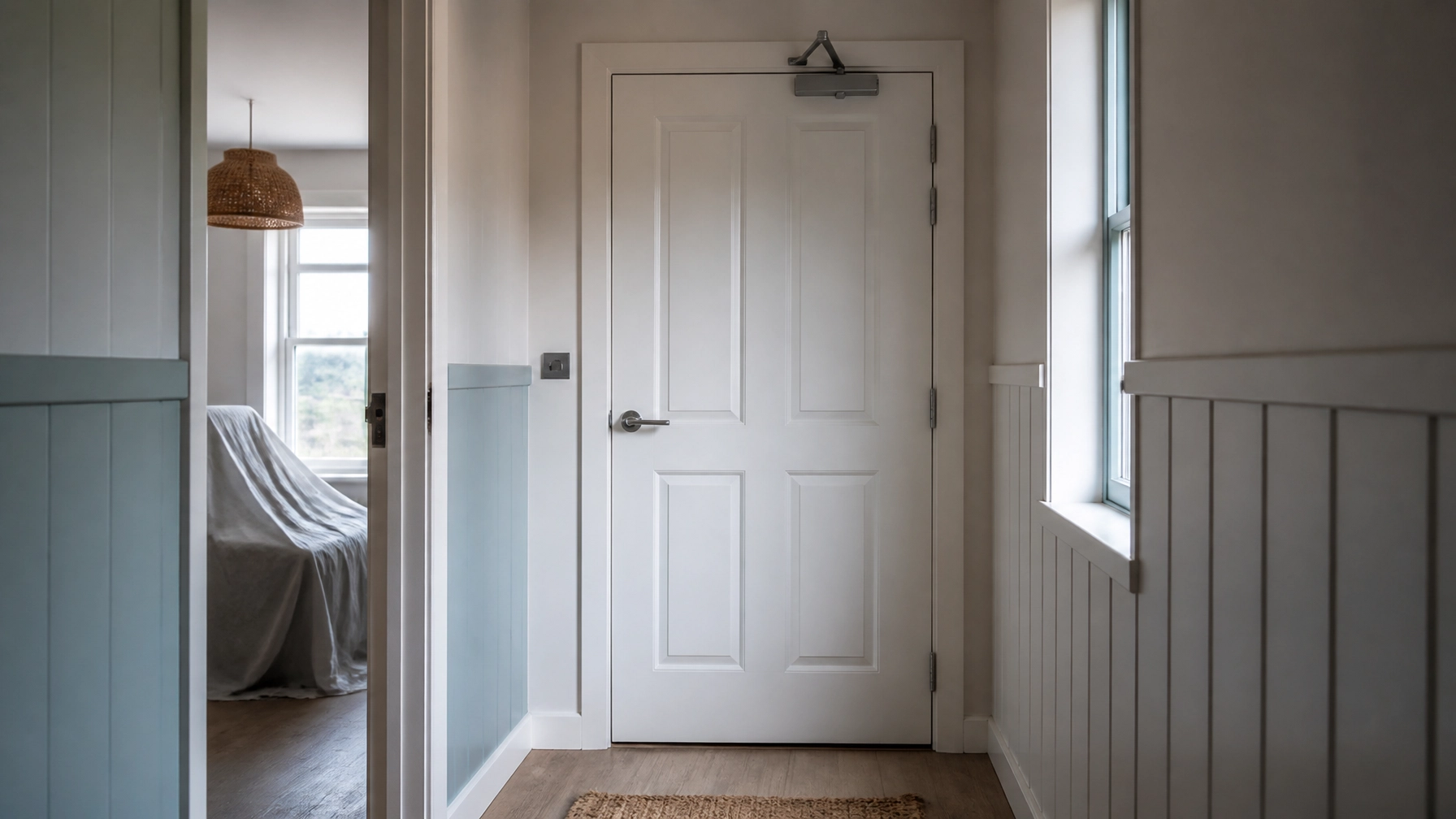
Vacant properties still require responsible fire safety management. Empty houses, flats, HMOs between tenancies, B&Bs, guest houses, holiday accommodation and restaurants that close seasonally can all develop fire-door issues before the next occupant, guest or customer returns.
Humidity, salt air, dust, building work, contractor access and long periods without use can affect the condition and operation of fire doors. A calm, documented maintenance plan helps landlords identify questions early, arrange professional support and reopen with greater confidence.
Key Takeaways
- Maintain fire safety responsibilities even when a property is empty or closed for a season.
- Review fire doors after building work, contractor access, damp conditions or extended vacancy.
- Coordinate with the responsible person, managing agent or qualified Fire Risk Assessment assessor.
- Use certified professionals for all fire-door Surveys, repairs, upgrades and installations.
- Resolve outstanding defects before occupation, guest bookings or business reopening.
- Retain a clear maintenance trail, including Survey findings, quotations, completed works and compliance documentation.
Table of Contents
- Maintain the Legal Duty During Vacancy
- Translate the FRA into a Reopening Plan
- Choose Proportionate Repair or Replacement
- Prepare Properties Before Occupation or Reopening
- Follow a Certified Survey-to-Handover Process
- Answer Common Questions About Seasonal Fire Doors
- Arrange Professional Support and Keep the Record
- Conclude with a Controlled Reopening Plan
Maintain the Legal Duty During Vacancy
A property does not cease to require fire safety management because it is temporarily empty. Under the Regulatory Reform (Fire Safety) Order 2005, the responsible person must manage fire risk and maintain relevant fire safety measures in suitable working order.
The responsible person may be the owner, landlord, employer, managing agent or another person with control of the premises. Responsibility should be clearly agreed and documented, particularly where several parties have access during a vacant period.
The Home Office guidance for sleeping accommodation applies to common areas of HMOs and flats, as well as B&Bs, guest houses and holiday accommodation. It should be read alongside the property’s current Fire Risk Assessment.
For restaurants and other commercial premises, the same principle applies. Fire doors form part of the building’s compartmentation and escape strategy where required by the layout and risk profile. A closed business still needs suitable arrangements for contractors, cleaners, maintenance personnel and other authorised visitors.
Keep the responsible person informed when:
- Building work changes the layout or door openings.
- Contractors remove, damage or alter doors, frames or hardware.
- Damp, humidity or coastal conditions may have affected materials.
- The property changes from residential use to guest, commercial or shared accommodation.
- The building is about to reopen after an extended closure.
Translate the FRA into a Reopening Plan
A Fire Risk Assessment should guide the maintenance plan. It should not be treated as a document that is completed once and then left unchanged.
A vacant period can alter the property. Doors may be used less frequently, furniture may be moved, services may be isolated, and contractors may work around protected routes. Before occupation or reopening, the responsible person should establish whether the existing FRA still reflects the building’s use, occupancy and physical condition.
Where the FRA identifies fire-door defects, arrange a professional Fire Door Survey to translate the findings into a clear physical action plan. A qualified FRA assessor may also need to review the wider fire strategy.
The action plan may identify:
- Doors requiring proportionate Fire Door Repairs.
- Doors requiring re-lipping, hardware upgrades or improved protection.
- Openings requiring a complete Fire Door Installation.
- Issues caused by surrounding building work or changes in compartmentation.
- Documentation needed for the property’s compliance file.
The frequency of professional Surveys should reflect the property’s risk profile, occupancy, use, condition and Fire Risk Assessment. There is no single timetable that is suitable for every empty or seasonal building.

Choose Proportionate Repair or Replacement
A failed fire door does not automatically require complete replacement. A certified installer should assess the door leaf, frame, seals, hinges, closer, latch, hardware and surrounding construction before recommending the appropriate solution.
Depending on the findings, a proportionate solution may include:
- A specialist Fire Door Repair to restore reliable operation.
- Re-lipping where the door construction and specification permit it.
- Replacing unsuitable or damaged fire-rated hardware.
- Improving the fit of the door within its frame.
- Applying certified intumescent mastic or sealant where professionally specified.
- Completing a full Fire Door Installation where the existing assembly cannot provide the required performance.
All work must be completed by certified professionals. Fire doors are tested assemblies, and an apparently minor alteration can affect their performance. Elite Fire Door Installations works to relevant requirements including BS 476-22 and BS 8214, with attention to the complete door set rather than the door leaf alone.
Prepare Properties Before Occupation or Reopening
Landlords should include fire-door readiness within the reopening programme for every property type.
Prepare Empty Houses and Flats
A vacant house or flat may appear straightforward, but fire doors can still be affected by refurbishment, damp conditions, storage or unauthorised alterations. Review the current FRA, establish who can access the building and arrange a professional Survey where the property has changed or remained empty for an extended period.
Flats in buildings under seven storeys and below 18 metres tall may generally be suitable for a specialist, provided the FRA, fire-door specification, insurer and contract requirements are satisfied. The building’s construction, management arrangements and escape strategy must still be considered.
Prepare HMOs Between Tenancies
For an HMO, arrange a qualified review before new residents move in. Shared accommodation often has several fire doors serving bedrooms, communal areas, kitchens and escape routes. A period between tenancies is an appropriate time to resolve outstanding HMO Fire Door Upgrades and organise the compliance file.
Prepare B&Bs, Guest Houses and Holiday Accommodation
Guest accommodation can experience rapid changes in occupancy. Before reopening, confirm that fire doors, escape routes, signage, alarm arrangements and guest information remain consistent with the current FRA. Coordinate the work with the responsible person and managing agent.
Prepare Seasonal Restaurants
Restaurants may close for refurbishment, seasonal reasons or changes in operation. Contractors can affect fire compartments, service penetrations, kitchen routes and protected stairs. Arrange professional fire-door support before staff return or customers are admitted.
Follow a Certified Survey-to-Handover Process
A controlled process helps property owners manage vacancy and reopening without uncertainty.
Step One: Arrange the Survey
A certified installer reviews the relevant fire doors, frames, hardware and available records. Where wider fire-risk questions arise, coordinate with the qualified FRA assessor or responsible person.
Step Two: Receive Clear Recommendations
The findings should identify which doors require repair, upgrade, replacement or further assessment. The recommendation should reflect the property’s use, specification and risk profile.
Step Three: Complete Certified Works
Certified installers use appropriate professional equipment, which may include Fire Door Gap Gauges, Intumescent Seal Routers, Hinge Jigs, Fire-Rated Packers, Digital Inclinometers, Force Gauges, Laser Levels and certified Intumescent Mastic or Sealant.
The work should be completed with minimal disruption and in accordance with the required specification.
Step Four: Receive the Compliance File
Retain the Survey findings, quotation, scope of work, product information, photographs where appropriate, completion details and signed compliance documentation. Pass the information to the responsible person or managing agent so the maintenance trail remains current.
Answer Common Questions About Seasonal Fire Doors
Do fire doors require attention while a property is empty?
Yes. The responsible person’s fire safety duties do not simply disappear during vacancy. Fire doors may still protect authorised visitors, contractors and future occupants. Their condition should be managed in line with the FRA and the property’s risk profile.
How often should a vacant property receive a professional Survey?
The frequency depends on the building’s use, occupancy, condition, access arrangements, environment and FRA. Seasonal accommodation, HMOs, restaurants undergoing works and properties near exposed coastal environments may need a more carefully planned review.
Can a landlord resolve fire-door defects without a certified installer?
No. Fire-door repairs, re-lipping, hardware changes and installations should be handled by certified professionals. Incorrect work can compromise the door assembly and create uncertainty about compliance.
What should happen after contractors have worked in the property?
The responsible person should establish whether the work affected fire doors, frames, protected routes or compartmentation. Arrange a professional FRA Remediation review where required, and resolve identified defects before occupation or reopening.
What records should landlords retain?
Keep the current FRA, professional Survey reports, agreed scope, completed works documentation, product information and signed compliance file. Record the date and reason for each review so the property has a clear maintenance trail.
Arrange Professional Support and Keep the Record
A planned review is often easier to manage than discovering a fire-door issue immediately before a tenancy, guest booking or business reopening.
Elite Fire Door Installations supports landlords and property managers with professional Fire Door Surveys, Fire Door Installations, Fire Door Repairs and tailored HMO Fire Door Upgrades across East Sussex and the wider South East.
You can also visit Elite Fire Door Installations to arrange a professional Survey or discuss an installation programme. Our team can help you move from review, to clear recommendations, to proportionate works and a signed compliance file.
Conclude with a Controlled Reopening Plan
Empty and seasonal properties still require active fire safety management. Salt air, humidity, dust, building work and contractor access can create questions that should be resolved before residents, guests, staff or customers return.
Coordinate with the responsible person, managing agent and qualified FRA assessor. Arrange a professional Survey where needed, use certified installers for physical fire-door work and retain a complete maintenance trail. This structured approach supports safety, regulatory compliance and peace of mind when the property reopens.
Note: This information is intended as general guidance and does not constitute professional or legal advice. Always consult a qualified fire safety engineer for your specific property.
Email: info@elitefiredoorinstallations.co.uk
Specialist Support: +44 7514 898517
Request a call back: +44 20 4511 9456
Website: https://elitefiredoorinstallations.co.uk
Leave a Reply