

Key Takeaways
- Coordinate access control, locks, closers and privacy hardware with the complete fire-rated doorset.
- Ensure escape remains immediate, simple and available without a key, card, code or specialist knowledge.
- Treat electronic locks, hold-open devices and access-control changes as part of the fire strategy, not isolated security upgrades.
- Use qualified FRA assessors and Certified Installers to review refurbishment changes, converted properties and HMO arrangements.
- Retain appropriate technical evidence for the fire-rated doorset, hardware, alarm interface and compliance decisions.
Table of Contents
- Protect Fire Safety When Adding Access Control
- Understand the Legal and Compliance Stakes
- Translate the FRA Report into a Clear Action Plan
- Choose Repair, Upgrade or Replacement Proportionately
- Prepare HMOs and Refurbished Properties Properly
- Follow a Controlled Professional Process
- Answer Common Access-Control Questions
- Arrange a Professional Review and Compliance File
- Conclude with Safer, Better-Coordinated Doors
1. Protect Fire Safety When Adding Access Control
Security improvements are common after refurbishment, conversion or a change of use. Landlords may add electronic locks to communal entrances, privacy hardware to bedrooms, hold-open devices to busy corridors or upgraded closers to improve door control.
Each change can affect more than security.
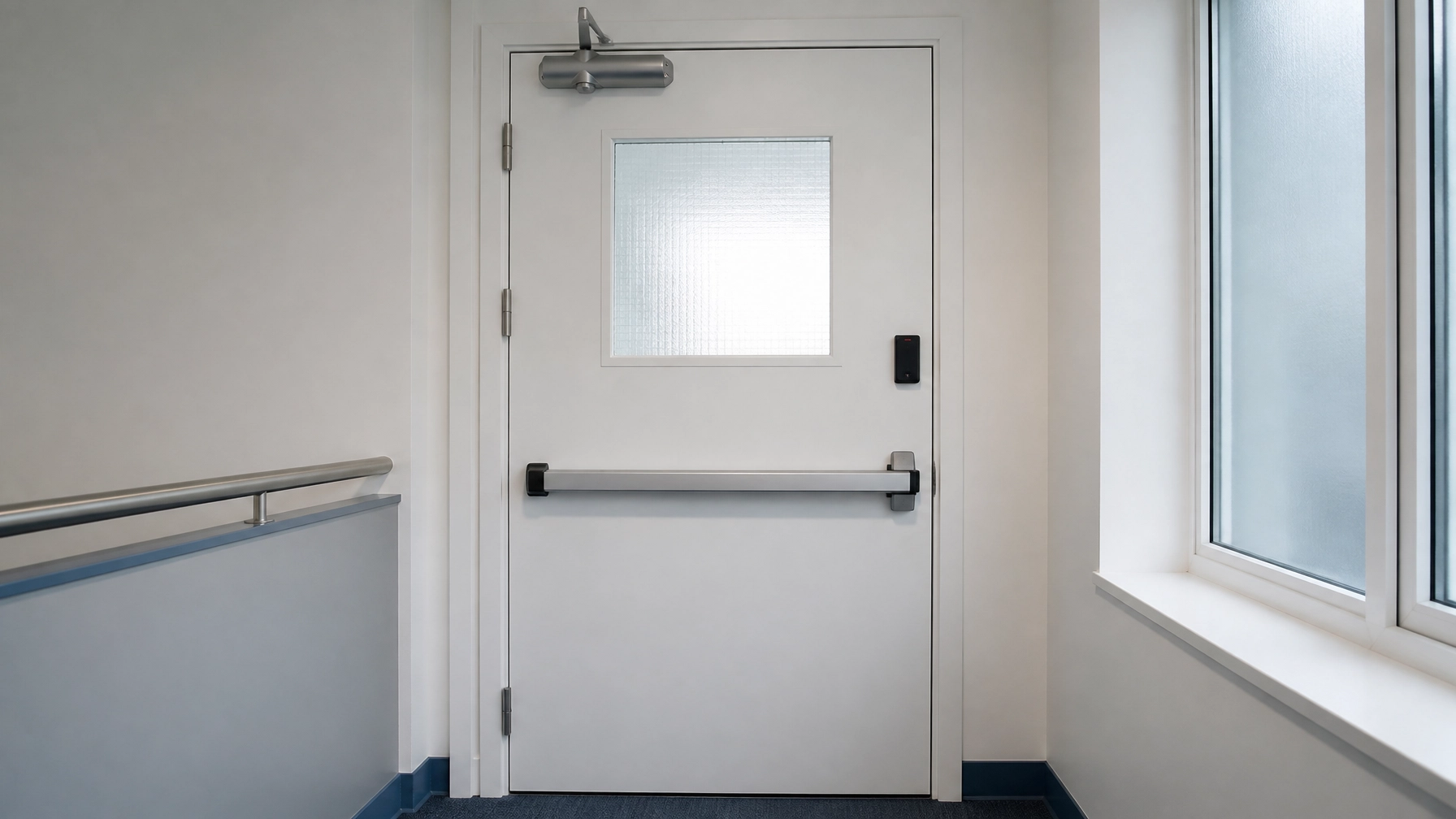
A lock, access reader, closer or hold-open device interacts with:
- The door leaf and frame.
- The hinges, latch and intumescent protection.
- The self-closing function.
- The escape route and direction of travel.
- The fire alarm and emergency release arrangements.
- The building’s fire strategy and occupancy profile.
A complete fire-rated doorset tested, assessed or classified to the relevant British Standard or other appropriate technical evidence must continue to perform as intended. This means property owners should not select access-control hardware in isolation.
The suitable arrangement depends on the Fire Risk Assessment, building layout, occupant needs, fire strategy, system design and supporting technical evidence.
2. Understand the Legal and Compliance Stakes
The Regulatory Reform (Fire Safety) Order 2005 places duties on the responsible person to manage fire risks and maintain safe means of escape. This responsibility applies whether the property is an HMO, block of flats, office, B&B, restaurant, converted house or mixed-use building.
Access control must not prevent people from leaving quickly in an emergency.
Keep escape simple and available
Doors serving escape routes generally need to be openable from the escape side without:
- A key.
- An access card or fob.
- A digital code.
- Specialist knowledge.
- More than one complicated action.
The correct hardware depends on the building and its users. Doors used by familiar occupants may require emergency exit devices aligned with BS EN 179. Premises used by members of the public may require panic exit devices aligned with BS EN 1125. Electrically controlled exit systems may also require consideration under BS EN 13637.
These standards do not remove the need for a suitable mechanical escape arrangement. Security must support the fire strategy rather than override it.
Coordinate locks with fire alarm systems
Electrically powered locks on escape routes may need to release when:
- The fire alarm operates.
- Power is lost.
- A system fault occurs.
- An appropriate manual emergency release is activated.
The release arrangement should be designed and coordinated by competent specialists. The relevant system design may involve BS 7273-4, BS 5839-1 and the requirements of the fire strategy.
A fail-secure arrangement that leaves people unable to escape would create a serious compliance concern. A qualified assessor must determine whether the proposed hardware is suitable for the specific door and escape route.
3. Translate the FRA Report into a Clear Action Plan
A Fire Risk Assessment may identify concerns such as unauthorised locks, unreliable closers, doors held open, missing evidence or access-control arrangements that do not clearly release during an emergency.
The report may not specify every physical action required. This is where a professional review is essential.
Identify the affected doors
A qualified FRA assessor or Certified Installer should establish:
- Which doors protect escape routes or compartment lines.
- Which doors are controlled electronically.
- Which doors are held open or fitted with free-swing closers.
- Whether the hardware matches the door’s evidence.
- Whether the arrangement remains suitable for the building’s occupancy.
This is particularly important after a refurbishment, where a security contractor may have changed locks or readers without reviewing the complete fire-rated doorset.
Record the evidence
The compliance file should bring together relevant information, such as:
- The Fire Risk Assessment.
- The fire strategy, where available.
- Doorset identification and location records.
- Hardware details and compatibility information.
- Alarm interface details supplied by the relevant specialist.
- Surveys for Quotations and remedial works.
- Completion records and photographs.
- Any limitations, assumptions or further actions.
This evidence gives landlords and property managers a clearer basis for ongoing compliance.

4. Choose Repair, Upgrade or Replacement Proportionately
Not every access-control issue requires complete door replacement. However, not every door can be safely adapted either.
Our approach begins with a professional Fire Door Survey for Quotations and a review of the available technical evidence. This helps determine whether the existing arrangement can be repaired, upgraded or replaced.
Restore compatible hardware
A suitable Fire Door Repair may address defects such as:
- A closer that does not reliably shut the door.
- Damaged or unsuitable hinges.
- Failing latches.
- Deteriorated intumescent protection.
- Hardware that has been altered without suitable evidence.
- A door that no longer aligns correctly with the frame.
Where the access-control arrangement is unsuitable, proportionate Fire Door Upgrades may provide a better solution than removing the entire doorset.
Replace when evidence is insufficient
Replacement may be necessary where the door, frame or hardware cannot be supported by appropriate evidence. The replacement should be selected as a complete system, with the access-control requirements considered from the outset.
Work must be carried out by Certified Installers. Unauthorised drilling, cutting, routing or hardware changes can affect fire performance and may invalidate the evidence relied upon for the doorset.
5. Prepare HMOs and Refurbished Properties Properly
Property investors converting houses into HMOs should consider fire doors and access control before refurbishment work begins.
Bedroom privacy locks, communal entrance systems, kitchen doors, stairway doors and final exits can all affect the escape strategy. A design that appears secure may create difficulties if residents need a card, key or code to leave.
Plan for each building type
- HMOs: Coordinate bedroom privacy hardware, shared corridors, entrance security, self-closing devices and the licensing requirements.
- Flats: Review flat entrance doors, communal access systems, protected corridors and arrangements for residents who may need additional assistance.
- Offices: Consider staff familiarity, visitor access, escape devices and doors serving shared circulation routes.
- B&Bs: Coordinate guest security with simple escape arrangements and reliable door closing.
- Restaurants: Consider public occupancy, panic exit requirements, kitchen separation and doors that may be held open during service.
- Mixed-use premises: Review the interaction between residential, commercial and shared areas.
Apply the Quick Compliance Cheat Sheet
Flats in buildings under 7 storeys and below 18 metres tall may generally be suitable for a specialist review, provided the arrangement meets the Fire Risk Assessment, specification, insurer and contract requirements.
This is not an automatic approval. Building height, occupancy, construction, fire strategy and access-control design must still be considered by qualified professionals.
6. Follow a Controlled Professional Process
Elite Fire Door Installations provides a structured route from concern to documented resolution.
Step One: Complete the Survey
We review the relevant fire-rated doorsets, hardware, access-control interfaces and physical condition. We consider the FRA findings, building use and available technical evidence.
Professional UK-standard tools may include Fire Door Gap Gauges, Intumescent Seal Routers, Hinge Jigs, Fire-Rated Packers, Digital Inclinometers, Force Gauges and Laser Levels. Certified Intumescent Mastic/Sealant and compatible fire-rated hardware may also form part of the remedial specification.
These tools are used by trained professionals. We do not provide DIY fitting, wiring or testing instructions.
Step Two: Prepare a Clear Quotation
The findings are translated into a prioritised scope of work. The recommendation may involve repair, hardware replacement, access-control coordination, a proportionate upgrade or complete Fire Door Installation.
Step Three: Complete Certified Works
Certified Installers carry out the agreed works in accordance with the doorset evidence, manufacturer requirements, relevant standards and the building’s fire strategy.
Step Four: Handover the Compliance Documentation
The completed handover can include records of the doors addressed, the work undertaken, relevant photographs and a signed compliance file for the responsible person and property manager.

7. Answer Common Access-Control Questions
Can an electronic lock be fitted to a fire-rated doorset?
It may be possible, but suitability depends on the doorset evidence, location, escape function, hardware compatibility and fire strategy. A qualified professional must assess the complete arrangement. The lock must not compromise fire performance, self-closing or safe escape.
Can residents use a key or fob to leave an HMO?
Escape arrangements must not rely on a key, fob, code or specialist knowledge where this would delay evacuation. The correct solution depends on the building design, occupancy and relevant technical guidance. A Certified Installer should coordinate the hardware with the FRA and fire strategy.
Can a fire door be held open for convenience?
Only a suitable hold-open or free-swing arrangement should be considered. Where appropriate, it must release on fire detection or alarm operation and allow the door to close fully. The device must be compatible with the complete doorset and installed by qualified professionals.
Does changing a closer affect fire compliance?
It can. The closer must be suitable for the door, frame, usage and occupant needs. Excessive closing force, unreliable latching or incompatible hardware may affect both accessibility and fire safety. A professional Fire Door Survey should establish the correct approach.
What should a landlord do after a security refurbishment?
Arrange a review by a qualified FRA assessor or Certified Installer. Provide the refurbishment details, access-control information and existing fire documentation. Do not assume that a new lock, reader or privacy device is suitable simply because it operates correctly during normal use.
8. Arrange a Professional Review and Compliance File
Security and fire safety can work together when they are designed as one coordinated system.
If your property has undergone refurbishment, conversion or a security upgrade, arrange professional Fire Door Surveys for Quotations. Elite Fire Door Installations can help identify affected doors, prioritise remedial action and provide a clear compliance record.
For further information about our professional services, visit Elite Fire Door Installations.
9. Conclude with Safer, Better-Coordinated Doors
Access control should protect a building without obstructing safe escape or weakening fire compartmentation.
The correct solution depends on the Fire Risk Assessment, fire strategy, occupancy, building layout, system design and relevant technical evidence. Locks, readers, closers, privacy hardware and hold-open devices must be assessed as part of the complete fire-rated doorset.
For landlords, HMO managers, flat managers, office owners, B&B operators and restaurant managers, early professional advice provides a calm and structured route forward. Review the arrangement, obtain clear recommendations, complete proportionate remedial work and retain a signed compliance file.
Email: info@elitefiredoorinstallations.co.uk
Specialist Support: +44 7514 898517
Request a call back: +44 20 4511 9456
Website: https://elitefiredoorinstallations.co.uk
Note: This information is intended as general guidance and does not constitute professional or legal advice. Always consult a qualified fire safety engineer for your specific property.
Leave a Reply