

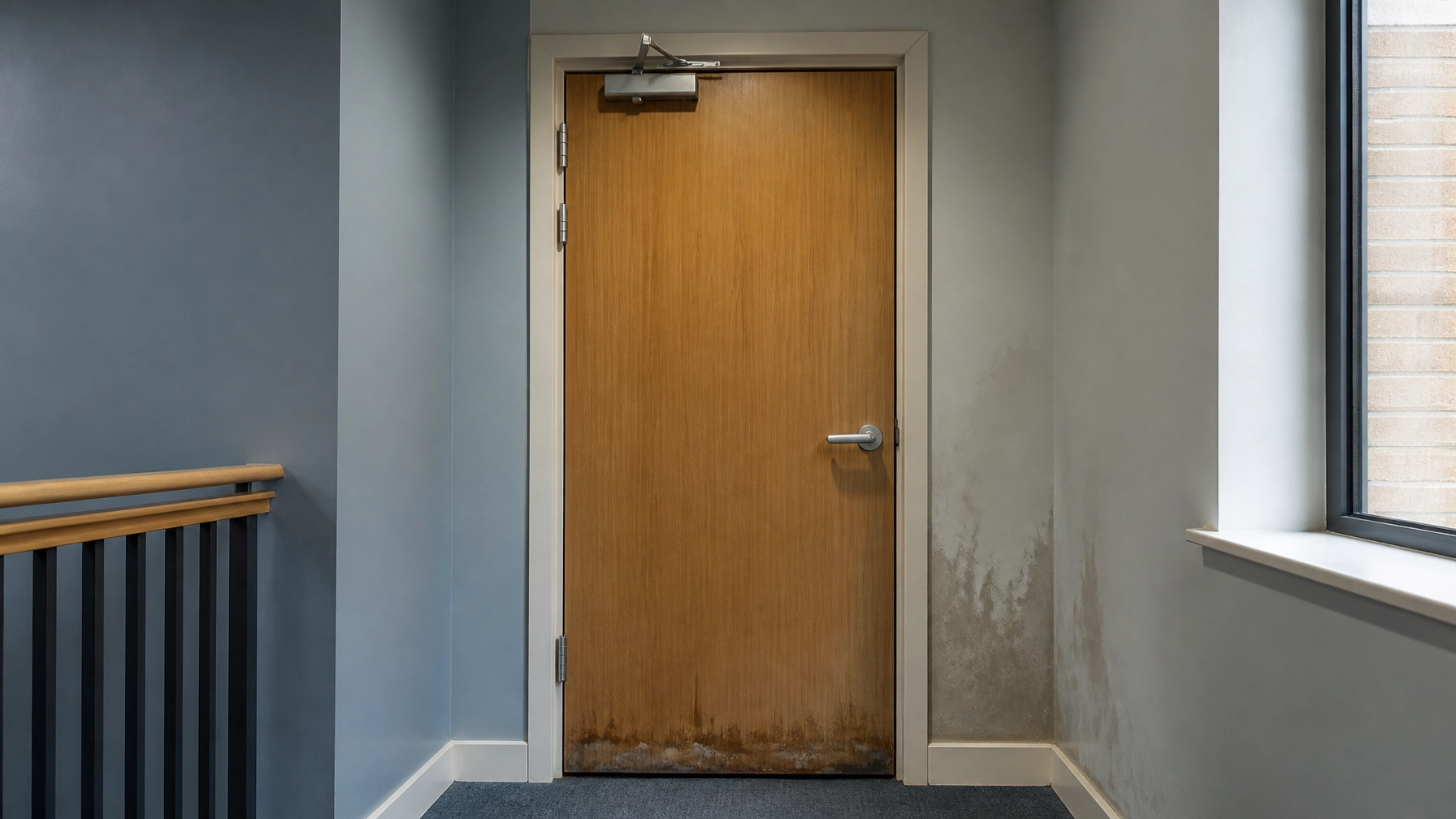
Water damage can affect far more than the appearance of a fire door. Leaks, flooding, damp, condensation and cleaning chemicals may alter the door leaf, frame, seals, hinges, closer and surrounding construction. These changes can prevent the complete doorset from performing as intended.
For landlords, sellers, HMO investors, flat managers, B&B operators and restaurant owners, the correct response is professional assessment rather than assumption. A qualified Fire Door Survey for Quotations can establish whether each affected doorset requires proportionate repair, an upgrade or replacement, while creating useful records for property management, sale discussions or insurance conversations.
Key Takeaways
- Recognise water-related defects: Swelling, warping, staining, corrosion and damaged seals may affect fire performance.
- Assess the complete doorset: The leaf, frame, hinges, closer, latch, seals and surrounding wall construction must be considered together.
- Prioritise professional advice: Do not assume that a dry-looking or operational door remains suitable after water damage.
- Prepare for property decisions: A documented Fire Door Survey for Quotations can support management, sale and insurance discussions without guaranteeing a particular outcome.
- Choose proportionate work: Affected doors may require Fire Door Repairs, an upgrade or a complete Fire Door Installation.
- Maintain compliance records: A signed compliance file provides a clearer record of decisions and completed work.
Table of Contents
- Understand the Legal Importance of Water-Damaged Fire Doors
- Identify How Moisture Affects the Complete Doorset
- Translate Water Damage into a Clear Action Plan
- Choose Repair, Upgrade or Replacement
- Prepare HMOs and Commercial Premises Properly
- Follow a Structured Professional Process
- Answer Common Water-Damage Questions
- Arrange Your Professional Survey
- Conclusion: Restore Confidence After Water Damage
Understand the Legal Importance of Water-Damaged Fire Doors
Fire doors form part of a building’s passive fire protection strategy. They help restrict the movement of fire and smoke, protect escape routes and support compartmentation when correctly specified, installed and maintained.
Under the Regulatory Reform (Fire Safety) Order 2005, the responsible person must ensure that relevant fire safety measures remain properly maintained. The Fire Safety Act 2021 also clarified the importance of fire safety responsibilities in multi-occupied residential buildings, including certain flat entrance doors and the building structure.
Water damage does not automatically mean that a property will fail a sale, an insurance discussion or an HMO licensing process. However, visible damage should be addressed promptly because the condition of the doorset may be questioned during a Fire Risk Assessment, property management review or professional survey.
A reliable record should explain:
- What damage was identified.
- Which doors and surrounding areas were affected.
- Whether the condition affected operation or fire performance.
- What professional recommendation was made.
- What remedial work was completed.
Identify How Moisture Affects the Complete Doorset
Moisture can affect different components at different rates. A door may appear usable while its seals, frame or fixing points have already deteriorated.
Assess the Door Leaf and Frame
Timber-based door leaves may swell, warp, split or delaminate after exposure to water. Damage commonly appears at the lower edge, around cut-outs, near the hinge side or where a leak has run down the face of the door.
Frames may also swell or move. This can alter the relationship between the leaf and frame, prevent reliable closing or create inconsistent gaps. A fire-rated doorset tested, assessed or classified to the relevant British Standard or other appropriate technical evidence depends on the complete installation, not the appearance of the leaf alone.
Review Seals, Hinges and Closers
Intumescent strips and smoke seals may become detached, compressed, contaminated or distorted by swelling. Cleaning products, paint and repeated moisture can also affect their condition.
Hinges may corrode or become loose where water has reached the fixing area. A door closer may lose reliable operation or become difficult to use. These components must work together so the door closes, latches and remains suitably positioned within its frame.
A professional survey can consider these issues using appropriate tools, including Fire Door Gap Gauges, Force Gauges and Digital Inclinometers. Property owners should not attempt technical adjustments without qualified advice.
Consider the Surrounding Construction
Water damage may extend beyond the door itself. Damp plasterboard, degraded linings, damaged architraves, movement around the frame or openings created for plumbing and cabling may affect the surrounding construction.
This is particularly important in:
- Kitchens and utility rooms.
- Bathrooms and shower areas.
- Basements and lower-ground entrances.
- Communal corridors and stairways.
- Restaurant back-of-house routes.
- Flat entrance doors.
- B&B bedrooms and shared circulation areas.
A fire-rated doorset cannot be assessed in isolation where the supporting construction has also been affected.
Translate Water Damage into a Clear Action Plan
A professional Fire Door Survey for Quotations converts a visible concern into a prioritised action plan. The survey can consider the water source, duration of exposure, visible damage, door operation, hardware, seals, frame and available documentation.
The resulting report may identify:
- Doors that show no apparent fire-related defect but require monitoring.
- Doors suitable for proportionate professional repair.
- Doors requiring compatible hardware or seal upgrades.
- Doors needing wider frame or surrounding construction work.
- Doors where replacement is the more appropriate solution.
- Areas requiring further investigation by a damp or building specialist.
This process is useful for landlords managing occupied properties, sellers preparing documentation, investors converting HMOs and business owners maintaining safe premises. It supports informed decisions without assuming that every affected door requires the same treatment.
Choose Repair, Upgrade or Replacement
Select Professional Repairs
Fire Door Repairs may be suitable where the door leaf and frame remain structurally appropriate and the damage can be addressed within the available technical evidence.
Potential repair considerations include damaged seals, compatible hardware, closer operation, hinge condition, frame alignment and localised deterioration. The precise recommendation must be made by qualified professionals because an apparently minor alteration can affect the tested or assessed configuration.
Relevant work should be considered against BS 476-22, BS 8214, the doorset manufacturer’s information and the findings of the property’s Fire Risk Assessment.
Arrange an Upgrade or Replacement
A Fire Door Upgrade may be suitable where the existing doorset provides a sound basis but requires compatible improvements to hardware, seals, closer arrangements or associated construction.
Replacement may be considered where water has caused substantial swelling, distortion, structural deterioration or damage that cannot be reliably restored. In some cases, the frame or surrounding construction may also require attention.
The decision should follow professional assessment. Water staining alone does not determine the outcome, and a visually clean door should not be assumed to remain suitable without review.
Prepare HMOs and Commercial Premises Properly
HMO investors should address water-related fire door risks early in the conversion programme. Kitchens, bathrooms, basements, plant areas and communal routes may experience higher exposure to leaks, condensation or cleaning activity.
Before letting rooms, investors should arrange a professional review of:
- Bedroom doors opening onto shared escape routes.
- Kitchen and utility-room doors.
- Basement and plant-room doors.
- Communal corridor and stairway doors.
- Flat entrance doors within multi-occupied buildings.
- Frames and walls affected by plumbing or damp.
- Hardware and seals exposed to repeated cleaning.
B&B operators and restaurant owners should also consider guest routes, kitchen access points, back-of-house corridors, storage areas and staff circulation routes. A clear Fire Door Installation programme should reflect the building’s FRA and the intended use of each area.
Follow a Structured Professional Process
Step One: Review the Damage
Elite Fire Door Installations begins by reviewing the affected areas, available FRA information and any details about the leak, flood, damp or cleaning damage. The condition of the complete doorset is considered rather than the door leaf alone.
Step Two: Receive a Clear Quotation
The recommended work is explained in a clear quotation. Where appropriate, repairs, upgrades and replacements are separated so that landlords, sellers, investors and business owners can make informed decisions.
Step Three: Complete Certified Work
Qualified specialists complete the agreed Fire Door Repairs, Fire Door Upgrades or Fire Door Installations using suitable components and professional equipment.
This may include Fire Door Gap Gauges, Intumescent Seal Routers, Hinge Jigs, Fire-Rated Packers, Laser Levels, Digital Inclinometers, Force Gauges and appropriate Intumescent Mastic or Sealant. Tools support precision, but they do not replace professional judgement or the relevant doorset evidence.
Step Four: Receive Compliance Documentation
At handover, the client receives records of the doors addressed, work completed and any relevant follow-up recommendations. A signed compliance file can support ongoing property management, future Surveys, sale discussions and insurance-related enquiries.
Answer Common Water-Damage Questions
Can a fire door remain suitable after a small leak?
Possibly, but this cannot be confirmed from the size of the leak alone. The duration of exposure, location of the moisture and condition of the leaf, frame, seals and hardware all matter. A professional Survey should determine the appropriate response.
Does swelling automatically mean the door must be replaced?
No. Some doors may be suitable for proportionate repair or an upgrade. Others may have damage that affects their structure or tested configuration. Only a qualified fire door specialist should recommend the correct option.
Can condensation damage fire door seals?
Yes. Persistent condensation can affect seals, timber components and hardware over time. The risk is greater where ventilation is poor or moisture is concentrated around bathrooms, kitchens and external entrances.
Will water damage automatically affect a property sale or insurance discussion?
No automatic conclusion should be drawn. A professional report and completed compliance records may help explain the condition of the doors and the action taken, but the final decision belongs to the relevant buyer, insurer or other professional adviser.
Should an HMO investor include water damage in the conversion programme?
Yes. Investors should consider previous leaks, damp-prone areas, plumbing routes and the condition of fire doors before completing the conversion. Early professional advice helps identify whether doors require repair, upgrade or replacement before occupation.
Arrange Your Professional Survey
If a fire door has been affected by flooding, leaks, damp, condensation or cleaning damage, arrange a professional Fire Door Survey for Quotations before making assumptions about its condition.
Elite Fire Door Installations provides clear advice, proportionate solutions and compliance documentation for landlords, sellers, HMO investors, flat managers, B&B operators and restaurant owners.
Visit the Elite Fire Door Installations website to learn more about professional Surveys, repairs, upgrades and installations.
Conclusion: Restore Confidence After Water Damage
Water damage can affect the complete fire-rated doorset, including the leaf, frame, seals, hinges, closer and surrounding construction. The correct response is not to rely on appearance or assumptions.
A professional Survey can identify the issue, prioritise the required work and establish whether repair, upgrade or replacement is appropriate. It can also create useful documentation for landlords, sellers, investors, managers and business owners.
By arranging qualified professional support and retaining a signed compliance file, property owners can manage water-related fire door concerns with greater clarity, safety and peace of mind.
Note: This information is intended as general guidance and does not constitute professional or legal advice. Always consult a qualified fire safety engineer for your specific property.
Email: info@elitefiredoorinstallations.co.uk
Specialist Support: +44 7514 898517
Request a call back: +44 20 4511 9456
Website: https://elitefiredoorinstallations.co.uk
Leave a Reply