

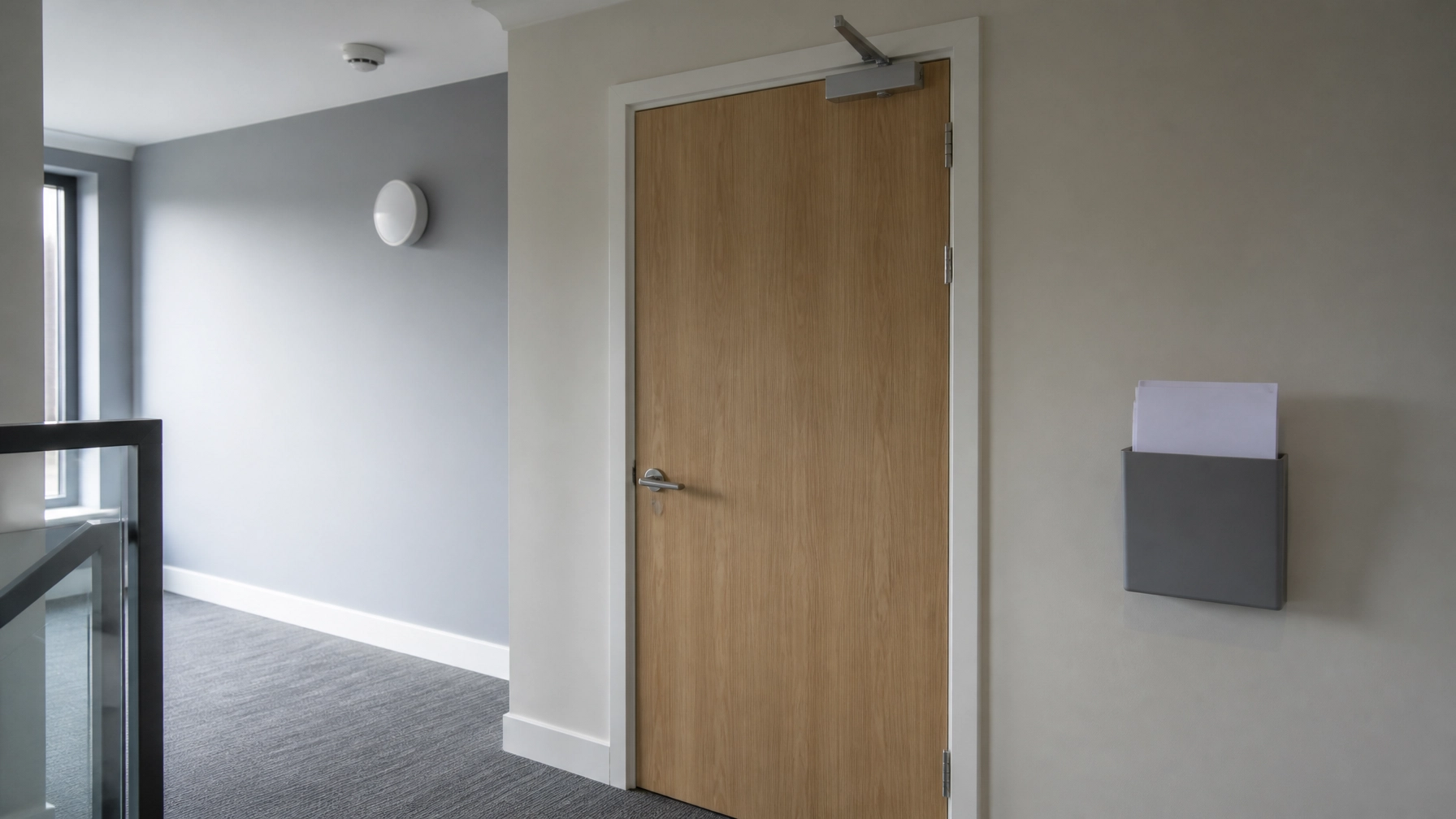
1. Understand Why Fire Door Records Matter
Fire-door records are an important part of responsible property management. They help landlords and property managers demonstrate that concerns were recorded, access was managed appropriately, professional advice was obtained and necessary work was addressed.
They do not automatically determine whether an eviction notice is valid, and a fire-door issue does not guarantee or prevent any particular legal outcome. Possession matters depend on their own facts and should be discussed with a qualified housing solicitor where necessary.
However, incomplete records can make it more difficult to explain how a property was managed when a tenancy dispute, local-authority enquiry or possession proceedings raise questions about safety.
Key Takeaways
- Keep accurate records for communal doors, flat entrances, HMO bedroom doors, guest areas and relevant service routes.
- Record concerns, access communications, professional Surveys, repair reports and signed compliance documents.
- Do not assume that a possession notice is invalid or enforceable because of a fire-door issue.
- Ask a qualified legal adviser about tenancy and possession questions.
- Use Certified Installers and qualified FRA assessors for fire-door compliance work.
- Arrange proportionate repairs or upgrades against the findings of a professional survey.
Explore This Guide
- Understand the legal context
- Translate fire-safety findings into action
- Choose proportionate repair or replacement
- Prepare HMOs, flats, B&Bs and mixed-use premises
- Follow a documented professional process
- Review frequently asked questions
- Request professional support
- Confirm the route forward
2. Understand the Legal Context
The Regulatory Reform (Fire Safety) Order 2005 places duties on the responsible person to maintain appropriate general fire precautions. In relevant buildings, this can include fire doors serving communal routes, protected stairways, shared lobbies and other areas forming part of the escape strategy.
The Fire Safety (England) Regulations 2022 guidance also sets out additional requirements for certain multi-occupied residential buildings, including recorded checks of communal fire doors and, where applicable, flat entrance doors.
The exact duties depend on the building, its height, use, fire strategy, occupancy and management arrangements. An HMO, block of flats, B&B, restaurant or mixed-use property may each have different fire-safety responsibilities.
Keep Evidence Without Making Legal Assumptions
A well-maintained compliance file can help show:
- When a fire-door concern was first reported.
- Who was informed and when.
- What access arrangements were offered.
- Whether access was refused, unavailable or rearranged.
- When a professional Fire Door Survey for Quotations was completed.
- What remedial work was recommended.
- When the work was completed.
- Whether follow-up confirmation was provided.
This evidence does not replace legal advice. It simply creates a clearer factual record for the landlord, managing agent, solicitor, local authority or other relevant party.
If a tenancy dispute or possession matter is already active, obtain appropriate legal advice before relying on fire-safety records or communicating about the dispute.
3. Translate Fire-Safety Findings into Action
A fire-risk assessment may identify a concern without providing a complete physical work schedule. For example, it may refer to defective self-closing devices, damaged doors, unsuitable gaps, missing seals or questionable fire-resisting performance.
A professional Fire Door Survey for Quotations can help translate those findings into a practical action plan.
Record Each Door Clearly
The resulting documentation should identify the relevant location and describe the concern in straightforward terms. Depending on the property, this may include:
- Communal corridor and stairway doors.
- HMO bedroom doors opening onto shared routes.
- Flat entrance doors.
- B&B guest-room and escape-route doors.
- Restaurant doors separating public, kitchen and service areas.
- Doors serving plant, storage or refuse areas.
The report should distinguish between an urgent safety concern, a repair requirement, a replacement recommendation and an issue requiring further technical assessment.
Connect Findings to Communications
If access is needed, retain copies of letters, emails or messages showing when access was requested and what appointment arrangements were proposed. Where access is not provided, record the dates and circumstances accurately.
Do not exaggerate, backdate or recreate records from memory without clearly identifying them as retrospective notes. Accurate records are more useful than extensive but uncertain paperwork.

4. Choose Proportionate Repair or Replacement
A door that does not meet requirements does not always require complete replacement. A qualified professional must assess whether the existing doorset can be repaired, re-lipped, upgraded or returned to an appropriate standard.
Elite Fire Door Installations provides professional Fire Door Repair and tailored Fire Door Installation services for property owners and managers.
Use Certified Professionals Only
Fire-door work should be completed by Certified Installers with the appropriate competence and understanding of the building’s fire strategy. A qualified FRA assessor may also be required to review the wider risk assessment and confirm whether the proposed action addresses the identified concern.
Professional work may involve specialist UK-standard equipment, including:
- Fire Door Gap Gauges.
- Intumescent Seal Routers.
- Hinge Jigs.
- Fire-Rated Packers.
- Certified Intumescent Mastic or Sealant.
- Suitable fire-rated hinges, closers and intumescent strips.
These tools should be used by competent professionals. This is not a DIY task, and improvised alterations can compromise the doorset or create unnecessary uncertainty.
Retain a Signed Completion Record
After work is completed, retain a clear report stating:
- Which doors were addressed.
- What work was undertaken.
- Which components were installed or renewed.
- Any limitations or follow-up recommendations.
- The date of completion.
- The name of the responsible contractor.
- Supporting photographs where appropriate.
5. Prepare Different Property Types
Prepare an HMO Before Occupation
Investors converting a property into an HMO should address fire-door requirements early in the project. The preparation may involve bedroom doors, communal kitchens, protected routes, stair enclosures and entrance doors.
Arrange a professional HMO Fire Door Upgrade review before the property is occupied. Coordinate the findings with the FRA, licensing requirements, insurer expectations and the intended management arrangements.
Review Flats and Communal Routes
For blocks of flats, the responsibility for flat entrance doors and communal doors may involve different parties. Clarify who manages each doorset and keep communications between freeholders, managing agents, leaseholders and contractors.
Address B&B and Mixed-Use Premises
B&Bs require attention to guest bedrooms, circulation routes and escape doors. Mixed-use buildings may also need careful separation between flats, restaurants, kitchens, storage rooms and service areas.
A single compliance file should not assume that every door has the same use or performance requirement. Each relevant doorset must be considered within the building’s overall fire strategy.

6. Follow a Documented Professional Process
Elite Fire Door Installations follows a clear process designed to reduce uncertainty and provide practical records.
Step One: Complete the Survey
A professional Fire Door Survey for Quotations establishes the condition of relevant doors and identifies proportionate actions. It should be considered alongside the FRA and any building-specific requirements.
Step Two: Issue a Clear Quotation
The written quotation should explain the proposed scope, identify the doors concerned and distinguish repair, upgrade and replacement recommendations. Clear documentation helps property managers organise access and communicate with occupants.
Step Three: Complete Certified Work
Certified Installers carry out the agreed work using appropriate materials, specialist tools and recognised standards, including BS 476-22 and BS 8214 where applicable.
Step Four: Handover the Compliance File
The handover should include signed completion records, relevant photographs, product information and any further recommendations. Keep the documents securely with the property’s wider fire-safety records.
7. Review Frequently Asked Questions
Can a fire-door problem automatically invalidate an eviction notice?
No. A fire-door concern does not automatically invalidate an eviction notice, and fire-door records do not guarantee a possession outcome. Tenancy and possession matters are fact-specific. Seek advice from a qualified housing solicitor.
Should landlords keep records of refused access?
Yes. Keep accurate records of access requests, proposed dates, cancellations, refusals and alternative arrangements. These records may help demonstrate the steps taken to manage the property, but they do not replace the need to resolve outstanding safety concerns.
Are HMO bedroom doors included in the compliance file?
They may be, particularly where they open onto a protected communal route or form part of the property’s fire strategy. A qualified FRA assessor and Certified Installers should determine the relevant scope.
Can a damaged fire door be repaired rather than replaced?
Sometimes. A competent professional must assess the doorset, its components, damage and specification. They can then recommend proportionate Fire Door Repair, upgrade or replacement work.
For further information about professional fire-door services, visit Elite Fire Door Installations.
8. Confirm the Route Forward
Accurate fire-door records support responsible property management. They help link reported concerns with access communications, professional surveys, completed works and signed compliance documents.
They do not decide tenancy disputes or possession proceedings, and no landlord should assume that a fire-door issue automatically determines the legal position. The safest route is to keep factual records, obtain legal advice where appropriate and use qualified FRA assessors and Certified Installers for technical work.
Whether the property is an HMO, flat, B&B, restaurant or mixed-use building, a clear review and documented action plan can provide reassurance for landlords, managers and residents.
Note: This information is intended as general guidance and does not constitute professional or legal advice. Always consult a qualified fire safety engineer for your specific property.
Contact Elite Fire Door Installations
- Email: info@elitefiredoorinstallations.co.uk
- Specialist Support: +44 7514 898517
- Request a call back: +44 20 4511 9456
- Website: https://elitefiredoorinstallations.co.uk
Leave a Reply