

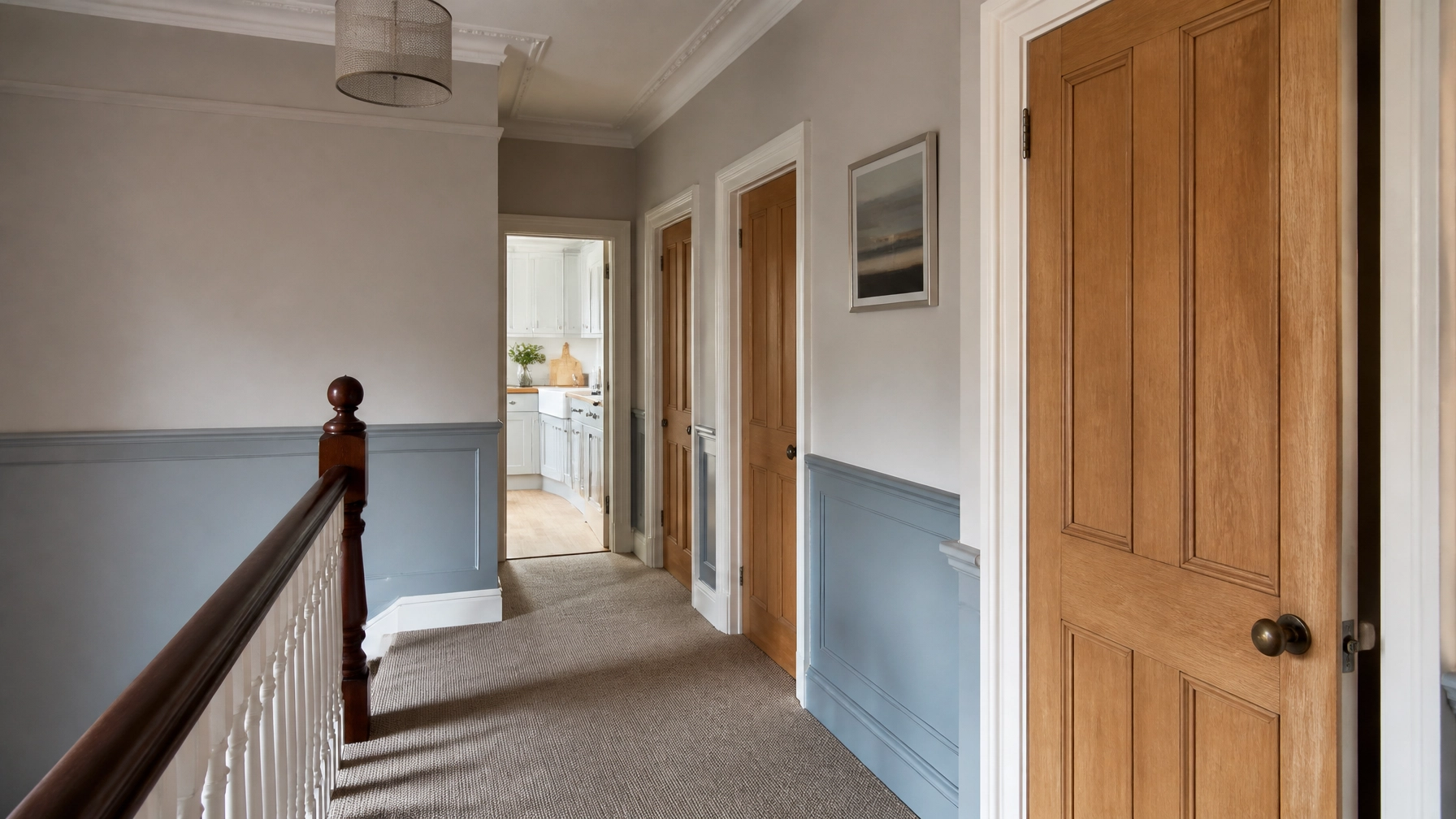
Whether you operate a B&B, guest house or holiday let, fire-door requirements depend on the property rather than its booking platform or marketing description. Building layout, guest numbers, escape routes, conversion history, kitchen arrangements and the findings of a suitable Fire Risk Assessment all influence the correct approach.
This practical guide explains what hosts should consider before opening, refurbishing or reconfiguring guest accommodation.
Key Takeaways
- Establish the required level of fire resistance through a suitable Fire Risk Assessment.
- Assess bedrooms opening onto shared halls, landings and stairways carefully.
- Give particular attention to kitchens, laundries, plant rooms and integral garages where relevant.
- Do not assume every holiday let requires the same door specification or rating.
- Use qualified fire safety professionals and competent, appropriately certified installers.
- Keep clear survey records, quotations, product information and signed compliance documentation.
- Arrange a professional Fire Door Survey before committing to renovation works.
Table of Contents
- 1. Understand Why Fire-Door Requirements Vary
- 2. Meet Your Legal Fire Safety Responsibilities
- 3. Translate Your FRA into a Clear Action Plan
- 4. Choose Proportionate Repair or Replacement
- 5. Prepare Your Guest Accommodation Before Opening
- 6. Follow a Professional Survey and Installation Process
- 7. Answer Common Fire-Door Questions
- 8. Take the Next Step with a Professional Review
- 9. Conclude with Confidence
1. Understand Why Fire-Door Requirements Vary
There is no single fire-door specification that applies to every B&B or holiday let. A small, simply arranged property may have different requirements from a larger guest house with several storeys, multiple bedrooms and longer escape routes.
A suitable Fire Risk Assessment should consider:
- The number of guests and bedrooms.
- The number of storeys and the building’s overall arrangement.
- Whether bedrooms open directly onto a shared corridor, landing or stairway.
- How guests reach the final exit.
- Whether the building was converted from another use.
- The position and construction of kitchens, laundries and service rooms.
- Any integral garage, boiler room or storage area connected to the accommodation.
- The alarm, emergency lighting and other fire safety measures already in place.
The result may be a requirement for fire-resisting doors, upgraded door sets, self-closing devices or improved separation in particular locations. It should not be assumed that every internal door requires the same treatment.
2. Meet Your Legal Fire Safety Responsibilities
Paying guest accommodation generally falls within the scope of the Regulatory Reform (Fire Safety) Order 2005. The person responsible for the premises must take reasonable steps to protect guests, staff and other relevant people from fire risks.
This is a risk-based duty. The law does not simply provide one universal door label for all B&Bs and holiday lets. Instead, the Responsible Person must ensure that suitable fire precautions are identified, implemented and maintained for the specific premises.
Faulty, damaged or unsuitable doors can create several problems:
- They may allow smoke and heat to spread into an escape route.
- They may undermine the conclusions of the Fire Risk Assessment.
- They may contribute to enforcement action or a requirement for remedial works.
- They may create concerns with insurers, licensing bodies, booking arrangements or future property transactions.
- They may increase potential liability if guests are exposed to avoidable risk.
Official guidance for small paying guest accommodation is available through the GOV.UK fire safety guide. More complex premises may require a more detailed assessment and specification.

3. Translate Your FRA into a Clear Action Plan
A Fire Risk Assessment may identify a concern in broad terms, such as an inadequate bedroom door, insufficient separation to a kitchen or an unprotected escape route. Turning that finding into an appropriate physical solution requires professional interpretation.
A qualified team can translate the report into a structured action plan by:
- Reviewing the FRA and any previous fire safety records.
- Surveying the relevant doors, frames, hardware and surrounding construction.
- Identifying which doors affect the escape strategy.
- Separating urgent remedial items from wider improvement works.
- Preparing a clear quotation with the proposed scope.
- Completing proportionate works and issuing a signed compliance file.
This approach prevents hosts from replacing doors unnecessarily while ensuring that important deficiencies are not overlooked. It also creates a clear link between the FRA findings, the work completed and the evidence retained for future review.
4. Choose Proportionate Repair or Replacement
Not every door that performs poorly must automatically be removed. The correct decision depends on its condition, construction, frame, hardware, history and role within the fire strategy.
Following a professional Fire Door Survey, a suitable solution may include:
- A targeted Fire Door Repair.
- Re-lipping or upgrading a suitable door where technically justified.
- Replacing incompatible or damaged hardware.
- Improving the frame or surrounding interface.
- Applying appropriate certified Intumescent Mastic/Sealant.
- Completing a full Fire Door Installation where repair is not suitable.
Professional repair can reduce disruption and avoid unnecessary replacement costs. However, it must be carried out by competent installers who understand fire-door performance and the limitations of individual door assemblies. A cosmetic improvement is not a compliance solution.
5. Prepare Your Guest Accommodation Before Opening
Hosts planning a purchase, conversion or refurbishment should include fire-door surveys and remedial works within the project budget from the outset.
Before welcoming guests, consider the following areas.
Protect Bedrooms Opening onto Shared Areas
Bedroom doors that open onto shared halls, landings or stairways may have an important role in protecting the escape route. The required arrangement depends on the building’s design and the FRA findings.
Do not rely on the appearance of a door alone. Its construction, frame, hardware and relationship with the surrounding wall all matter.
Separate Kitchens and Service Areas
Kitchens present a different level of risk from ordinary guest bedrooms. Commercial kitchens, laundry rooms, plant rooms and utility spaces may require additional fire separation.
Where an integral garage connects directly to the accommodation, the door and surrounding construction should also be considered as part of the overall fire strategy.
Review Entrance and Exit Arrangements
The main entrance, alternative exits and routes to safety should be considered together. A fire door cannot compensate for an unsuitable escape arrangement, and an effective escape route can be undermined by a poorly performing door.
Retain Evidence for Future Reviews
Keep the FRA, survey findings, quotation, invoices, product information, completion records and signed compliance documentation together. Good records demonstrate a managed approach and help future professionals understand what has been done.
Quick Compliance Cheat Sheet
Use this as a discussion prompt rather than a replacement for professional advice:
- Small, straightforward guest accommodation may have different requirements from larger or more complex premises.
- Bedrooms opening onto shared escape routes require particular attention.
- Kitchens and service rooms should be assessed as higher-risk areas.
- Do not assume one rating applies universally.
- Flats in buildings under 7 storeys and below 18 metres tall may generally be suitable for a specialist, provided they meet FRA, specification, insurer and contract requirements.
- Final decisions should be confirmed by a qualified fire safety professional and competent installer.

6. Follow a Professional Survey and Installation Process
A calm, documented process gives hosts greater certainty and helps control costs.
Step One: Complete the Survey
The team reviews the property layout, door locations, escape routes, frames, hardware and relevant FRA findings. This establishes which doors require attention and why.
Step Two: Provide a Fixed-Price Quotation
The quotation should distinguish between repair, upgrade and replacement options. It should explain the proposed work clearly, helping the host make an informed decision before works begin.
Step Three: Complete Certified Execution
Work should be completed by competent installers using appropriate UK-standard equipment. Depending on the project, this may include:
- Fire Door Gap Gauges.
- Intumescent Seal Routers.
- Hinge Jigs.
- Fire-Rated Packers.
- Digital Inclinometers.
- Force Gauges.
- Laser Levels.
- Certified Intumescent Mastic/Sealant.
- Suitable fire-rated hinges, closers and intumescent strips.
These tools support precision and consistency. They are part of a professional installation process, not a DIY checklist.
Where relevant, specifications may refer to BS 476-22 and BS 8214, alongside the product evidence, building design and conclusions of the FRA.
Step Four: Handover Compliance Documentation
On completion, the host should receive clear records confirming the work carried out. A signed compliance file can support future FRA reviews, insurance discussions, property management and licensing requirements.
7. Answer Common Fire-Door Questions
Do all holiday lets need FD30 fire doors?
No. Requirements depend on the property’s layout, occupancy, escape strategy, construction and FRA. Some smaller premises may be suitable for a different arrangement, while larger or more complex accommodation may require fire doors with specific performance and self-closing features. A qualified professional must determine the appropriate specification.
Do bedroom doors need self-closing devices?
Not necessarily in every property. The need for self-closing devices depends on the role of the door within the escape strategy and the findings of the FRA. Where a self-closing fire door is required, it must be selected and installed correctly by a competent installer.
Does a kitchen always need a fire door?
The kitchen should always be considered carefully because it can present a higher fire risk. The required door and separation depend on the kitchen’s size, use, position and relationship with escape routes. Commercial kitchens and associated service areas may require more robust separation than a small domestic-style kitchen.
Can an existing door be repaired?
Sometimes. A professional survey may identify an appropriate repair, re-lipping or hardware upgrade. In other cases, replacement will be necessary because the door, frame or surrounding construction cannot provide reliable performance. Only qualified professionals should make that decision.
What records should a host retain?
Retain the Fire Risk Assessment, professional survey, quotation, work details, product information, photographs where appropriate and signed completion documentation. These records help demonstrate that fire-door decisions were considered, proportionate and properly managed.
8. Take the Next Step with a Professional Review
If you are opening a new guest property, planning a conversion or responding to concerns raised in an FRA, begin with a professional review rather than an assumption.
Elite Fire Door Installations provides tailored Fire Door Surveys, Fire Door Installations, repairs and compliance documentation for property owners and accommodation operators.
Visit the Elite Fire Door Installations website to arrange a professional survey or discuss an installation.
9. Conclude with Confidence
B&Bs and holiday lets do not all require identical fire doors. The appropriate solution depends on the building, its use, its guests, its escape routes and the findings of a suitable Fire Risk Assessment.
A professional survey gives you a clear understanding of the issue. A transparent quotation helps you choose proportionate repairs or upgrades. Competent installation and signed compliance documentation provide a reliable record for future reviews.
By addressing fire doors early in your property plans, you can protect guests, support legal adherence and operate with greater peace of mind.
Note: This information is intended as general guidance and does not constitute professional or legal advice. Always consult a qualified fire safety engineer for your specific property.
Contact Elite Fire Door Installations
- Email: info@elitefiredoorinstallations.co.uk
- Specialist Support: +44 7514 898517
- Request a call back: +44 20 4511 9456
- Website: https://elitefiredoorinstallations.co.uk
Leave a Reply