

1. Understand the Risk Before Your Sale Stalls
A fire door issue often comes to light at a sensitive stage of the transaction: after an offer has been accepted, when a mortgage lender is reviewing the valuation, or when an insurer asks questions about the property.
For owners, landlords and buyers in Kent, including those dealing with properties in or around Royal Tunbridge Wells, a missing or unsuitable fire door can create a conveyancing query that is best addressed early. A surveyor may flag an unprotected stair route. A lender may request evidence that a loft conversion meets Building Regulations. An insurer may ask whether a garage entrance or flat entrance door provides the protection described in the policy.
These issues do not automatically void every insurance policy or stop every mortgage. More commonly, they may prompt further questions, lead to remedial conditions or cause delays while the position is clarified.
Key takeaways
- Recognise the sale risk: A third storey or loft conversion may require fire doors protecting the central stair escape route.
- Protect insurance validity: Integral garage and flat entrance doors must be suitable for their location, with compatible hinges, appropriate gaps and effective intumescent seals.
- Use competent professionals: UK fire safety duties require work to be undertaken by a competent person with suitable knowledge, training and experience.
- Understand FireQual: FireQual provides evidence of the individual installer’s technical competence. It is not the same as a company-level scheme such as BM TRADA Q-Mark.
- Avoid unnecessary replacement costs: A professional assessment may identify whether a door can be repaired, re-lipped or upgraded instead of replaced.
- Prepare evidence early: A clear survey report, quotation, completion record and compliance file can help reduce conveyancing uncertainty.
2. Resolve the Conveyancing Problem Before Completion
Identify the three-storey and loft conversion trap
A loft conversion can transform a property’s value, but it can also introduce additional fire safety requirements. When a conversion creates a third storey, the central staircase generally becomes a protected escape route. Rooms opening onto that route may need suitable fire-resisting doors, together with other measures such as appropriate alarms and protected construction.
The problem frequently appears during conveyancing. A mortgage valuation or building survey may identify:
- Ordinary domestic doors where fire doors appear to be required.
- Missing or ineffective self-closing devices.
- Damaged, discontinuous or unsuitable intumescent seals.
- Door leaves with excessive gaps or poor alignment.
- Hardware that does not appear compatible with the doorset.
- No clear evidence that the loft conversion was completed in accordance with Building Regulations.
The surveyor is not necessarily providing a detailed fire engineering assessment. They may simply identify an apparent risk or lack of documentation. That can still be enough for a lender or conveyancer to request clarification before proceeding, but it also means the issue can often be assessed and resolved in a practical, proportionate way.
Prepare the evidence a buyer will need
If you are selling a house with a loft conversion, locate the Building Control completion certificate and any fire door documentation before marketing the property. If the paperwork is incomplete or the doors have been altered since installation, arrange a professional Fire Door Survey for Quotations.
A competent specialist can establish whether the doors appear suitable for the intended fire strategy and identify any remedial work required. This gives you an opportunity to address concerns before they become a last-minute negotiation point.

3. Protect Insurance and Mortgage Approval
Address integral garage doors
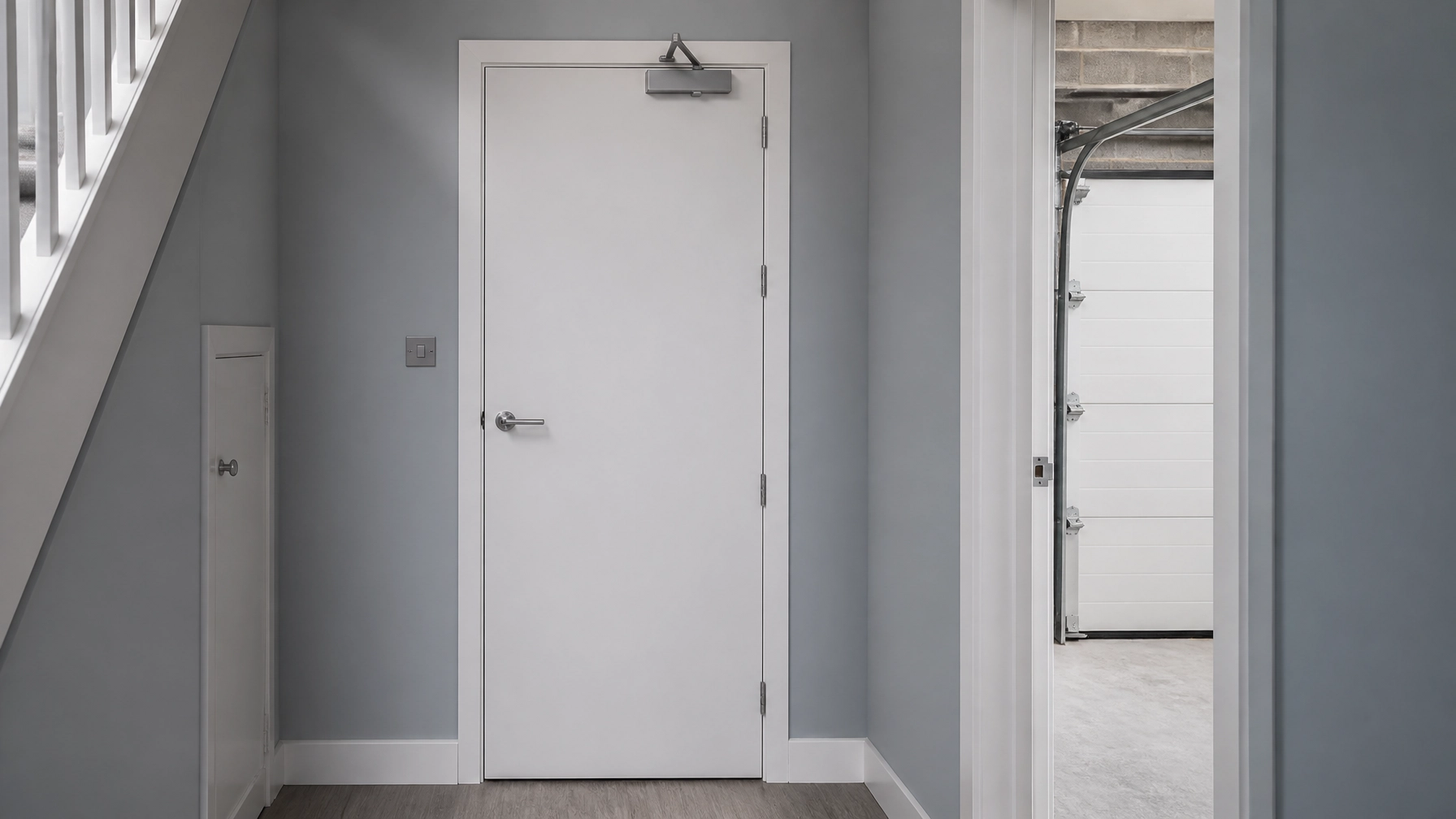
An integral garage creates a direct connection between a higher-risk area and the dwelling. The separating door is therefore a crucial part of the property’s fire protection.
A door that looks substantial is not necessarily a suitable fire door. The complete doorset must be considered, including:
- The door leaf and frame.
- Fire-rated hinges compatible with the doorset.
- The closing arrangement.
- Perimeter and threshold gaps.
- Intumescent and, where required, smoke seals.
- The manufacturer’s test evidence and installation requirements.
BS 8214 provides recognised good-practice guidance for specifying, installing and maintaining fire-resisting and smoke-control doors. It does not replace the requirements of Building Regulations, the property’s fire strategy or the insurer’s policy terms, but it provides an important technical context for competent work.
If an insurer discovers that an integral garage entrance is an ordinary hollow-core door, has unsuitable hinges, has damaged seals or does not close correctly, the insurer may ask whether the property has been maintained in accordance with its stated risk information. Depending on the policy wording and the circumstances of a claim, this could lead to:
- A request for remedial work.
- A policy exclusion.
- A discussion about increased risk.
- A review of claim handling.
- Additional underwriting conditions.
That is materially different from claiming that every defective door automatically voids every policy. Insurance decisions depend on the policy, the facts, disclosure requirements and the connection between the defect and any loss.
Review flat entrance doors carefully
A flat entrance door usually protects occupants from fire and smoke in a communal corridor or lobby. It must be suitable for the building’s fire strategy and properly installed as a complete doorset.
A replacement entrance door that has no effective self-closing device, unsuitable hinges, damaged seals or visibly excessive gaps can attract questions from managing agents, surveyors, insurers and lenders. In blocks where the top storey is above 11 metres, the Fire Safety (England) Regulations 2022 also introduce specific duties relating to flat entrance door checks.
Buildings under 18 metres are not exempt from fire door requirements. The 18-metre threshold is relevant to certain building safety matters, but it does not remove the need for a suitable flat entrance door where one is required by the building’s design and fire strategy.
Keep mortgage conditions in perspective
Mortgage lenders normally want confidence that the property is insurable, legally usable and not affected by a significant unresolved safety defect. A fire door concern may not mean an application will be refused, but it may delay approval while the lender requests:
- Building Control documentation.
- Product or doorset certification.
- A competent person’s report.
- Evidence of completed remedial work.
- Confirmation from the insurer or broker.
Resolving the issue before exchange is usually more controlled than attempting to deal with it between exchange and completion.
4. Distinguish FireQual from Corporate Certification
Understand the difference between person and process
UK fire safety law requires relevant work to be carried out by a competent person. Competence involves appropriate knowledge, training and practical experience. It is not created simply by hiring a large company or displaying a corporate badge.
FireQual supports evidence of the actual installer’s competence. It relates to the individual specialist carrying out the practical work on the property: the person specifying compatible components, fitting the doorset and recording the completed work.
BM TRADA Q-Mark is different. It is a company-level third-party certification scheme that assesses an organisation’s systems, procedures, documentation and quality controls. Such schemes can be highly relevant to major contractors, large high-rise programmes, public-sector frameworks and substantial procurement exercises.
Neither scheme should be presented as a universal legal shortcut. A FireQual certificate alone does not make an unsuitable product compliant, and Q-Mark does not remove the need for correct installation. The door, hardware, fire strategy, specification and workmanship still need to be appropriate for the property.
Apply the FireQual suitability guide
For many private-sector projects, an individual FireQual-certified specialist is a proportionate and cost-effective choice, subject to the FRA, technical specification, insurer requirements and contract conditions.
This generally includes:
- Most private-sector HMOs and shared houses.
- B&Bs and guest houses.
- Small offices and shops.
- Small private schools.
- Flats in buildings under seven storeys and below 18 metres tall.
Large council schools and major public-sector tenders may specify Q-Mark or an equivalent company-level scheme because of procurement requirements. That is a commercial or contractual requirement, not proof that every domestic property requires a large corporate contractor.
Elite Fire Door Installations is positioned as a FireQual-certified sole trader, not as a BM TRADA Q-Mark-registered company. This model provides direct accountability, practical specialist attention and a proportionate route for domestic properties, landlords and many smaller private-sector buildings.
5. Prepare Your Kent Property Before Sale or Letting
Budget for fire door work during a loft conversion
Property investors should address fire doors at the design and budgeting stage, not after the conversion is complete. Allow for suitable doorsets, compatible hardware, frames, seals, closers and professional installation along the protected stair route.
If a conversion has already been completed, do not assume that painted doors or recently fitted handles demonstrate compliance. Arrange a professional Fire Door Installation or survey quotation where the existing arrangement is uncertain. In many cases, the right next step is simply to confirm what is already suitable and identify any proportionate remedial work.
Allow for garage and entrance door remediation
Budget for the possibility that an integral garage door or flat entrance door may need more than a new leaf. The surrounding frame, hinges, closer, seals and fixing arrangements may all affect the performance of the completed doorset.
A professional Fire Door Repair may be appropriate where the existing door is structurally suitable. Where it is not, a certified replacement may be necessary. The aim is to choose the most appropriate solution for the property rather than assume full replacement is always required.
Avoid buying a compliance problem
Before purchasing an investment property, ask for:
- The current FRA, where applicable.
- Building Control completion certificates for loft conversions or alterations.
- Fire door schedules and product information.
- Records of previous remedial work.
- Details of any insurer or lender requirements.
- Confirmation of the intended HMO layout and licensing conditions.
A pre-purchase Fire Door Survey for Quotations can help you identify likely costs before committing to the purchase. It cannot replace legal conveyancing advice or a formal FRA, but it can prevent fire door costs from being overlooked in the renovation budget.
6. Choose a Certified, Documented Solution
Follow a controlled professional process
Elite Fire Door Installations applies a clear process for owners, landlords and buyers who need reliable evidence. The process is designed to keep decisions straightforward and well documented.
Step One: Arrange a survey
We review the relevant doors, frames, hardware and available documentation. The findings are matched against the intended use, fire strategy, applicable specification and recognised standards including BS 476-22 and BS 8214.
Step Two: Receive a fixed-price quotation
Where remedial work is required, the quotation separates repair, upgrade and replacement options. This helps property owners avoid paying for full replacement where a structurally suitable door can be professionally restored and makes the available choices easier to understand.
Step Three: Complete certified work
A FireQual-certified specialist carries out the agreed work using appropriate UK-standard equipment and compatible components. This may include Fire Door Gap Gauges, Intumescent Seal Routers, Hinge Jigs, Fire-Rated Packers, Digital Inclinometers, Force Gauges, Laser Levels and certified Intumescent Mastic/Sealant.
These tools support precision. They do not replace professional judgement, product test evidence or the manufacturer’s installation requirements.
Step Four: Receive the compliance file
The handover should clearly record the work completed, relevant products, door references and any limitations or recommendations. Retain this file with your property documents and provide it to your conveyancer, insurer, managing agent or licensing officer where appropriate.

7. Answer the Questions That Delay Transactions
Can a missing fire door automatically void my home insurance?
No single answer applies to every policy. A missing or defective door may lead to insurer questions, exclusions or a claims discussion if the condition is relevant to the risk or to the loss. Ask your insurer or broker for written clarification and arrange competent remedial work where required.
Will a loft conversion always stop my mortgage?
Not necessarily. However, a third storey without suitable protection to the central stair escape route can be flagged by a surveyor or lender. Missing Building Control records and visibly unsuitable doors can increase the risk of a mortgage condition or conveyancing delay.
Does FireQual guarantee that my property is legally compliant?
No. FireQual provides evidence of the individual specialist’s competence. Compliance also depends on the correct doorset, specification, fire strategy, installation, maintenance and documentation. Project and contract requirements must still be satisfied.
Do domestic properties require BM TRADA Q-Mark?
Not usually as a universal legal requirement. FireQual is generally suitable for many private-sector HMOs, shared houses, B&Bs, guest houses, small offices, shops, small private schools and flats under seven storeys and below 18 metres, subject to the project requirements. Large public-sector tenders may require Q-Mark or an equivalent scheme.
Should I replace a defective garage or flat entrance door?
Not automatically. A qualified specialist should determine whether the existing doorset can be repaired, re-lipped or upgraded, or whether replacement is necessary. Do not attempt DIY modifications, hinge changes or seal fitting, because incompatible work can undermine the doorset’s tested performance.

8. Request a Professional Survey Before the Sale Stalls
If a lender, conveyancer, surveyor or insurer has raised a fire door concern, early action gives you more options. Elite Fire Door Installations can provide a professional survey quotation, targeted remediation or a complete certified installation, depending on the property and the evidence available.
For Kent property owners, landlords and buyers, the practical objective is straightforward: identify the issue, confirm the appropriate solution and retain a clear compliance file.
If you are a local property owner in East Sussex or the wider South East, contact Elite Fire Door Installations for rapid fire door upgrades, remediation and signed compliance files before your sale stalls. Many concerns can be resolved through proportionate repair, upgrade or replacement, supported by clear documentation.
You can also visit Elite Fire Door Installations to request a professional survey or discuss a compliant installation.
9. Conclude With Evidence, Not Assumptions
A fire door issue may begin as a small physical concern, but it can still become an important property matter when it appears during a house sale, mortgage application or insurance review.
Loft conversions, third-storey stair routes, integral garages and flat entrances all require careful consideration. Appropriate fire-resisting doorsets, compatible hinges, effective intumescent seals and suitable gaps must be assessed as part of the complete installation. BS 8214 provides an important benchmark for competent specification, installation and maintenance, while BS 476-22 remains relevant to fire-resistance test evidence.
FireQual is a practical way to evidence the competence of the individual specialist working on many private-sector properties. It is not a substitute for a suitable product or correct workmanship, and it does not replace project-specific requirements. Where a contract requires Q-Mark or an equivalent corporate scheme, that requirement must be followed.
For most owners, the sensible first step is a professional survey and clear quotation. Addressing concerns before exchange, completion or letting can protect your timetable, reduce uncertainty and provide greater peace of mind. If you are based in East Sussex or elsewhere in the wider South East, contact Elite Fire Door Installations for rapid fire door upgrades, remediation and signed compliance files before your sale stalls. The process is straightforward, and many issues can be resolved through proportionate repair, upgrade or replacement once the property has been properly assessed.
Note: This information is intended as general guidance and does not constitute professional or legal advice. Always consult a qualified fire safety engineer for your specific property.
- Email: info@elitefiredoorinstallations.co.uk
- Specialist Support: +44 7514 898517
- Request a call back: +44 20 4511 9456
- Website: https://elitefiredoorinstallations.co.uk
Leave a Reply