

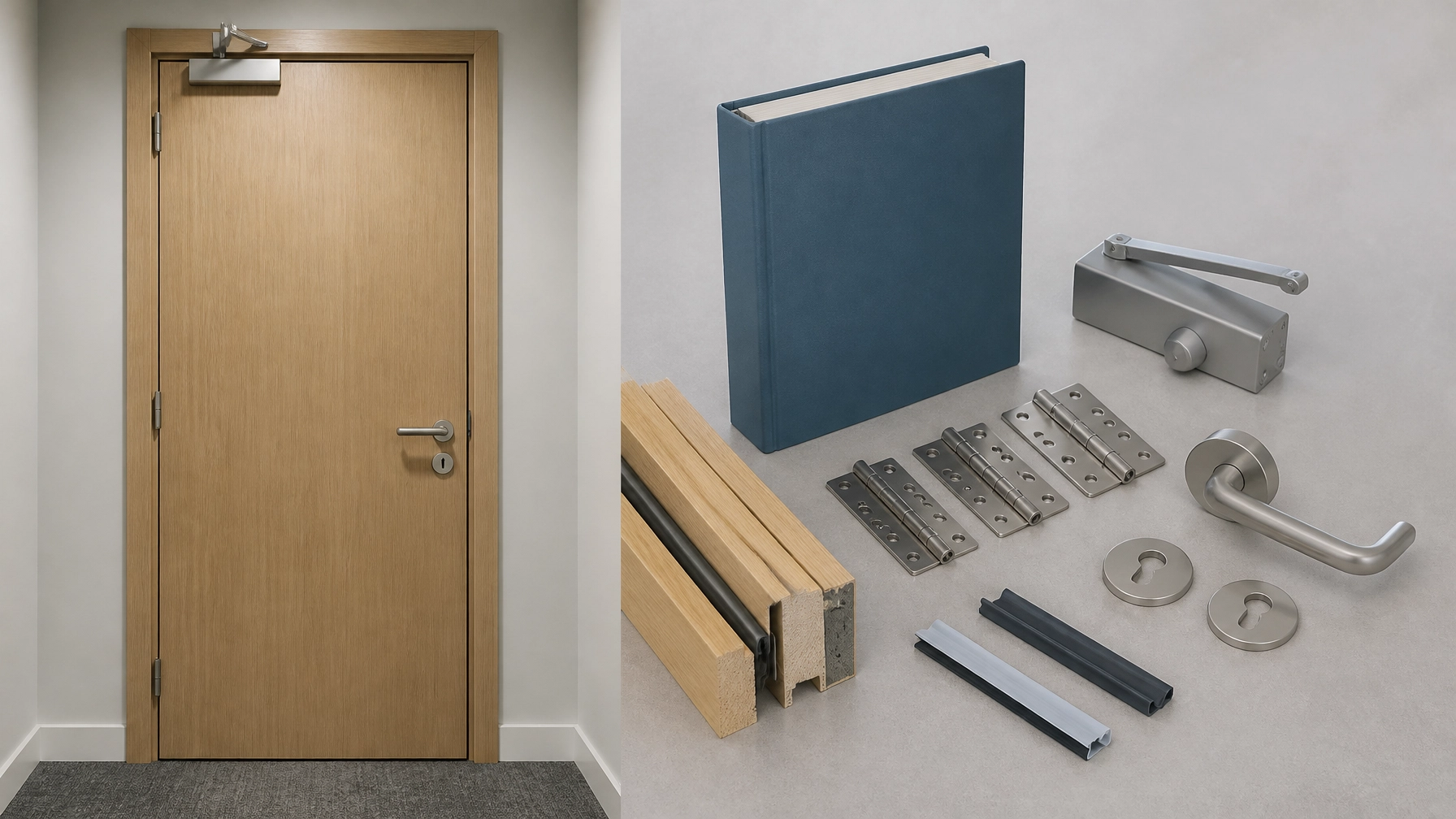
A fire door is not simply a door leaf. It is a complete doorset designed to work as one tested or technically supported assembly. For property owners, landlords, HMO managers, flat owners, managing agents and business operators, understanding the relevant British Standards helps clarify what evidence is required and when professional action is necessary.
1. Understand the Legal and Practical Context
Protect the complete fire compartment
A fire-rated doorset may include:
- The door leaf and frame
- Hinges, latches and self-closing devices
- Intumescent and smoke seals
- Glazing, where applicable
- Letterplates or other apertures, where relevant
- The surrounding wall and supporting construction
- Compatible installation materials and fixing methods
Each component must be suitable for the doorset and supported by appropriate technical evidence. A tested leaf fitted with incompatible hardware cannot automatically be treated as a compliant assembly.
Fire safety duties may arise under the Regulatory Reform (Fire Safety) Order 2005, the Fire Safety Act 2021, Building Regulations, licensing conditions, insurance requirements and the building’s fire strategy. The exact obligations depend on the property type, its use, construction and responsible person.
For buildings covered by Approved Document B in England, national fire-resistance classifications are subject to a transition towards the European classification route. Current government guidance identifies 2 September 2029 as an important date for the withdrawal of national classes from Building Regulations guidance. Property owners should therefore review future projects carefully rather than relying on one historic document or rating.
The safest approach is to consider standards, legislation, the Fire Risk Assessment (FRA), manufacturer evidence, building design and professional advice together.
2. Decode Your FRA Report
An FRA may identify issues such as unsuitable fire doors, damaged frames, missing seals, incompatible hardware, inadequate self-closing action or a lack of supporting documentation. It does not always specify the exact physical solution for every opening.
Elite Fire Door Installations does not conduct Fire Risk Assessments. However, we can review client-provided FRA information and translate relevant fire door findings into a clear physical scope through professional Fire Door Surveys for Quotations.
Convert findings into a prioritised action plan
A professional review considers:
- The location and function of each doorset
- The required fire and smoke performance
- The existing leaf, frame and surrounding construction
- The suitability of hinges, closer, latch, seals and glazing
- Available manufacturer or test evidence
- Whether proportionate repair, upgrade or replacement is appropriate
- The documentation required at handover
This process supports targeted FRA Remediation rather than unexplained or unnecessarily extensive work.

3. Distinguish Repair from Replacement
A failed fire door does not always require complete replacement. Equally, a door with serious damage, unsuitable construction or no defensible evidence may not be suitable for repair.
Elite Fire Door Installations assesses the available evidence and the physical condition of the doorset before recommending a proportionate solution. Depending on the circumstances, work may include professional repair, re-lipping, hardware upgrades, replacement seals, frame remediation or a new Fire Door Installation.
All work must be completed by qualified professionals and Certified Installers using compatible components. No single repair can create compliance where the wider doorset assembly is unsuitable.
Preserve evidence and performance
The relevant question is not simply whether the door looks new. The question is whether the complete fire-rated doorset is:
- Appropriate for its location
- Supported by suitable evidence
- Correctly specified
- Professionally installed
- Maintained with a clear record
Where physical defects cannot be resolved proportionately, a replacement doorset may provide the clearer compliance route. Where the existing assembly remains suitable, professional Fire Door Repairs may restore function and support continued fire performance.
4. Prepare Different Property Types Correctly
Fire door requirements vary according to the use and layout of a building. Property owners should identify fire door requirements early during sales, refurbishment, letting, licensing or management handover.
Prepare houses and HMOs
For an HMO conversion, consider bedroom doors, protected routes, communal areas, kitchens, service risers and doors opening onto escape routes. The FRA, licensing requirements, building’s fire strategy and relevant technical evidence must be considered together.
A tailored HMO Fire Door Upgrade programme should be planned before occupation and supported by a signed compliance file.
Prepare flats and flat entrance doors
Flat entrance doors form part of the separation between an individual dwelling and common areas. Their performance, self-closing arrangement, smoke control requirements and compatibility with the surrounding frame must be considered within the building’s wider fire strategy.
Flats in buildings under seven storeys and below 18 metres tall may generally be suitable for a specialist solution, provided the FRA, specification, insurer and contract requirements are satisfied.
Prepare B&Bs, restaurants and mixed-use buildings
B&Bs and guest houses may contain sleeping accommodation, communal routes and staff areas. Restaurants may have kitchens, storage areas, plant rooms and escape routes with different fire-separation needs. Mixed-use buildings require particular care where residential, commercial and communal areas meet.
Clear test evidence, professional Surveys and signed handover records may assist with:
- Property sales and purchaser enquiries
- HMO licensing
- Insurance discussions
- Refurbishment approvals
- Letting and management handover
- Ongoing maintenance planning

5. Apply the Relevant British Standards
Use BS 476-22 correctly
BS 476-22 is a national fire-resistance test method for non-loadbearing elements, including fire doors, screens and other assemblies. It assesses performance under controlled furnace conditions.
In plain English, integrity means the assembly continues to prevent flames and hot gases from passing through for the required period. FD30 and FD60 are examples of fire-resistance periods. They are not universal requirements for every property or door location.
For applicable work in England, BS 476-22 evidence remains relevant during the current transition arrangements. However, property owners should obtain project-specific advice, particularly for new work expected to remain in service beyond the transition period.
Understand BS EN 1634-1 and BS EN 13501-2
BS EN 1634-1 is a fire-resistance test standard for doorsets, shutters and openable windows. It describes how the assembly is tested; it is not itself the classification.
BS EN 13501-2 is the classification standard. It uses suitable fire-resistance test evidence to establish classifications such as E30, EI30 or EI60. Smoke classifications, including Sa or S200, may be relevant where smoke-control performance is required.
A classification reference alone does not prove that a particular installed doorset is suitable. The classification must be understood alongside the test report, field of application, manufacturer information, components and installation details.
Consider hardware and timber assemblies
BS EN 1634-2 covers the fire-resisting characteristics of hardware where relevant. This reinforces the need to select compatible hinges, latches, locks, closers and other components.
BS EN 1634-3 relates to smoke-control testing for doorsets and should only be relied upon where smoke-control performance is required and supported by appropriate evidence.
BS 8214 is the code of practice for the specification, installation and maintenance of timber-based fire door assemblies. Passing a fire test does not guarantee that an installed doorset will perform if it is fitted incorrectly or combined with incompatible components.
The correct terminology is:
A fire-rated doorset tested, assessed or classified to the relevant British Standard or other appropriate technical evidence.
A British Standard is the technical reference. The fire-rated doorset is the complete product used for installation, upgrade or remedial works.

6. Follow a Professional Compliance Process
Elite Fire Door Installations uses a structured process for property owners and responsible organisations.
Step One: Review and Survey
We review available FRA information, drawings, schedules, product details and site requirements. A professional Survey for Quotations then establishes the physical scope.
Step Two: Provide Clear Quotation Information
The proposed work is explained clearly, including the relevant doorsets, evidence requirements, component compatibility and documentation to be provided.
Step Three: Complete Certified Installation or Remediation
Qualified professionals use appropriate UK-standard equipment, such as:
- Fire Door Gap Gauges
- Intumescent Seal Routers
- Hinge Jigs
- Fire-Rated Packers
- Digital Inclinometers
- Force Gauges
- Laser Levels
- Certified Intumescent Mastic and Sealant
These tools support precision. They do not replace the need for technical evidence, competent installation or a suitable fire strategy.
Step Four: Handover the Compliance File
The final handover should identify the work completed, relevant products, supporting evidence and any limitations or future requirements. A signed compliance file gives property owners a clear record for management, licensing, insurance discussions and future refurbishment.
7. Answer Common Questions
Does a fire door leaf prove that the whole installation is compliant?
No. The leaf is only one part of a complete doorset. The frame, hinges, closer, latch, seals, glazing, surrounding construction and installation must be compatible and supported by appropriate evidence.
Is FD30 suitable for every HMO bedroom door?
No. FD30 is an example of a fire-resistance period, not a universal specification. The appropriate performance depends on the FRA, building layout, fire strategy, licensing conditions and technical evidence.
Is BS EN 1634-1 a classification?
No. BS EN 1634-1 provides the fire-resistance test method. Classification is addressed through BS EN 13501-2 and must be considered alongside the underlying test evidence.
Can a landlord combine components from different doorsets?
Not without suitable technical justification. Components must be compatible with the complete assembly. A Certified Installer should assess the evidence before any upgrade or replacement is specified.
Can Elite Fire Door Installations complete my Fire Risk Assessment?
No. We do not conduct FRAs. We can review client-provided FRA information and provide a physical scope for Fire Door Installation, repairs, upgrades or remediation.
8. Take the Next Compliance Step
Whether you are selling a house, preparing an HMO, managing flats, operating a B&B or refurbishing a restaurant, clear fire door evidence supports confident decision-making.
Arrange a professional review, receive a clear scope and progress proportionate remedial work with a signed compliance file.
For further information about Elite Fire Door Installations and our specialist services, visit https://elitefiredoorinstallations.co.uk/.
9. Conclusion
British Standards provide essential technical references for fire door testing, classification, specification and installation. They do not operate in isolation, and no single standard automatically guarantees that an installed doorset is compliant.
Property owners should treat the fire door as a complete assembly, obtain suitable evidence, use compatible components and appoint qualified professionals for Surveys, installation, repairs and remediation. With a structured review and documented handover, fire door compliance can be managed calmly, proportionately and with greater confidence.
Note: This information is intended as general guidance and does not constitute professional or legal advice. Always consult a qualified fire safety engineer for your specific property.
Email: info@elitefiredoorinstallations.co.uk
Specialist Support: +44 7514 898517
Request a call back: +44 20 4511 9456
Website: https://elitefiredoorinstallations.co.uk
Leave a Reply