

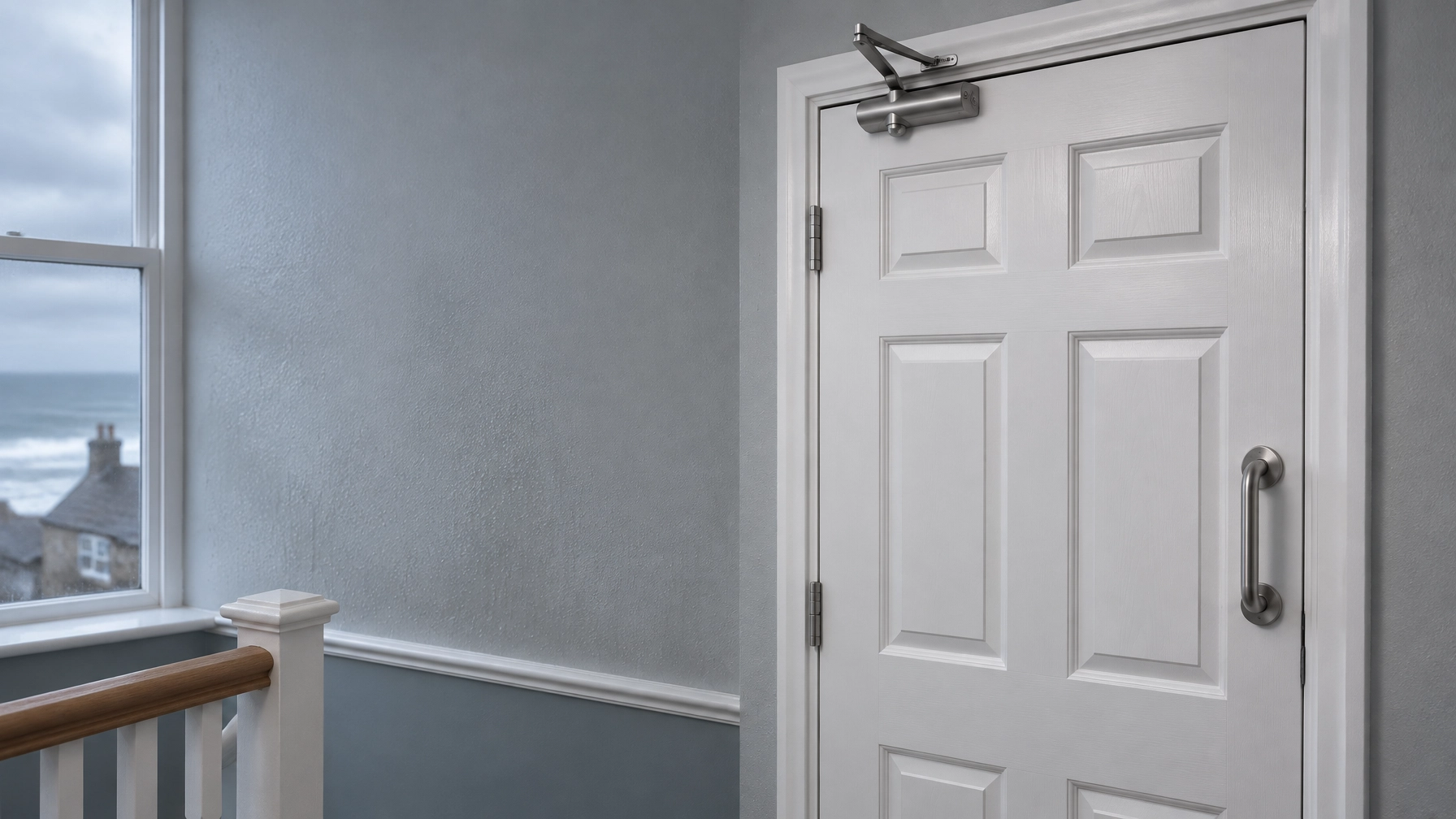
Salt air, humidity and sea spray can quietly weaken fire door hardware. Discover how coastal conditions affect hinges, closers, seals, fixings and frames, and why professional surveys are essential for maintaining compliance.
Coastal properties experience environmental conditions that can accelerate the deterioration of fire door components. Salt particles carried in the air can settle on metal surfaces, while damp conditions can affect timber frames, seals, fixings and door alignment.
For landlords, HMO investors and property managers, this deterioration may not be immediately obvious. A hinge can begin to corrode internally. A door closer may gradually lose control. A frame can swell slightly and prevent the door from closing correctly. By the time the problem becomes visible, the complete doorset may no longer perform as intended.
A fire-rated doorset tested, assessed or classified to the relevant British Standard must remain properly maintained throughout its service life. Coastal exposure makes professional Surveys and planned maintenance particularly important.
Key Takeaways
- Recognise that salt air and damp can affect every part of a fire doorset.
- Understand that corroded hardware may prevent a door from closing, latching or maintaining compartmentation.
- Arrange a professional Fire Door Survey for Quotations before specifying remedial work.
- Use qualified professionals for all repairs, upgrades and installations.
- Consider coastal exposure when preparing an HMO, flat, guest accommodation or other rental property.
- Retain a signed compliance file showing the survey findings, completed works and maintenance recommendations.
Table of Contents
- Understand the Legal Duty and Coastal Risk
- Decode How Salt Air Damages Fire Door Components
- Translate Your FRA Report into a Practical Action Plan
- Choose Proportionate Repair, Upgrade or Replacement
- Prepare Coastal HMOs Before Letting
- Follow a Professional Coastal Compliance Process
- Answer Common Questions
- Arrange Professional Support
- Reach a Practical Conclusion
Understand the Legal Duty and Coastal Risk
The responsible person has a duty to keep fire safety measures in effective working order and good repair. This duty is established through the Regulatory Reform (Fire Safety) Order 2005, with further clarification provided by the Fire Safety Act 2021.
Fire doors form part of a wider fire safety strategy. They may help protect escape routes, support compartmentation and limit the movement of fire and smoke between areas. If corrosion causes a door to drag, remain open or fail to latch, the doorset may not provide its intended level of protection.
Coastal exposure does not remove the landlord’s or property manager’s legal responsibilities. Instead, it creates an environmental factor that should be considered when completing the Fire Risk Assessment, selecting hardware and planning maintenance.
The risk can be greater in:
- Properties close to open sea or exposed waterfronts.
- HMOs with frequently used communal doors.
- Buildings with damp entrance halls, unheated stairwells or open access balconies.
- Doors exposed to wind-driven rain or sea spray.
- Older properties with timber frames or previously corroded fixings.
Hardware corrosion can progress quietly. A doorset may look acceptable from a distance while hinges, closer mechanisms or fixing points are already deteriorating.
Decode How Salt Air Damages Fire Door Components

Protect Hinges from Corrosion
Hinges carry the door leaf and allow it to move within the frame. Salt deposits and moisture can cause corrosion around hinge pins, knuckles and fixing screws.
As corrosion develops, hinges may become stiff or lose strength. This can cause the door to drop, bind against the frame or place additional pressure on the closer. A door that no longer moves freely may fail to close and latch reliably.
The correct hinge specification should be assessed against the doorset, exposure conditions and relevant performance requirements. Substituting standard hardware without professional assessment can compromise the tested assembly.
Maintain Reliable Door Closers
Door closers are essential to controlled closing. Coastal damp and airborne salt can affect the closer body, arm, fixings and internal mechanism.
A deteriorating closer may:
- Lose control over the closing cycle.
- Become stiff or inconsistent.
- Leak or suffer internal corrosion.
- Fail to bring the door fully into the frame.
- Place excessive force on hinges, latches or fixings.
A door closer that appears to operate occasionally may still be unreliable. Fire door performance depends on consistent operation, not occasional success.
Protect Intumescent and Smoke Seals
Intumescent and smoke seals can be affected by moisture, dirt, salt deposits, decorating products and timber movement. Damp conditions may also contribute to swelling or distortion around the door edge and frame.
A seal that is loose, damaged, contaminated or displaced may not perform as required. The surrounding frame can also affect the seal if it becomes swollen, cracked or distorted.
Do not remove, trim, paint over or replace seals without professional advice. The appropriate product must be compatible with the doorset and its tested, assessed or classified specification.
Check Fixings and Frames
Fixings may corrode beneath plates, hinges, closers and latches even when the visible surface appears intact. Incompatible metals can also contribute to accelerated corrosion in damp, salt-laden environments.
Timber frames may absorb moisture and swell. Steel frames may develop surface rust, coating failure or corrosion around fixing points. These conditions can alter clearances and affect the way the door closes.

Translate Your FRA Report into a Practical Action Plan
A Fire Risk Assessment may identify defective or unsuitable fire doors, but it may not specify the exact physical remedy for each doorset. A professional Survey translates the finding into a prioritised action plan.
The Survey should consider:
- The door leaf, frame and surrounding construction.
- The condition of hinges, closers, latches and fixings.
- Evidence of corrosion, damp, swelling or distortion.
- Whether the door closes and latches consistently.
- The condition and compatibility of intumescent and smoke seals.
- The building’s coastal exposure and maintenance arrangements.
- Existing product information and records.
- Whether the doorset remains suitable for its intended location.
The outcome should distinguish between defects requiring prompt action, matters suitable for planned remedial work and doorsets requiring further fire safety or engineering advice.
This evidence-led approach helps prevent two common errors. The first is assuming that a door is compliant because it looks intact. The second is replacing every door without first establishing whether a proportionate professional solution is possible.
Choose Proportionate Repair, Upgrade or Replacement
Restore Suitable Doors
A professional Fire Door Repair may be suitable where the door leaf and frame remain appropriate but coastal exposure has affected hardware, seals, fixings or alignment.
Depending on the doorset, remedial work may include compatible hardware replacement, professionally assessed door-edge work, re-lipping or other specialist repairs. The work must be based on the doorset’s construction and supporting evidence.
Upgrade Where Appropriate
A tailored HMO Fire Door Upgrade may be appropriate where an existing doorset can be improved to meet the requirements of the building’s fire strategy.
Coastal exposure should be considered when selecting replacement hinges, closers, fixings, seals and protective finishes. The solution must be compatible with the complete doorset rather than selected solely because an individual component appears durable.
Replace Unsuitable Doorsets
A complete Fire Door Installation may be required where corrosion, damp, distortion or previous alterations have compromised the door or frame beyond proportionate repair.
Every new doorset should be specified for its location, use and exposure. Elite Fire Door Installations works with reference to BS 476-22 and BS 8214, alongside the relevant manufacturer’s information and the property’s Fire Risk Assessment.
Prepare Coastal HMOs Before Letting
HMO investors should assess fire doors before residents move into a property. Coastal conditions should form part of the renovation and compliance planning process, particularly where doors open onto exposed entrances, balconies, stairwells or unheated communal areas.
Before letting, arrange professional advice on:
- Bedroom doors opening onto protected routes.
- Communal entrance and corridor doors.
- Kitchen, utility, plant and service-area doors.
- Flat entrance doors where the building arrangement requires them.
- Hinge, closer, latch and seal specifications.
- Damp-related movement in frames and door leaves.
- Planned maintenance and future access arrangements.
- A signed compliance file for the property.
Flats in buildings under seven storeys and below 18 metres tall may generally be suitable for a specialist fire door contractor, provided they meet the requirements of the FRA, specification, insurer and contract arrangements. This is not an automatic exemption. The building’s construction, layout and fire strategy must still be considered by qualified professionals.
Property managers should also record environmental factors. A doorset exposed to sea spray may need a different maintenance programme from one located in a sheltered internal corridor.
Follow a Professional Coastal Compliance Process
Step One: Review the Property Information
Provide the FRA, fire strategy, door schedule, previous records and details of known damp or corrosion concerns. This enables the professional team to understand the property before completing the Survey.
Step Two: Complete a Professional Survey
A specialist Survey considers the complete doorset rather than the door leaf alone. Professional UK-standard tools may include:
- Fire Door Gap Gauges.
- Intumescent Seal Routers.
- Hinge Jigs.
- Fire-Rated Packers.
- Digital Inclinometers.
- Force Gauges.
- Laser Levels.
- Suitable certified Intumescent Mastic and Sealant.
These tools support precision, but they do not replace professional judgement. Landlords, tenants and property managers should not attempt to alter fire doors or hardware themselves.
Step Three: Receive a Clear Quotation
The quotation should explain whether each affected doorset requires repair, upgrade or replacement. It should also identify any limitations, further information required and recommendations for ongoing maintenance.
Step Four: Complete Certified Work and Handover
Qualified installers should complete the agreed works using compatible components and documented methods. On completion, the landlord or manager should receive a signed compliance file containing the Survey findings, completed works, relevant product information and maintenance recommendations.

Answer Common Questions
Can salt air make a compliant fire door non-compliant?
Yes. Compliance depends on continued performance. If corrosion affects hinges, closers, latches, fixings or frames, the door may stop closing or latching correctly. A professional Survey is needed to establish the current condition.
How often should coastal fire doors be surveyed?
There is no single interval suitable for every property. Exposure, occupancy, building use, previous deterioration and the Fire Risk Assessment should determine the maintenance programme. High-use or highly exposed doors may require more frequent professional review.
Can a corroded hinge or closer simply be replaced?
Not without professional assessment. The replacement component must be compatible with the complete doorset, its fire performance and the environmental conditions. A component that fits physically may still be unsuitable for a fire-rated assembly.
Are intumescent seals affected by damp?
They can be. Moisture, salt deposits, swelling, contamination and adhesive deterioration may affect the seal or the surrounding door and frame. Only a qualified professional should decide whether the seal requires replacement or whether wider remedial work is necessary.
Does every coastal property require a complete new installation?
No. Some doorsets may be suitable for professional repair or upgrade, while others may require replacement. The decision should follow a documented Survey and consider the door, frame, hardware, seals, exposure and available evidence.
Arrange Professional Support
Coastal fire door compliance requires a structured process. Review the Fire Risk Assessment, arrange a professional Fire Door Survey for Quotations, agree a proportionate solution and retain a signed compliance file.
Elite Fire Door Installations supports landlords, HMO investors and property managers with:
- Professional Fire Door Repairs.
- Tailored HMO Fire Door Upgrades.
- Compliant Fire Door Installations.
- Structured Compliance Documentation.
Arrange a professional review through the Elite Fire Door Installations website.
Reach a Practical Conclusion
Salt air and damp can affect fire door hardware gradually, but the consequences can be significant. Corroded hinges, weakened fixings, stiff closers, damaged seals and swollen frames may prevent a doorset from operating as intended.
The solution is not to rely on appearance or informal adjustments. Arrange a professional Survey, identify the cause of deterioration, agree proportionate repair or upgrade work and retain a signed compliance file.
For landlords, HMO investors and property managers, early action provides greater control over maintenance, supports legal adherence and helps protect residents. A properly specified and professionally maintained fire-rated doorset can continue to provide dependable protection, even in demanding coastal conditions.
Note: This information is intended as general guidance and does not constitute professional or legal advice. Always consult a qualified fire safety engineer for your specific property.
Contact Elite Fire Door Installations
- Email: info@elitefiredoorinstallations.co.uk
- Specialist Support: +44 7514 898517
- Request a call back: +44 20 4511 9456
- Website: https://elitefiredoorinstallations.co.uk
Leave a Reply