

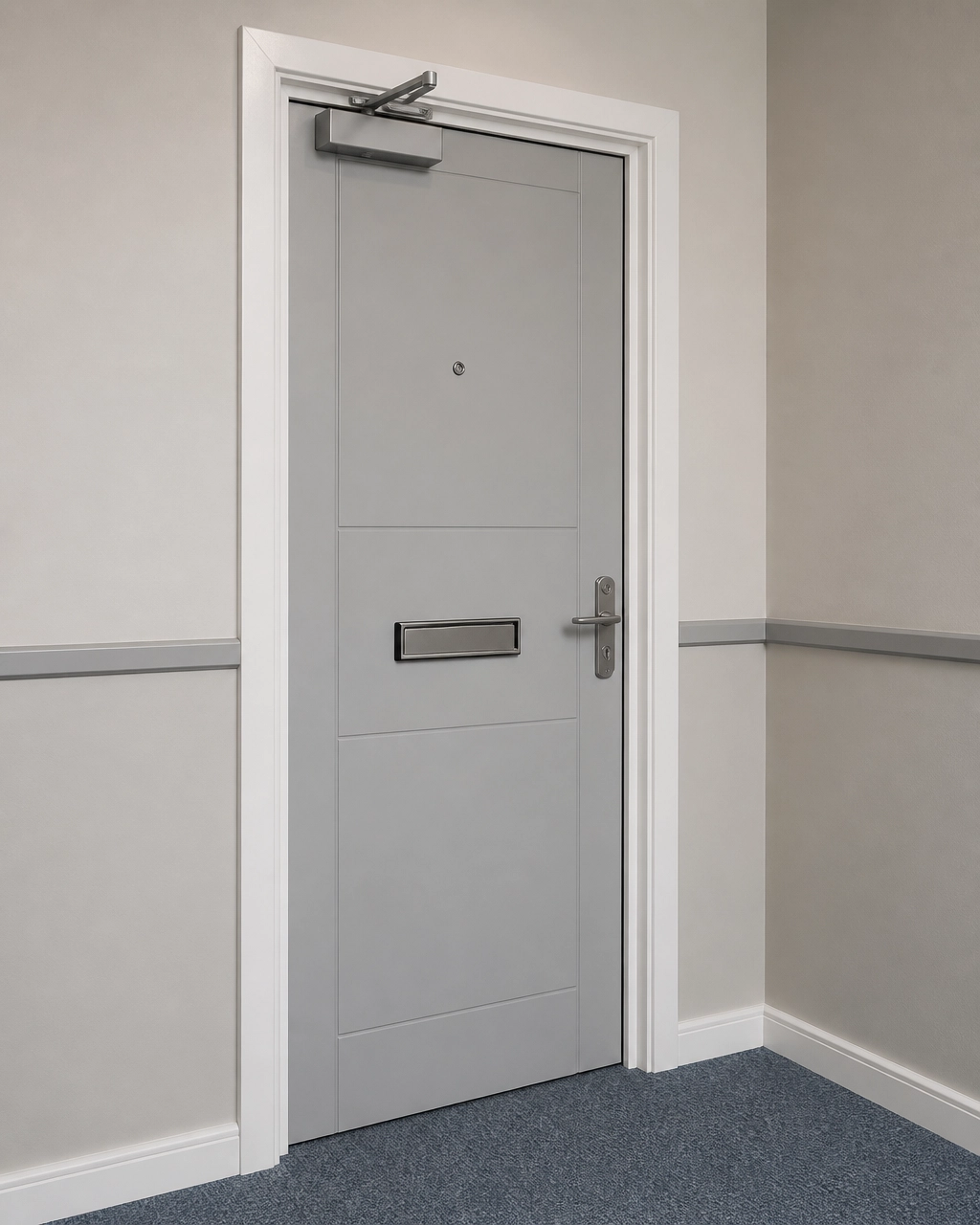
Protect a complete residential doorset, resolve hardware concerns and prepare for a clear FRA outcome with qualified professional support.
Key Takeaways
- Treat a flat entrance fire door as a complete doorset, not simply as a door leaf.
- Review letterplates, viewers, locks, handles, closers and other additions against the door’s specification.
- Do not drill, replace or alter fire door hardware without evidence that the change is suitable.
- Use a qualified Fire Risk Assessment and Certified Installers to determine the proportionate solution.
- Keep written records of the Survey, agreed scope, completed works and compliance handover.
- Apply the same careful approach to HMOs, converted houses, refurbished homes and properties being prepared for sale.
Table of Contents
- Protect the Complete Residential Doorset
- Understand the Legal and Practical Stakes
- Translate the FRA into a Clear Action Plan
- Choose Repair, Upgrade or Installation Professionally
- Prepare Flats, HMOs and Converted Houses for Sale or Letting
- Follow a Controlled Compliance Process
- Answer Common Questions About Letterplates and Fire Doors
- Request a Professional Review and Compliance Solution
- Conclusion: Protect the Doorset and the Building
Protect the Complete Residential Doorset
A flat entrance fire door separates a private dwelling from a communal corridor, staircase or other shared area. Its performance depends on the complete assembly, including the door leaf, frame, seals, hinges, locking hardware, closing device and any apertures.
A letterplate or door viewer may appear to be a small addition. However, each opening or fitted component can affect fire resistance, smoke control, security and the way the door closes. The correct solution depends on the door specification, surrounding frame, building arrangement and findings of the Fire Risk Assessment.
This is particularly important when a property has been altered over time. A replacement letterplate, additional viewer, new lock, decorative handle or security chain may not have formed part of the original doorset evidence. That does not automatically mean the door must be replaced, but it does mean the arrangement should be reviewed by qualified professionals.
Elite Fire Door Installations supports property owners, leaseholders, landlords, managing agents and sellers across East Sussex and the wider South East with professional Surveys, written scopes and proportionate compliance solutions.

Understand the Legal and Practical Stakes
The Regulatory Reform (Fire Safety) Order 2005 places duties on the responsible person to assess fire risks and maintain relevant fire precautions in effective working order. The Fire Safety Act 2021 clarified that flat entrance doors leading onto common parts can fall within the scope of the building’s fire safety arrangements.
For certain multi-occupied residential buildings, the Fire Safety (England) Regulations 2022 also include duties relating to flat entrance fire doors. These include arrangements for checking doors and confirming that features such as letterboxes are not left open or improperly maintained.
You can review the wider legislative framework through the Fire Safety Act 2021 and published guidance relating to the Fire Safety (England) Regulations 2022.
The practical concerns are clear:
- An unsuitable letterplate may leave an aperture insufficiently protected.
- An incorrectly fitted viewer may affect the integrity of the door leaf.
- An incompatible lock or handle may prevent reliable closing and latching.
- A replacement closer may not provide suitable control for the doorset.
- Unrecorded alterations may create uncertainty during a FRA, sale or licensing review.
These issues should not be approached through trial and error. Fire door compliance is a specialist matter. A qualified FRA assessor and Certified Installer should establish what is required and confirm whether the existing arrangement can be retained, repaired or improved.
Translate the FRA into a Clear Action Plan
A Fire Risk Assessment may identify a concern without specifying the precise physical work needed. For example, it may refer to an unsuitable flat entrance door, an unprotected aperture, defective hardware or uncertainty over the door’s performance.
A professional Survey converts that finding into a practical action plan.
Review the Existing Doorset
The Survey should consider the door leaf, frame, seals, hinges, closer, lock, handles, letterplate, viewer and surrounding building arrangement. The purpose is to understand how the components work together rather than assess one item in isolation.
Confirm the Required Performance
The required performance may depend on the building’s fire strategy, escape route, occupancy, compartmentation and existing documentation. A flat entrance door, an HMO bedroom door and a door within a converted house may have different requirements.
Work should be specified with reference to the relevant door evidence and appropriate standards, including BS 476-22 and BS 8214 where applicable.
Record the Recommended Action
The final written scope should explain whether the door requires:
- A suitable repair to existing components.
- A documented hardware upgrade.
- Removal or replacement of an incompatible feature.
- A complete Fire Door Installation.
- Wider FRA Remediation across several doors.
This approach gives property owners a clear route from an identified concern to completed compliance work.
Choose Repair, Upgrade or Installation Professionally
Not every concern requires a complete replacement. A qualified Certified Installer should assess whether the existing door and frame can be retained while addressing defective, damaged or unsuitable components.
Depending on the evidence, the appropriate response may include professional Fire Door Repair, hardware replacement, seal renewal, frame work, door re-lipping or a carefully specified upgrade. Where the existing doorset cannot provide the required performance, a new Fire Door Installation may be the appropriate solution.
Letterplates require particular care because they create an opening through the door leaf. A suitable product must be appropriate for a fire-resisting door and compatible with the relevant doorset specification. A product described generally as fire-rated is not automatically suitable for every door.
The same principle applies to viewers, locks, handles and closers. A component may be suitable in one doorset but unsuitable in another. The frame, door construction, rating, smoke control requirements and installation details all matter.
Elite Fire Door Installations provides a written scope before work begins, helping clients understand what will be retained, what will be upgraded and where a new installation is necessary.

Prepare Flats, HMOs and Converted Houses for Sale or Letting
Property sellers should address fire door concerns before they become a late-stage issue during conveyancing, a buyer’s survey or a managing agent’s review. A clear compliance file can help show that reported defects have been considered and addressed professionally.
Landlords and investors preparing an HMO or converted house should also review entrance and internal fire doors before occupation. Their preparation should include:
- Confirming which doors form part of the protected escape arrangements.
- Reviewing alterations to letterplates, viewers, locks and handles.
- Checking whether existing doorset records are available.
- Arranging a professional Fire Door Survey for Quotations.
- Separating urgent remedial work from planned improvements.
- Ensuring all agreed work is completed by Certified Installers.
- Requesting signed completion and compliance documentation.
The correct specification will vary. A property with individual flat entrances, an HMO with several bedrooms or a converted house with shared circulation areas may each require a different strategy. Flats in buildings under seven storeys and below 18 metres tall may generally be suitable for a specialist provider, provided the FRA, specification, insurer and contract requirements are satisfied.
Avoid Unrecorded Changes During Refurbishment
Refurbishment often introduces new locks, handles, viewers, letterplates, access-control devices or decorative alterations. These changes should be reviewed before installation rather than after a concern is raised.
A professional review helps protect fire performance, security requirements, lease conditions and the property’s sale or letting position.
Follow a Controlled Compliance Process
Elite Fire Door Installations uses a structured process for flat entrances, HMOs, converted houses and residential properties being sold or refurbished.
Step One: Complete the Survey
A qualified professional reviews the doorset, hardware, frame, seals, surrounding arrangement and available documentation. The Survey identifies the issue without providing unsuitable DIY instructions.
Step Two: Issue a Clear Written Scope
The client receives a concise scope explaining the recommended repair, upgrade or installation. This prevents assumptions and makes the intended compliance outcome clear.
Step Three: Complete Certified Work
Certified Installers carry out the agreed works using appropriate professional equipment and materials. Depending on the specification, this may include Fire Door Gap Gauges, Intumescent Seal Routers, Hinge Jigs, Fire-Rated Packers, Digital Inclinometers, Force Gauges, Laser Levels and certified Intumescent Mastic/Sealant.
Step Four: Handover the Compliance File
The completed handover should include relevant records, photographs where appropriate, details of the works undertaken and confirmation of the agreed outcome. This documentation can support future FRA reviews, property management and sale enquiries.
Answer Common Questions About Letterplates and Fire Doors
Does every flat entrance fire door need a fire-rated letterplate?
No. Not every fire door requires a letterplate. Where one is present or required, its suitability depends on the doorset specification, fire strategy and available evidence. A qualified Certified Installer should determine the correct solution.
Can a standard letterplate be fitted to a fire door?
A standard domestic letterplate should not be assumed suitable. A letterplate creates an aperture through the door leaf and must be appropriate for the relevant fire-resisting doorset. Only qualified professionals should specify and install a replacement.
Can I add a door viewer to an existing flat entrance door?
Do not drill or alter the door yourself. A viewer may affect the doorset’s performance if it is not supported by suitable evidence. A Certified Installer should review the door construction and confirm whether an approved upgrade is possible.
Do locks and handles form part of fire door compliance?
Yes. Locks, latches, handles and closers affect the door’s operation and ability to close securely. They should be assessed as part of the complete doorset and replaced or upgraded only by qualified professionals using compatible components.
What records should an HMO landlord retain?
An HMO landlord should retain the Survey, written scope, details of completed works, relevant product or installation information and signed handover records. A professional HMO Fire Door Upgrade should always be completed by Certified Installers.
Request a Professional Review and Compliance Solution
If a letterplate, viewer, lock, handle or other feature has been added to a residential fire door, arrange a professional review rather than relying on appearance alone.
Elite Fire Door Installations can help property owners, leaseholders, landlords, managing agents and sellers move through a calm, documented process:
- Review the existing doorset.
- Identify the relevant compliance concern.
- Provide a clear written scope.
- Complete proportionate repair, upgrade or installation.
- Supply signed handover records.
For further information about our professional services, visit the Elite Fire Door Installations website.
Conclusion: Protect the Doorset and the Building
Letterplates and other door furniture should never be considered in isolation from the fire door, frame and building fire strategy. The correct solution depends on the doorset specification, surrounding construction, occupancy and the findings of the FRA.
A professional Survey provides clarity. A written scope establishes the required work. Certified Installers can then complete a proportionate repair, improvement or installation and provide the records needed for ongoing management, sale preparation or HMO compliance.
By treating every flat entrance and residential fire door as a complete doorset, property owners can protect residents, support legal adherence and maintain confidence in the condition of their building.
Note: This information is intended as general guidance and does not constitute professional or legal advice. Always consult a qualified fire safety engineer for your specific property.
Email: info@elitefiredoorinstallations.co.uk
Specialist Support: +44 7514 898517
Request a call back: +44 20 4511 9456
Website: https://elitefiredoorinstallations.co.uk
Leave a Reply