

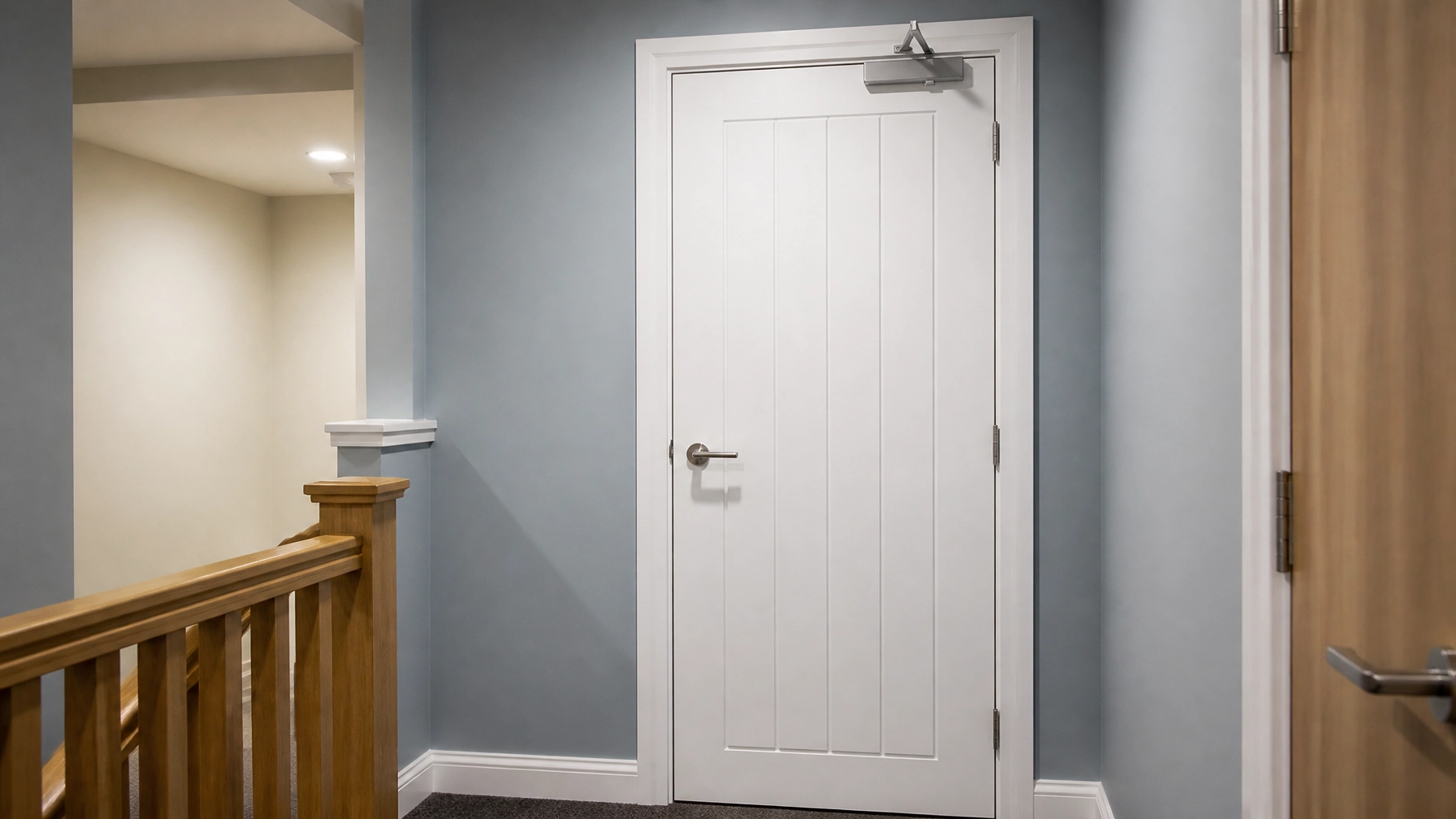
If a Fire Risk Assessment identifies failing fire doors, a clear professional action plan can help you prepare for local authority questions, new tenancies, property sales and management reviews.
Key Takeaways
- HHSRS assesses fire as a housing hazard, but it does not create one universal fire-door specification for every rented property.
- The correct fire-door provision depends on the property layout, fire strategy, occupancy, escape routes and relevant legal requirements.
- HMOs, flats and shared buildings may require more specific measures through licensing conditions and fire safety legislation.
- A client-provided Fire Risk Assessment should inform a professional Fire Door Survey for Quotations.
- Qualified FRA assessors and Certified Installers should define and complete any remedial work.
- A signed compliance file provides a clear record of the agreed scope, completed work and supporting documentation.
Table of Contents
- 1. Prepare for HHSRS Fire Questions
- 2. Understand What HHSRS Does and Does Not Specify
- 3. Translate the FRA into a Practical Action Plan
- 4. Choose Proportionate Repair or Replacement
- 5. Prepare HMOs, Flats and New Tenancies
- 6. Follow a Certified Compliance Process
- 7. Answer Common HHSRS and Fire-Door Questions
- 8. Request Professional Support and Documentation
- 9. Confirm Your Next Steps
1. Prepare for HHSRS Fire Questions
The Housing Health and Safety Rating System helps local authorities assess risks to the health and safety of people living in residential premises. The current government HHSRS landlord and agent guide applies to rented homes and explains how housing hazards are considered and enforced.
Fire is one of the hazards considered under HHSRS. In practical terms, a landlord may need to demonstrate that the property provides suitable protection against fire and smoke spread, supports safe escape and is managed responsibly.
This may become relevant when:
- A local authority raises questions about the condition of a rented property.
- A new tenancy is being prepared.
- An HMO licence application or renewal is under review.
- A property is being sold and the buyer requests fire safety information.
- A managing agent is reviewing its compliance records.
- A Fire Risk Assessment identifies defects affecting protected routes or means of escape.
A calm, organised response is usually the most effective approach. Landlords should use the available Fire Risk Assessment, obtain a professional survey and retain a clear record of any completed works.
2. Understand What HHSRS Does and Does Not Specify
HHSRS is risk-based. It does not automatically state that every door in every rented property must meet one identical specification.
The required approach depends on factors such as:
- The building’s layout and height.
- Whether the property is a single household dwelling, flat or HMO.
- The number and vulnerability of occupants.
- The position of bedrooms, kitchens and other higher-risk rooms.
- The design of communal corridors and stair enclosures.
- The available escape routes.
- The findings of the Fire Risk Assessment.
- Local authority licensing requirements and the building’s fire strategy.
A flat entrance door opening onto a communal corridor may need to protect the shared escape route. In an HMO, bedroom doors opening onto a common escape route may need fire and smoke resistance. A kitchen door may require particular consideration because of the higher likelihood of ignition and heat-producing appliances.
The correct specification should be confirmed by a qualified FRA assessor and implemented by Certified Installers. Landlords should avoid relying on assumptions based only on the age, appearance or label of a door.
3. Translate the FRA into a Practical Action Plan
A Fire Risk Assessment may identify a concern without setting out every physical work item needed at each doorset. This is where a professional Fire Door Survey for Quotations can provide structure.
Elite Fire Door Installations can review the information supplied by the client and help translate it into a documented scope covering:
- The location of each affected doorset.
- The likely role of each door within the fire strategy.
- Whether the door serves a bedroom, kitchen, communal route or stair enclosure.
- The condition of the leaf, frame, hinges, closer, latch and seals.
- Any evidence of unsuitable alterations or damage.
- Whether proportionate remedial work is appropriate.
- Whether a complete Fire Door Installation is more suitable.
- The documentation required at handover.
The purpose is not to replace the Fire Risk Assessment. Instead, the survey helps turn the assessor’s findings into a physical work schedule that can be understood by landlords, agents, contractors and other property professionals.

4. Choose Proportionate Repair or Replacement
A fire door that does not meet requirements is not always beyond repair. A Certified Installer should assess whether the doorset can be physically repaired, re-lipped, adjusted or upgraded while maintaining the necessary performance and compatibility.
Depending on the findings, professional Fire Door Repairs may address issues such as damaged edges, unsuitable seals, defective hardware or poor alignment. In other cases, replacement may be the more appropriate solution.
The decision should consider:
- The evidence available for the door and frame.
- The compatibility of hardware and seals.
- The extent of damage or alteration.
- The door’s position within the escape strategy.
- Whether the required performance can be reliably demonstrated.
- The recommendations of the FRA assessor.
This proportionate approach helps landlords avoid unnecessary disruption while ensuring that safety remains the priority. No remedial work should be specified or completed without professional evaluation.
5. Prepare HMOs, Flats and New Tenancies
Landlords preparing a property for letting, sale or conversion should review fire doors before other works are finalised. This is particularly important for HMO projects, where multiple occupants may share escape routes and communal spaces.
Review bedroom doors and communal routes
Bedroom doors opening onto a shared escape route may require fire and smoke protection. The survey should consider whether the door, frame, closer and seals work together as a suitable doorset.
Communal corridors should remain protected and usable. Doors must not be altered in a way that undermines their intended function or prevents reliable closing.
Review stair enclosures
Stairs are often a critical means of escape. Doors leading to or from a protected stair enclosure require careful consideration within the overall fire strategy. A qualified professional should confirm the required performance and hardware.
Review flat entrance doors
Flat entrance doors opening onto communal areas can affect every resident using the corridor or stair. Their suitability should be considered alongside the building’s fire strategy and any relevant duties applying to multi-occupied buildings.
Review kitchens and higher-risk rooms
Kitchens, utility rooms, boiler rooms and electrical cupboards may require additional protection where they adjoin a means of escape. The correct approach will depend on the risk assessment and property design.
Apply the Quick Compliance Cheat Sheet
Flats in buildings under seven storeys and below 18 metres may generally be suitable for a specialist fire-door provider, provided the arrangement meets the requirements of the Fire Risk Assessment, specification, insurer and relevant contract.
This is not a blanket exemption. The building’s circumstances must still be reviewed by appropriate professionals.
6. Follow a Certified Compliance Process
Elite Fire Door Installations follows a structured process designed to keep the work clear and properly documented.
Step One: Review and Survey
We review the client-provided Fire Risk Assessment and complete a professional Fire Door Survey for Quotations. The survey records the relevant doorsets and helps define the remedial scope.
Step Two: Provide Clear Quotation Documentation
The proposed works are set out clearly so the landlord or property manager understands which doors require repair, upgrade or replacement. The scope remains aligned with the FRA findings and the building’s fire strategy.
Step Three: Complete Certified Works
Certified Installers carry out the agreed works using professional UK-standard equipment, which may include:
- Fire Door Gap Gauges.
- Intumescent Seal Routers.
- Hinge Jigs.
- Fire-Rated Packers.
- Digital Inclinometers.
- Force Gauges.
- Laser Levels.
- Certified Intumescent Mastic and Sealant.
Works are completed with reference to relevant requirements, including BS 476-22 and BS 8214, where applicable to the agreed scope.

Step Four: Handover the Compliance File
The completed project is supported by a signed compliance file. This can include the survey information, remedial scope, installation or repair records, photographs and relevant supporting documentation.
A well-organised file helps landlords respond to management reviews, future tenancy questions, property sales enquiries and local authority requests.
7. Answer Common HHSRS and Fire-Door Questions
Does HHSRS state that every rented property must have the same fire door specification?
No. HHSRS is risk-based and considers the particular property, occupants, layout and hazards. Specific fire-door requirements may also arise from HMO licensing, fire safety legislation, the Fire Risk Assessment and the building’s fire strategy.
Do all bedroom doors in an HMO need to be fire doors?
Not automatically in every layout. However, bedroom doors opening onto a shared escape route commonly require fire and smoke protection. A qualified FRA assessor should determine the appropriate arrangement, followed by a professional survey from Certified Installers.
Can a landlord decide whether a door needs repairing or replacing?
A landlord can request professional advice, but the decision should not be based on appearance alone. A Certified Installer should assess the doorset and confirm whether proportionate repair, re-lipping, upgrading or replacement is appropriate.
Should flat entrance doors be included in a fire-door review?
Yes, where they open onto communal corridors or stairs. Their condition and performance can affect the protection of shared escape routes. The review should consider the building’s fire strategy and any applicable legal duties.
What documents should a landlord retain?
Landlords should retain the client-provided Fire Risk Assessment, professional survey, agreed remedial scope, completed works record and signed compliance file. The exact documentation will depend on the property and the advice of the relevant fire safety professionals.
8. Request Professional Support and Documentation
If your HHSRS review, Fire Risk Assessment, property sale or tenancy preparation has raised questions about fire doors, Elite Fire Door Installations can help organise the next step.
Book a professional survey or discuss a compliant installation through the company website:
Visit Elite Fire Door Installations
9. Confirm Your Next Steps
HHSRS provides a risk-based framework for considering fire safety in rented homes, HMOs and flats. It does not remove the need for professional judgement or create one specification for every property.
The practical route is straightforward:
- Review the client-provided Fire Risk Assessment.
- Arrange a professional Fire Door Survey for Quotations.
- Confirm a clear, proportionate remedial scope.
- Use Certified Installers for repairs, upgrades or installation.
- Retain a signed compliance file for future reviews.
Elite Fire Door Installations provides expert support for landlords and property managers who need clear documentation, precise workmanship and reassurance that the agreed fire-door works have been completed appropriately.
Note: This information is intended as general guidance and does not constitute professional or legal advice. Always consult a qualified fire safety engineer for your specific property.
Email: info@elitefiredoorinstallations.co.uk
Specialist Support: +44 7514 898517
Request a call back: +44 20 4511 9456
Website: https://elitefiredoorinstallations.co.uk
Leave a Reply