

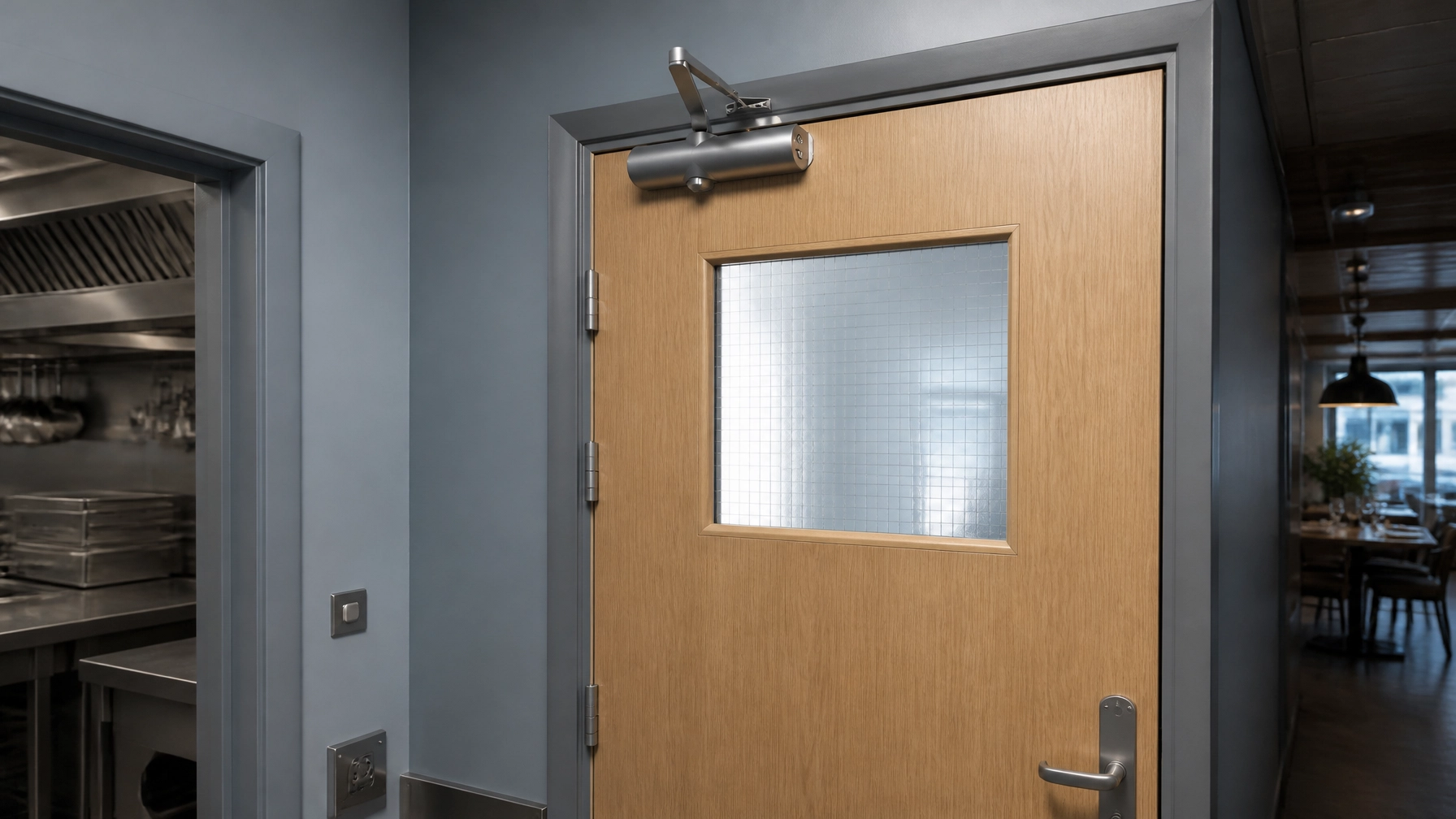
A failed fire door does not always require a complete replacement. With the right professional survey, hospitality owners can identify the actual issue, arrange proportionate remedial work and maintain a clear compliance record for future Fire Risk Assessment reviews.
This guide explains how fire doors support safety in restaurants, cafés, pubs with dining areas and takeaways, including premises with kitchens, storage areas, cellars, staff spaces and protected escape routes.
Key Takeaways
- Understand how the Regulatory Reform (Fire Safety) Order 2005 applies to hospitality premises.
- Protect kitchens, escape routes, cellar doors, store rooms and compartment lines with suitable fire doorsets.
- Ask qualified professionals to translate FRA findings into a clear action plan.
- Confirm that self-closing devices, hinges, intumescent seals, smoke seals, gaps and signage are suitable.
- Never allow fire doors to remain propped open unless a properly designed, alarm-linked system has been approved.
- Use certified installers for all surveys, repairs, upgrades and new installations.
- Receive a signed compliance file following completed works.
Table of Contents
- Understand the Legal Duties for Hospitality Premises
- Decode Fire Risk Assessment Findings
- Choose Repair, Upgrade or Replacement
- Prepare Hospitality and HMO Investments
- Follow a Certified Compliance Process
- Answer Common Hospitality Fire Door Questions
- Request Professional Fire Door Support
- Conclude with a Clear Compliance Plan
Understand the Legal Duties for Hospitality Premises
The Regulatory Reform (Fire Safety) Order 2005 places duties on the Responsible Person for non-domestic premises. This includes restaurants, cafés, pubs with dining areas, takeaways and other hospitality businesses.
The Responsible Person must ensure that fire precautions are suitable for the premises, the activities taking place and the people who may be affected. Fire doors are one part of this wider strategy. They work alongside alarms, emergency lighting, escape routes, staff procedures, compartmentation and evacuation arrangements.
The government’s fire safety legislation and guidance for those with legal duties provides further information for businesses and Responsible Persons.
Protect Kitchens and Escape Routes
Commercial kitchens can contain several sources of ignition and combustible materials. Cooking equipment, oils, extraction systems, packaging and stored goods can increase the importance of separating the kitchen from customer areas and escape routes.
Depending on the building design and Fire Risk Assessment, suitable fire doors may be needed between:
- Kitchens and dining areas.
- Kitchens and service corridors.
- Cellars and stairways.
- Store rooms and protected escape routes.
- Plant or utility rooms and occupied areas.
- Back-of-house spaces and customer areas.
The required fire resistance, smoke control and hardware specification should be confirmed by a qualified fire safety professional. A common rating may be FD30, but the correct specification depends on the building’s fire strategy, construction, occupancy and risk profile.
Maintain Compartmentation During Daily Operations
A fire door can only support compartmentation when the complete doorset functions correctly. This includes the door leaf, frame, seals, hinges, latch, closer, surrounding wall and associated hardware.
Hospitality operations can create practical challenges. Staff may move between the kitchen and dining area frequently, deliveries may pass through service doors, and busy teams may be tempted to wedge doors open. Propping open a fire door can remove an important barrier between a developing fire and an escape route.
Where an open-door arrangement is genuinely required, it must be designed and approved as part of the fire strategy. Any hold-open system should be properly integrated with the fire alarm and installed by qualified professionals.

Decode Fire Risk Assessment Findings
Fire Risk Assessment reports often identify an issue without specifying the complete physical solution. A finding such as “improve kitchen fire door” or “repair doors to escape route” may not explain which doors are affected, whether repair is possible or what hardware is required.
That uncertainty can delay action and make it difficult to demonstrate compliance.
Turn General Findings into Specific Actions
A professional Fire Door Surveys for Quotations translates broad FRA findings into a door-by-door action plan.
The survey process considers:
- The location and purpose of each doorset.
- The required fire resistance and smoke-control performance.
- The condition of the door leaf and frame.
- The operation of the self-closing device.
- The condition and compatibility of hinges and other hardware.
- The presence and condition of intumescent and smoke seals.
- Door gaps and alignment.
- Signage and operational use.
- Damage caused by impact, moisture, heat or unauthorised alterations.
The result should be a clear schedule identifying doors for proportionate repair, upgrade or replacement. This gives the Responsible Person a practical route from FRA report to completed remedial work.
Choose Repair, Upgrade or Replacement
Not every failed fire door needs to be removed. Equally, not every damaged doorset can be made suitable through minor adjustments. The correct decision requires an assessment by a Certified Installer with appropriate knowledge of fire-resisting construction and manufacturer requirements.
Repair Suitable Existing Doorsets
Where the door core, frame and construction remain suitable, professional Fire Door Repairs may restore performance.
Depending on the findings, certified remedial work may include:
- Re-lipping a damaged or over-planed door edge.
- Renewing missing or damaged intumescent and smoke seals.
- Replacing unsuitable hinges or other ironmongery.
- Upgrading a defective self-closing device.
- Correcting alignment using fire-rated packers or shims.
- Restoring frame protection with certified intumescent mastic or sealant.
These works must be selected and completed by qualified professionals. A general handyman should not make unverified alterations to a fire doorset.
Replace Unsuitable or Unrecoverable Doorsets
Replacement may be appropriate where the door has severe damage, an unsuitable core, an incompatible frame or no reliable evidence of its intended performance.
A new Fire Door Installation should be specified for the actual location and use. The complete doorset must be considered, not just the door leaf. This includes compatible hinges, closer, latch, seals, frame details, signage and surrounding construction.
Elite Fire Door Installations works to relevant requirements including BS 476-22 and BS 8214, subject to the project specification and professional assessment.
Prepare Hospitality and HMO Investments
Investors purchasing a restaurant, café, pub, takeaway or mixed-use property should review fire door requirements before completing refurbishment or changing the building’s use.
This is particularly important where a hospitality premises includes upper-floor flats, staff accommodation, guest rooms or an HMO arrangement. A door strategy that was suitable for the previous use may not remain suitable after conversion.
Investors should factor the following into their early project planning:
- A professional survey of existing fire doorsets.
- Review of the current Fire Risk Assessment and fire strategy.
- Kitchen, cellar, store room and plant room separation.
- Protection of stairs, corridors and final escape routes.
- Doors serving flats, bedrooms or shared accommodation.
- Fire-rated hardware and compatible seals.
- Any required HMO Fire Door Upgrades.
- A signed compliance file for handover, management and future reviews.
Use the Quick Compliance Cheat Sheet
Flats in buildings under seven storeys and below 18 metres tall may generally be suitable for a specialist fire door contractor, provided the arrangement meets the requirements of the Fire Risk Assessment, specification, insurer and contract.
This is not a blanket approval. The building’s design, occupancy, escape strategy and documentation must still be reviewed by qualified professionals.

Follow a Certified Compliance Process
Elite Fire Door Installations provides a simple, structured route for hospitality owners and property managers.
Step One: Complete a Professional Survey
A Certified Installer reviews the relevant doorsets, frames, hardware and FRA findings. UK-standard tools may include Fire Door Gap Gauges, Intumescent Seal Routers, Hinge Jigs, Fire-Rated Packers, Digital Inclinometers, Force Gauges and Laser Levels.
These tools support precise technical decisions. They should be used by trained professionals rather than by unqualified staff attempting to diagnose or alter fire doors.
Step Two: Receive a Fixed-Price Quote
Following the survey, you receive a clear fixed-price quote describing the proposed works. It should distinguish between:
- Proportionate repairs.
- Hardware or seal upgrades.
- New doorset installations.
- FRA-related remedial actions.
- Required documentation and handover information.
This makes the next step easier to authorise and schedule around trading hours.
Step Three: Complete Certified Execution
Qualified Certified Installers complete the agreed works using compatible products and professional methods. Where required, work may include certified intumescent mastic or sealant, fire-rated packers, compliant hinges, closers and other hardware.
The installation or remediation must be appropriate to the doorset’s intended performance and the relevant building requirements.
Step Four: Receive the Compliance File
At handover, the Responsible Person should receive a signed compliance file. This may include the completed schedule, records of work, product information, photographs where appropriate and details of any outstanding actions.
A well-maintained file supports future FRA reviews, property management and discussions with insurers or other relevant professionals.

Answer Common Hospitality Fire Door Questions
1. Do all restaurant and café doors need to be fire doors?
No. The requirement depends on the building’s fire strategy, compartmentation, escape routes, occupancy and Fire Risk Assessment. Doors protecting kitchens, high-risk rooms and escape routes commonly require fire-resisting performance, but a qualified professional should confirm the specification for each location.
2. Can staff prop open a kitchen fire door during service?
A fire door should not be propped, wedged or tied open. If operational use requires a door to remain open, a suitable alarm-linked hold-open arrangement must be designed, approved and installed by qualified professionals.
3. What should we do if our FRA report says that fire doors require improvement?
Arrange a professional FRA Remediation survey. A Certified Installer can identify the affected doorsets and translate the report into a clear schedule of repairs, upgrades or replacements.
4. Can a damaged fire door be repaired rather than replaced?
Sometimes. If the core, frame and construction remain suitable, certified repairs may be possible. Severe damage, unsuitable construction or missing performance evidence may require replacement. This decision must be made by a qualified fire door professional.
5. How can we demonstrate that completed work supports compliance?
Keep the signed compliance file, relevant product information and completed work schedule with your fire safety records. Continue to manage the doors in line with the Fire Risk Assessment and arrange further professional reviews when required.
Request Professional Fire Door Support
Hospitality owners do not need to manage unclear fire door findings alone. Elite Fire Door Installations can review your premises, provide a clear fixed-price quote, complete proportionate repairs or upgrades and supply a signed compliance file.
Book a professional survey or installation through the Elite Fire Door Installations website.
Conclude with a Clear Compliance Plan
Fire doors help protect kitchens, dining areas, cellars, store rooms and escape routes from the spread of fire and smoke. In restaurants, cafés, pubs and takeaways, their reliability depends on the complete doorset and the way it is managed every day.
The practical solution is straightforward: review the FRA findings, arrange professional Fire Door Surveys for Quotations, obtain a clear fixed-price quote, complete proportionate certified work and retain the signed compliance file.
For hospitality owners in East Sussex and the wider South East, Elite Fire Door Installations provides calm, professional support for fire door upgrades, remediation and compliance documentation.
Email: info@elitefiredoorinstallations.co.uk
Specialist Support: +44 7514 898517
Request a call back: +44 20 4511 9456
Website: https://elitefiredoorinstallations.co.uk
Note: This information is intended as general guidance and does not constitute professional or legal advice. Always consult a qualified fire safety engineer for your specific property.
Leave a Reply