

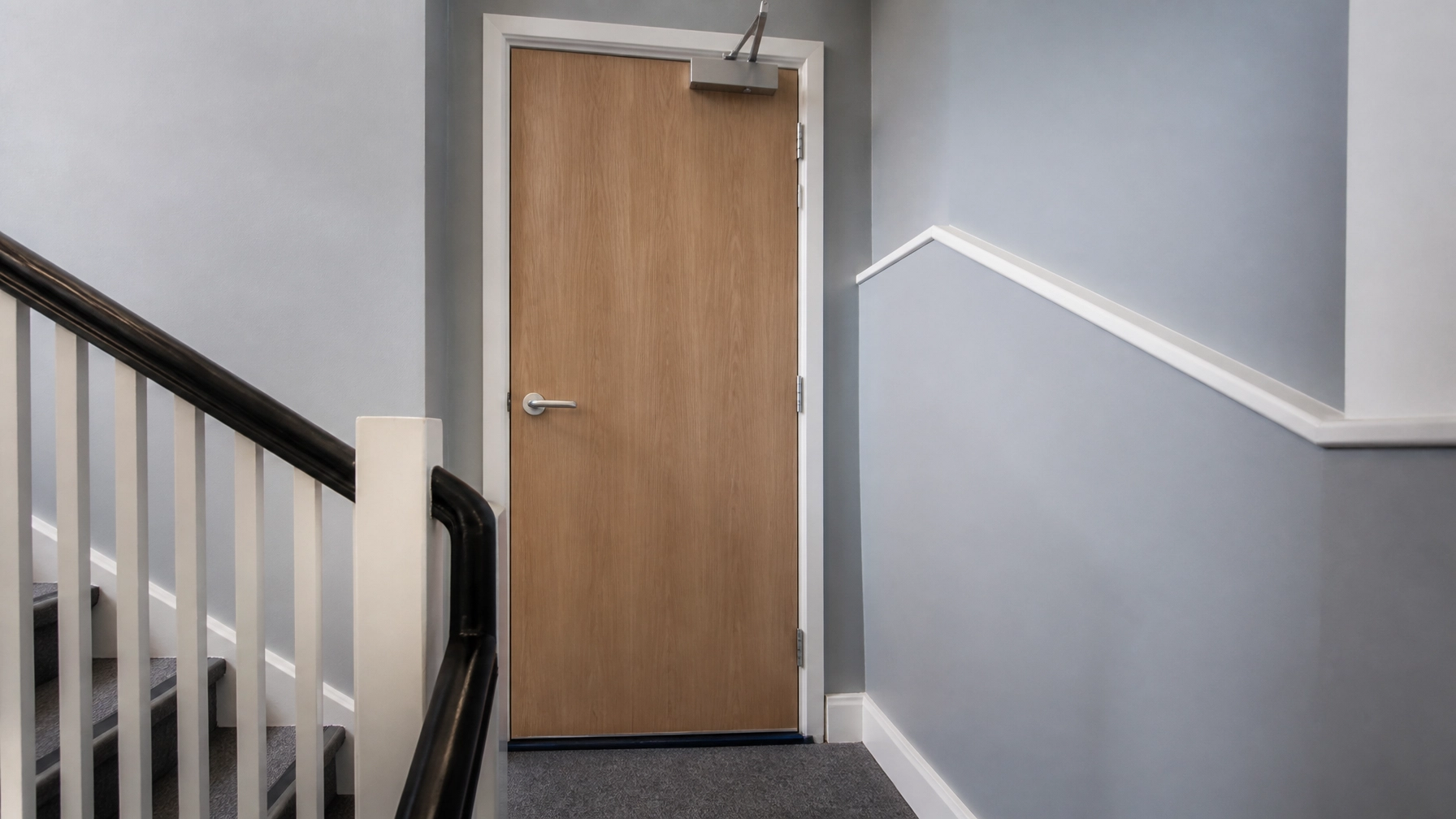
1. Protect the Sale Before Fire Door Concerns Escalate
Selling or refinancing an HMO, shared house, B&B or guest house can become more complicated when a buyer’s surveyor identifies missing fire doors, failed FRA actions or incomplete compliance evidence. In many cases, however, these points can be reviewed, prioritised and resolved with the right professional support.
The issue is often discovered late. The seller may already have accepted an offer, instructed conveyancers and made plans to complete. Then a survey report raises questions about the central stair escape route, bedroom doors, service areas or entrance doors. The buyer asks for clarification, the lender requests further evidence and the insurer wants confirmation that the property remains adequately protected.
For property owners and investors, the issue is not simply whether a door looks suitable. The wider concern is whether the doorset has been correctly specified, competently fitted, maintained and supported by a clear compliance file. A structured plan, clear quotation and proportionate remedial work can often move matters forward in a practical way.
Key Takeaways
- Resolve fire door concerns early so issues can be prioritised and addressed before they disrupt a sale or refinance.
- Treat missing evidence seriously, particularly where an FRA contains outstanding remedial actions, but remember that many items can be organised into manageable stages.
- Protect insurance arrangements by ensuring required fire doors and their associated hardware remain compliant and properly documented.
- Use a competent professional for surveys, repairs and installations. FireQual provides evidence of the individual installer’s competence.
- Choose proportionate certification. FireQual is generally suitable for HMOs, B&Bs, guest houses, small offices, shops, private schools and flats under seven storeys and below 18 metres, subject to the FRA, specification, insurer and contract requirements.
Navigate the Fire Door Evidence You Need
- Protect the Sale Before Fire Door Concerns Escalate
- Understand Why Lenders and Insurers Care
- Translate FRA Findings into a Clear Action Plan
- Choose Repair or Replacement on Evidence
- Prepare an HMO or B&B for Sale or Refinance
- Select the Right Competence Evidence
- Answer Five Fire Door Compliance Questions
- Request a Professional Survey and Compliance File
- Conclude with a Clear Route Forward
2. Understand Why Lenders and Insurers Care
Fire doors are part of the building’s life-safety strategy. In a shared property, they help protect escape routes and separate areas where fire or smoke may develop. A missing or unsuitable door can therefore create a genuine compliance question about occupant safety, licensing and the building’s overall risk profile.
Under the Regulatory Reform (Fire Safety) Order 2005, the Responsible Person must ensure that appropriate fire precautions are provided and maintained. The Fire Safety Act 2021 also clarified that flat entrance doors in multi-occupied residential buildings fall within the scope of the fire risk assessment. The legal duty remains with the Responsible Person, even when specialist work is delegated.
Serious failures can lead to enforcement notices, prosecution and substantial financial penalties. More commonly in a live transaction, however, identified fire door issues lead to practical follow-up points that need to be evidenced and resolved in a sensible order. For a seller, that can include:
- Further enquiries from the buyer’s solicitor.
- A lender’s valuation being made conditional on remedial work.
- Delayed mortgage approval or refinancing while information is gathered.
- HMO licensing questions.
- Insurance underwriters requesting additional information.
- Requests for quotations, remedial records or completion documents.
Avoid the Three-Storey and Loft Conversion Trap
A loft conversion can create a third storey and change the fire strategy of an otherwise ordinary house. If habitable rooms open onto the central stair escape route, surveyors and Building Control professionals will usually expect an appropriate protected route with fire-resisting doors.
This is a common point raised during conveyancing. A property may have attractive bedrooms and strong rental potential, but missing fire doors on the stair route can lead to sensible questions about:
- Whether the loft conversion received Building Regulations approval.
- Whether the original fire strategy was completed.
- Whether doors have since been removed, altered or replaced with unsuitable products.
- Whether the current arrangement matches the approved plans.
- What proportionate remedial work is needed to regularise the position.
Being below 18 metres does not remove the need for suitable fire protection. The height threshold is relevant to particular regulatory regimes, but a three-storey dwelling may still require fire-resisting doors to protect the escape route. The helpful point for owners is that these matters can often be assessed clearly, costed properly and addressed in stages where appropriate.

Protect Insurance Validity
Insurance policies commonly require property owners to comply with relevant laws, disclose material facts and maintain safety measures. A missing fire door between an integral garage and the dwelling, or an unsuitable flat entrance door, can therefore raise insurance questions that are best addressed with proper evidence.
A door may appear solid while still failing as a complete doorset because of unsuitable:
- Hinges.
- Closers.
- Frames.
- Intumescent strips or smoke seals.
- Letterplates, glazing or other installed components.
- Gaps or alterations that are inconsistent with the door’s test evidence.
Non-compliance does not automatically mean every claim will be refused. The insurer will consider the policy wording, the facts of the claim and whether the defect contributed to the loss. Even so, it is sensible to resolve known issues and keep clear records of what has been assessed, repaired, upgraded or replaced.
The safest approach is to organise any known concerns, obtain a professional survey and retain useful documentation before renewing cover, applying for finance or exchanging contracts.
3. Translate FRA Findings into a Clear Action Plan
A Fire Risk Assessment may identify broad concerns such as “upgrade fire doors” or “provide suitable self-closing doors”. Those recommendations still need to be translated into a practical, property-specific programme.
A professional Fire Door Survey for Quotations connects the FRA findings with the actual doors on site. The survey should establish which doors are relevant, what documentation exists and whether each door requires professional remediation, upgrade, staged repair or replacement.
Prioritise the Doors That Affect the Escape Strategy
For HMOs, B&Bs and guest houses, the survey should consider more than bedroom doors. Relevant locations may include:
- Bedrooms opening onto communal corridors or stairways.
- Doors protecting the central escape route.
- Kitchen and communal room doors.
- Plant, electrical, boiler and service cupboards.
- Riser and storage areas.
- Doors leading to integral garages.
- Flat entrance doors opening onto common parts.
- Final exit or access doors where they form part of the fire strategy.
The resulting report should distinguish urgent life-safety matters from lower-priority maintenance issues. It should also identify any evidence gaps, including missing product information, previous contractor records or completion documents.
This makes it easier to prioritise work sensibly, control costs where viable repairs are possible and provide a buyer, lender, insurer or licensing authority with a coherent explanation rather than a collection of disconnected invoices.
4. Choose Repair or Replacement on Evidence
A failed fire door does not always require complete replacement. Replacing every door without first considering its condition can unnecessarily increase the cost of selling or refinancing a property.
At Elite Fire Door Installations, the approach is to assess whether the existing door and frame remain structurally suitable. Where the assembly allows, a qualified specialist may be able to carry out professional repair, re-lipping or upgrading work using compatible components and methods. This often gives owners a more cost-effective route, supported by a clear quotation and a realistic scope of work.
Restore Viable Doors Professionally
A professional Fire Door Repair programme may address issues involving the door leaf, frame, hardware, seals or operation. The correct solution depends on the door’s construction, test evidence, condition and intended rating.
Where repair is not technically defensible, a certified Fire Door Installation may be the appropriate route. The objective is not to make a door appear compliant for a survey. It is to provide a properly specified and competently installed fire doorset that supports the property’s fire strategy.
All work should be completed by a competent professional in accordance with the relevant manufacturer’s evidence and recognised standards, including BS 476-22 and BS 8214. Owners should receive clear records describing the work completed, the locations addressed and any limitations that remain, along with a quotation that makes the recommended actions easy to understand.
5. Prepare an HMO or B&B for Sale or Refinance
Investors buying a property for HMO conversion often focus on kitchens, bathrooms, decoration and room layouts. Fire door preparation should be included in the initial budget so it can be planned properly, rather than being left as a late-stage issue.
Budget for Every Relevant Fire Door Location
Before committing to a purchase, investors should allow for:
- A professional FRA by a suitably qualified assessor.
- A Fire Door Survey for Quotations.
- Door upgrades along bedrooms and communal escape routes.
- Suitable fire-rated hardware and self-closing arrangements where required.
- Service-area and cupboard-door upgrades.
- Entrance-door work where doors open onto protected common parts.
- Documented remedial work and a signed compliance file.
- Potential replacement where existing doors cannot be responsibly restored.
For B&Bs and guest houses, guest bedrooms, corridors, stairways, kitchens and back-of-house service areas may all affect the fire strategy. For HMOs, the licensing authority may require evidence that the proposed arrangement has been completed by competent specialists.
6. Select the Right Competence Evidence
UK fire safety law requires work to be completed by a competent person. It does not make one commercial accreditation logo universally mandatory for every private property.
Follow a Documented Four-Stage Process
- Commission the Survey: Complete a property-specific Fire Door Survey for Quotations and align the findings with the FRA.
- Receive a Fixed-Price Quote: Set out repair, upgrade and replacement requirements clearly, including documentation.
- Approve Certified Execution: Complete the work using professional UK-standard equipment, such as Fire Door Gap Gauges, Intumescent Seal Routers, Hinge Jigs, Fire-Rated Packers, Digital Inclinometers, Force Gauges, Laser Levels and certified Intumescent Mastic/Sealant.
- Secure the Compliance File: Receive relevant completion records, photographs, product information and signed documentation for your conveyancer, buyer, lender, insurer or licensing authority.

7. Answer Five Fire Door Compliance Questions
Can missing fire doors really delay a house sale?
Yes. A buyer’s surveyor may flag the issue as a safety, Building Regulations or insurance concern. The lender may then request further evidence or make finance conditional on remedial work. That does not always mean the transaction will fail. In many cases, early surveying, clear quotations and staged remedial works help the seller retain control and answer queries constructively.
Does a loft conversion always require fire doors?
A loft conversion that creates a third storey commonly requires a protected escape route. The precise solution depends on the approved design, building construction and fire strategy. A qualified professional should review the property and existing records rather than relying on assumptions.
Can a non-compliant integral garage door affect insurance?
Yes. If the door is required as part of the dwelling’s fire protection and is unsuitable, missing or materially altered, the insurer may question compliance with the policy conditions. The practical response is to obtain professional advice, understand what work is needed and retain evidence of any remedial work completed.
Can existing fire doors be repaired instead of replaced?
Sometimes. A qualified specialist must determine whether the doorset is suitable for professional repair, re-lipping or upgrading. Where that is possible, repair can be a more cost-effective option than full replacement. Do not assume that a door can be saved, and do not attempt alterations without appropriate competence and supporting evidence.
8. Request a Professional Survey and Compliance File
If you are selling or refinancing an HMO, B&B, guest house or shared house, it is helpful to address fire door questions before the buyer’s survey raises them.
A professional Fire Door Survey for Quotations, followed by documented Fire Door Repair, FRA Remediation or Fire Door Installation, can help you deal with concerns in a calm, organised and practical way.
Three-storey layouts and loft conversions deserve particular attention. Once an additional storey changes the escape route strategy, missing or unsuitable fire doors can lead to lender queries, insurance questions and requests for further information. For HMO and B&B owners, that usually means putting a clear plan in place, supported by sensible priorities, cost-effective upgrades where appropriate and useful documentation for the transaction file.
If you are selling but need a contractor who can also support local property owners across East Sussex and the wider South East, contact Elite Fire Door Installations for swift Fire Door Installation, Fire Door Repair or FRA Remediation with signed compliance files before your sale stalls. We aim to make the process straightforward, with clear quotations, proportionate recommendations and helpful records for your solicitor, lender, insurer or buyer.
Explore Elite Fire Door Installations for a professional route to fire door upgrades, remedial work and compliance documentation.
9. Conclude with a Clear Route Forward
Fire door concerns can affect far more than day-to-day safety. Missing doors, failed FRA actions and poor evidence can also create buyer queries, insurance questions, licensing points and mortgage delays. The reassuring point is that these issues can often be identified clearly, prioritised properly and resolved in sensible stages.
The practical solution is to obtain a professional survey, establish which doors require attention and appoint a competent installer who can complete proportionate work with clear records.
Note: This information is intended as general guidance and does not constitute professional or legal advice. Always consult a qualified fire safety engineer for your specific property.
Contact Block
- Email: info@elitefiredoorinstallations.co.uk
- Specialist Support: +44 7514 898517
- Request a call back: +44 20 4511 9456
- Website: https://elitefiredoorinstallations.co.uk
Leave a Reply