

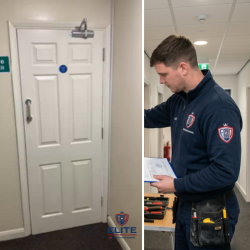
GET A FREE QUOTE: Looking to ensure your rental properties meet the latest safety standards? GET A FREE QUOTE today for expert surveys and certified fire door services.
Key Takeaways
- Strict New HHSRS Enforcement: The updated Housing Health and Safety Rating System introduces tighter scoring bands, with Category 1 (High) fire hazards triggering immediate civil penalties up to £7,000 without warning buffers.
- Expanded Fire Hazard Scope: Fire hazards now formally encompass uncontrolled fire, smoke, fumes, explosions, and related structural collapse, putting escape route doors under intense local authority scrutiny.
- Landlord Legal Obligations: Multi-occupied buildings and Houses in Multiple Occupation (HMOs) face mandatory fire door checks (annual for flat entrances, quarterly for communal doors) under current fire safety regulations.
- Certified Expertise Required: Remediation and Fire Door Installations must be carried out exclusively by accredited professionals to withstand council audits and maintain insurance validity.
Table of Contents
- Hero Header
- The Legal Stakes of Non-Compliance
- Decoding Your FRA Report
- The Elite Solution: Repair vs. Replace
- HMO Investor Preparation
- Our Certification & Process
- FAQ Section
- Final Call to Action & Schema
- Conclusion
The Legal Stakes of Non-Compliance

The regulatory landscape for private landlords and HMO operators has undergone a major shift with the implementation of the updated Housing Health and Safety Rating System (HHSRS). Local authorities across East and West Sussex are now exercising rigorous enforcement powers, scrutinising rental properties for fire safety defects with unprecedented strictness. Under the modernised HHSRS framework, fire hazards are categorised into simplified High, Medium, and Low scoring bands.
When an inspector identifies a Category 1 (High) fire hazard: such as a compromised escape route, missing intumescent seals, or a failing fire door: councils now possess the authority to issue civil penalties of up to £7,000. Crucially, these financial penalties can be administered immediately without issuing a prior improvement notice. For property owners, this means there is no longer a “warning buffer” or grace period to rectify severe compliance failures.
Furthermore, fire doors play a foundational role in containing smoke, limiting fire spread, and protecting vital means of escape. When defective hardware, excessive gaps, or uncertified modifications compromise these physical barriers, the overall property fire hazard score escalates dramatically. Ensuring absolute compliance is no longer just a best-practice guideline; it is a strict legal necessity that protects your investment from severe financial liabilities and prosecution.
Decoding Your FRA Report
A Fire Risk Assessment (FRA) is often the first formal document that highlights structural and compliance shortcomings within a rental property or HMO. However, translating a complex technical assessment into a tangible, compliant action plan can be overwhelming for landlords. An FRA report typically details specific defects, such as excessive door leaf-to-frame clearances exceeding the permitted 3mm to 4mm tolerance, damaged hinges, or non-compliant glazing.
Ignoring these recommendations or attempting temporary, uncertified fixes leaves landlords exposed to severe regulatory scrutiny. Professional FRA Remediation bridges the gap between assessment findings and legal compliance. By partnering with certified specialists, property owners ensure that every identified defect is addressed in strict accordance with British Standards (such as BS 476-22 and BS 8214), transforming a vulnerable property into a fully fortified environment ready for local authority inspection.
The Elite Solution: Repair vs. Replace

Many landlords assume that any failed fire door audit automatically triggers the costly expense of ripping out every door and installing brand-new units throughout the building. At Elite Fire Door Installations, our specialist approach challenges this assumption. We evaluate failing doors to physically repair, re-lip, and upgrade them wherever structurally viable, saving landlords significant capital compared to full replacements.
Whether a door suffers from damaged hinge recesses, compromised intumescent strip channels, or minor surface wear that breaches fire certification, our certified experts restore integrity with precision craftsmanship. Every repair is executed meticulously to preserve the door’s original fire rating and acoustic properties while complying fully with current building regulations. This targeted approach delivers exceptional cost-efficiency without ever compromising on safety or regulatory standards.
HMO Investor Preparation
Property investors acquiring properties for conversion into Houses in Multiple Occupation (HMOs) face rigorous licensing standards and local authority checks before tenants can legally move in. Fire safety preparation must be factored into the core renovation budget from day one. In multi-occupied settings, every internal bedroom door and communal escape route door is subject to stringent fire-resisting requirements.
Investors must ensure that doors designated for HMO use are certified FD30 or FD60 fire doors, fitted with approved overhead self-closing devices, smoke seals, and appropriate ironmongery. Attempting to bypass these requirements or utilizing general-purpose timber doors during conversion works will result in immediate licensing refusal and potential prohibition orders. Proactive planning with accredited professionals guarantees that your HMO investment meets all legal thresholds right from initial handover.
Our Certification & Process

Achieving flawless fire door compliance requires a disciplined, step-by-step methodology executed by qualified professionals. We operate a streamlined, transparent process designed to give landlords complete peace of mind:
- Step One: Survey – We conduct comprehensive Fire Door Surveys to evaluate existing doors, recording dimensions, hardware condition, and compliance gaps.
- Step Two: Fixed-Price Quoting – We provide a transparent, itemised quotation detailing all required Fire Door Repair, upgrade, or installation works with no hidden costs.
- Step Three: Certified Execution – Our FireQual-certified technicians carry out all works using professional UK-standard equipment: including Fire Door Gap Gauges to verify exact clearances, Intumescent Seal Routers, Hinge Jigs, Fire-Rated Packers, Digital Inclinometers, Force Gauges, Laser Levels, and certified Intumescent Mastic/Sealant.
- Step Four: Handover of Compliance Documentation – Upon completion, we provide full certification records and compliance documentation to satisfy local authority auditors and insurance underwriters.
FAQ Section
1. Can I install or repair fire doors in my rental property myself?
No. Fire door installation and remedial repairs are highly technical safety-critical tasks. Under UK building regulations and fire safety legislation, work must be completed by a competent, certified person to ensure the door retains its certified fire resistance. DIY alterations invalidate fire door certification and risk severe legal penalties.
2. How often must fire doors be inspected in an HMO or block of flats?
Under the Fire Safety (England) Regulations 2022, flat entrance doors in multi-occupied residential buildings must be inspected at least annually, while communal fire doors must be checked at least quarterly. HMO licensing conditions often require even more frequent routine checks by responsible landlords.
3. What does a Fire Door Gap Gauge measure during a compliance check?
A Fire Door Gap Gauge is a specialized precision tool used to measure the operational gaps around the door leaf. Regulations require perimeter gaps (between the door and the frame) to remain strictly within 2mm to 4mm, with 3mm being the ideal standard to prevent smoke and flame passage during a fire.
4. Are full fire door replacements always necessary if a door fails an FRA audit?
Not necessarily. Many doors can be saved through expert HMO Fire Door Upgrades and professional repairs. Our certified technicians assess each unit individually to determine whether re-lipping, hardware replacement, or resealing can restore full compliance cost-effectively.
5. What are the financial risks if my rental property has Category 1 fire hazards?
Under updated HHSRS enforcement rules, local authorities can issue civil penalties of up to £7,000 per High hazard immediately without serving a prior improvement notice. Ensuring your fire doors and escape routes are fully compliant is vital to avoiding these penalties.
Final Call to Action & Schema
Protect your tenants, safeguard your property assets, and ensure full compliance with the latest HHSRS updates. GET A FREE QUOTE today to book your professional fire door survey or installation with our certified specialists.
For further information on our complete range of services across East and West Sussex, visit our website at Elite Fire Door Installations.
- Email: info@elitefiredoorinstallations.co.uk
- Specialist Support: +44 7514 898517
- Request a call back: +44 20 4511 9456
- Website: https://elitefiredoorinstallations.co.uk
Conclusion

Navigating the complexities of modern fire safety legislation and updated HHSRS enforcement demands vigilance, expertise, and proactive property management. Faulty fire doors or neglected escape routes can quickly translate into Category 1 fire hazards, exposing landlords to severe financial penalties and legal liability. By relying exclusively on certified professionals for your fire door surveys, repairs, and installations, you ensure complete regulatory compliance and absolute peace of mind for both property owners and residents.
Leave a Reply