

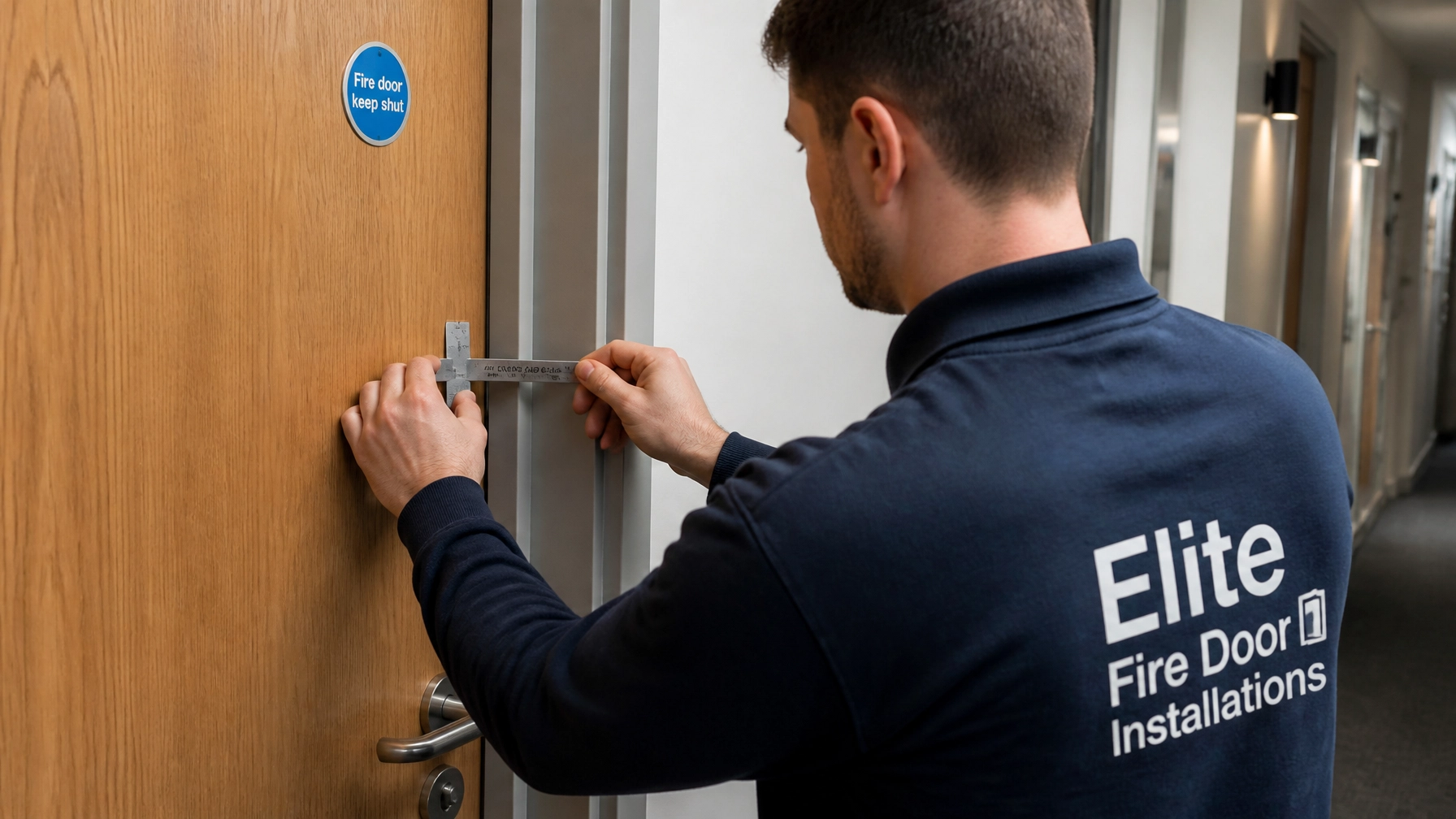
For property investors and landlords in Sussex, the safety of tenants is a primary responsibility that carries significant legal and financial weight. When managing a House in Multiple Occupation (HMO), the integrity of your fire doors is not merely a box to be checked; it is a critical life-safety system that must perform flawlessly under extreme conditions. While the temptation to handle maintenance “in-house” or via a general handyman can be high, the risks of non-certified fire door work are immense.
In this guide, we explore why a professional Fire Door Survey is the only way to ensure absolute compliance and peace of mind for your property portfolio.
Key Takeaways
- Legal Necessity: The Fire Safety Act 2021 places strict obligations on HMO landlords to maintain certified fire doors.
- DIY Risks: Non-certified repairs can invalidate insurance and lead to catastrophic safety failures.
- Financial Protection: Professional surveys identify issues that can be repaired rather than replaced, saving significant costs.
- Expert Precision: Certified installers use specialized tools to meet BS 476-22 and BS 8214 standards.
Table of Contents
- The Legal Stakes of Non-Compliance in Sussex
- Decoding Your FRA Report: From Paper to Physical Action
- The Elite Solution: Physical Repair vs. Full Replacement
- HMO Investor Preparation: Planning for Compliance
- Our Certification & Precision Process
- Serving the Sussex Community
- Frequently Asked Questions
- Conclusion & Contact Information
The Legal Stakes of Non-Compliance in Sussex
Managing an HMO in cities like Brighton or Worthing involves navigating a complex web of local council enforcement and national legislation. Under the Fire Safety Act 2021 and the Regulatory Reform (Fire Safety) Order 2005, the “Responsible Person” (landlord or agent) must ensure that all fire doors, including flat entrance doors, are fit for purpose.
Local authorities across East and West Sussex are increasingly stringent. A single non-compliant door, perhaps one with an incorrect gap or a missing intumescent strip, can lead to failed licensing inspections, heavy fines, or even criminal prosecution in the event of a fire. “Doing it yourself” or hiring an uncertified contractor creates a paper trail of non-compliance that can invalidate your building insurance and leave you personally liable.

Decoding Your FRA Report: From Paper to Physical Action
Most landlords start with a Fire Risk Assessment (FRA). While an FRA identifies that a problem exists, it often lacks the technical depth to provide a physical action plan. This is where a certified Fire Door Survey becomes essential.
We translate the observations of your FRA into a detailed, door-by-door remediation schedule. Where an assessor might note “door does not close,” we identify why, whether it’s a warped frame, incorrect hinge placement, or a failing self-closing device, and provide a certified solution to rectify it.
The Elite Solution: Physical Repair vs. Full Replacement
One of the most significant misconceptions in the industry is that a failing fire door must always be replaced. At Elite Fire Door Installations, we take a more sustainable and cost-effective approach.
By employing “Certified Installers” who understand the physical properties of fire-rated timber, we can often perform Fire Door Repairs that restore compliance without the cost of a full replacement. This might involve:
- Precision re-lipping of door edges.
- Upgrading non-compliant hardware to BS EN 1935 hinges.
- Installing high-performance intumescent seals using specialized routers.
This level of detail is only possible through professional intervention. A DIY repair that uses standard hardware store components is not just ineffective; it is dangerous.

HMO Investor Preparation: Planning for Compliance
For investors acquiring properties for HMO conversion in areas like Shoreham-by-Sea or Bognor Regis, fire door compliance must be factored into the initial renovation budget.
Council standards for HMOs often require specific FD30 or FD60 ratings for communal corridors and bedroom entrances. Engaging with us early in the renovation process allows for the seamless integration of HMO fire door upgrades. This ensures that when the council officer arrives for the final licensing check, your doors are already certified, documented, and fully compliant, preventing costly delays in tenant occupancy.
Our Certification & Precision Process
Our workflow is designed to provide landlords with total safety and legal protection. We don’t guess; we measure.
- Professional Survey: A comprehensive audit of every door set using calibrated Fire Door Gap Gauges to ensure 3mm tolerances.
- Fixed-Price Quoting: Transparent costs for all remediation work.
- Certified Execution: Our team, trained to FireQual standards, utilizes specialized tools including Intumescent Seal Routers, Hinge Jigs for perfect alignment, and Digital Inclinometers to test closing speeds (BS 8300 compliance).
- Compliance Documentation: Upon completion, you receive a full handover pack, providing the necessary evidence for local authorities and insurers.

Serving the Sussex Community
We are deeply committed to maintaining the safety of the Sussex rental market. Our teams are frequently seen across:
- Brighton & Hove: Supporting the high density of student and professional HMOs.
- Worthing & Lancing: Helping landlords upgrade older coastal properties to modern safety standards.
- Eastbourne & Hastings: Providing rapid response Fire Door Repairs for property managers.
Frequently Asked Questions
1. Why can’t my regular handyman fix a fire door?
Fire doors are tested as a complete “kit.” Any alteration, even replacing a hinge, must be done with components that match the door’s original test evidence. A handyman typically uses standard hardware, which can cause the door to fail in a fire, leading to legal liability for the landlord.
2. How often should HMO fire door surveys be conducted?
Under the latest guidance, fire doors in communal areas of HMOs should be checked regularly. For high-occupancy buildings, a professional survey every 6 to 12 months is recommended to ensure that wear and tear hasn’t compromised the door’s integrity.
3. What is the difference between an FRA and a Fire Door Survey?
A Fire Risk Assessment (FRA) looks at the whole building’s safety. A Fire Door Survey is a technical, physical inspection of the door’s construction, gaps, seals, and hardware to ensure it meets BS 476-22 or BS 8214 standards.
4. Can a fire door be repaired if it has too large a gap?
In many cases, yes, but only by a “Certified Installer.” We use specialized techniques like re-lipping or adjusting the frame with Fire-Rated Packers to bring the gaps back within the 2mm-4mm tolerance required for compliance.
5. What documentation do I get after a professional survey?
You will receive a detailed report for each door, documenting its current state and any work performed. This document is vital for demonstrating your “due diligence” to local councils and is a key part of your building’s health and safety file.
Conclusion
Protecting your investment and your tenants requires more than just good intentions; it requires certified expertise. The risks of DIY fire door work in the Sussex HMO market are simply too high to ignore. From legal fines to the ultimate risk of life safety, the consequences of a failed fire door are absolute.
Ensure your property meets the highest standards of safety and compliance today.
Don’t wait for an enforcement notice. Upload your latest FRA report or book your certified survey now.
Get a Professional Quote via Our Portal
Email: info@elitefiredoorinstallations.co.uk
Specialist Support: +44 7514 898517
Website: https://elitefiredoorinstallations.co.uk
Service Areas:
- East Sussex & Brighton: Brighton, Hove, Portslade, Lewes, Peacehaven, Newhaven, Seaford, Eastbourne, Bexhill, Hastings, Hailsham, Crowborough, Uckfield.
- West Sussex: Shoreham-by-Sea, Southwick, Lancing, Worthing, Littlehampton, Bognor Regis, Chichester, Crawley, Horsham, Haywards Heath, Burgess Hill, East Grinstead, Arundel.
- Surrey, Hampshire & Kent: Guildford, Redhill & Reigate, Woking, Epsom, Egham, Gatwick Area, Portsmouth, Royal Tunbridge Wells.
- Greater London: Croydon, Kingston, Twickenham, Richmond, Bromley, Sutton & Merton.
If you can’t see whether or not we service your area, please let us know so we can discuss more details.
Leave a Reply