

Fire safety is not a “DIY” project. For landlords and property investors in Brighton & Hove, a single failed fire door can be the difference between a successful HMO license application and a £30,000 civil penalty. As local authorities tighten enforcement under the Fire Safety Act, the margin for error has vanished.
If your Fire Door Installation is handled by anyone other than a certified professional, you are likely sitting on a ticking time bomb of legal and financial liability. This guide exposes the critical mistakes we see daily in Brighton & Hove and how our Certified Installers can rectify them before the inspectors arrive.
Key Takeaways
- Precision Matters: Gaps exceeding 4mm or falling below 2mm render a fire door non-compliant.
- Certification is Mandatory: In Brighton & Hove, HMO licensing requires documented proof of certified installation.
- Legal Risks are Severe: Non-compliance can lead to unlimited fines and Rent Repayment Orders.
- Repair is Often Possible: Not every failed door needs replacement; expert Fire Door Repair can save thousands.
- HMO Focus: Investors must plan fire safety budgets early in the renovation phase to pass initial council audits.
Table of Contents
- The Legal Stakes of Non-Compliance
- 7 Common Fire Door Installation Mistakes
- Decoding Your FRA Report
- The Elite Solution: Repair vs. Replace
- HMO Investor Preparation in Brighton & Hove
- Our Certification & Professional Process
- Local Area Coverage
- FAQ: Fire Door Compliance
- Conclusion
The Legal Stakes of Non-Compliance
In Brighton & Hove, the City Council operates strict additional and mandatory licensing schemes for Houses in Multiple Occupation (HMOs). Under the Regulatory Reform (Fire Safety) Order 2005 and the Fire Safety Act 2021, the “Responsible Person” (usually the landlord) is legally obligated to ensure all fire doors are fit for purpose.
Failures identified during a council inspection or a Fire Risk Assessment (FRA) are not merely suggestions; they are legal directives. In the last year alone, landlords across Sussex have faced:
- Civil Penalties: Up to £30,000 for licensing breaches related to fire safety.
- Rent Repayment Orders: Tenants can claim back up to 12 months of rent if the property is found to be unlicensed or dangerously non-compliant.
- Unlimited Fines: In cases of severe negligence, the courts can impose unlimited financial penalties and even custodial sentences.
Entrusting your HMO fire door upgrades to a general builder or attempting a DIY fix is a gamble with your entire investment portfolio.
7 Common Fire Door Installation Mistakes
1. Incorrect Gaps (The 3mm Rule)
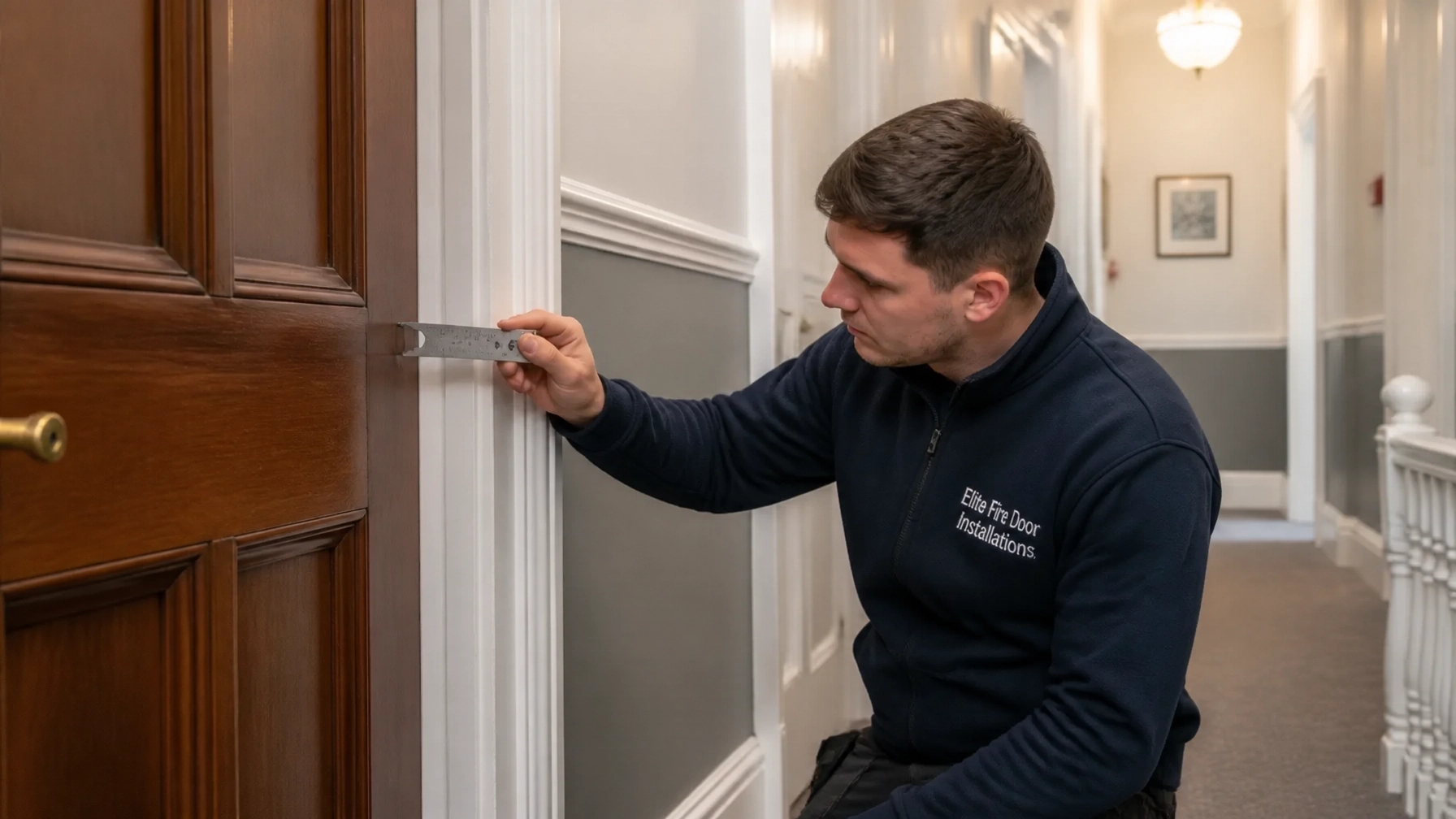
The most common failure we see is incorrect clearance. A fire door must have a consistent gap of 2mm to 4mm (ideally 3mm) between the door leaf and the frame. If the gap is too large, smoke and flames will bypass the door before the intumescent strips can expand. If it’s too small, the door may fail to close under the power of the overhead closer.

2. Using Non-Fire-Rated Hardware
Every hinge, latch, and closer must be fire-rated and compatible with the specific door leaf. We frequently find Brighton properties where standard domestic hinges have been used. Under the heat of a fire, these can melt or warp, causing the door to drop and fail.
3. Missing or Painted-Over Intumescent Seals
Intumescent strips are the “active” part of the fire door. They expand when heated to seal the gaps. Mistakenly painting over these seals or failing to install them in a continuous routered groove will prevent them from functioning.
4. Excessive Trimming of the Door Leaf
Every certified fire door has a “trimming allowance” (usually 3mm-10mm). Exceeding this destroys the structural integrity of the door and voids its certification. We often see doors that have been “shaved” to fit uneven Victorian frames in Hove, rendered useless in the process.
5. Inadequate Frame Fixing and Fire-Stopping
A fire door is only as good as the frame it sits in. If there are voids between the door frame and the wall, fire will burn through the gap. These voids must be filled with certified fire-rated mineral wool and sealed with intumescent mastic, not standard expanding foam.
6. Incorrect Installation of Self-Closing Devices
A fire door that doesn’t close fully is just a piece of wood. Closers must be BS EN 1154 compliant and adjusted so the door latches from any angle. In Brighton & Hove, we often find closers that are too weak or have been tampered with by tenants.
7. DIY “Fixes” and Repairs
Attempting to repair a damaged fire door without the correct technical knowledge is a major compliance risk. Re-lipping a door or replacing a vision panel requires specific materials and methods to maintain the FD30 or FD60 rating. This is strictly a job for Certified Installers.
Decoding Your FRA Report
If you have received a Fire Risk Assessment (FRA) that lists “Category A” or “Category B” failures on your fire doors, do not panic, but do act immediately.
At Elite Fire Door Installations, we specialise in FRA Remediation. We translate the technical jargon of an assessor’s report into a physical action plan. We don’t just tell you it’s broken; we provide the certified solution to make it compliant. Our team works directly with landlords in Brighton & Hove to ensure every point on the FRA is addressed to the satisfaction of the Fire and Rescue Service.
The Elite Solution: Repair vs. Replace
One of our unique selling points is our commitment to cost-effective compliance. Many contractors will tell you that a failing door must be replaced entirely.
However, as experts in Fire Door Repair, we can often save Brighton landlords thousands of pounds by:
- Re-lipping doors that have been over-trimmed.
- Replacing damaged intumescent seals and smoke brushes.
- Upgrading hardware to meet current BS EN standards.
- Adjusting frames and hinges to restore the perfect 3mm gap.
We only recommend replacement when a door is structurally compromised or beyond the point of certified repair.
HMO Investor Preparation in Brighton & Hove
For property investors purchasing Victorian terraces or conversions in Brighton & Hove for HMO use, fire safety should be the first item on your renovation budget.

Before you rent out a single room, you must ensure:
- Protected Escape Routes: Every door leading onto the hallway must be a fire door (usually FD30S).
- Kitchen Safety: Kitchens require high-specification doors and specific heat detection.
- Correct Signage: “Fire Door Keep Shut” signs are a mandatory licensing condition.
Consulting with us during your renovation ensures you pass your initial council inspection the first time, preventing costly delays in getting your property on the market.
Our Certification & Professional Process
We follow a rigorous, professional process to guarantee your peace of mind and legal safety:
- Survey: A comprehensive audit of your existing doors using precision tools.
- Fixed-Price Quoting: Transparent pricing with no hidden compliance costs.
- Certified Execution: Our Certified Installers use specialised UK-standard tools, including Fire Door Gap Gauges for precise 3mm tolerances, Intumescent Seal Routers, and Digital Inclinometers to ensure closing speeds comply with BS 8300.
- Handover of Documentation: You receive a full compliance pack, including installation certificates, which is essential for your Brighton & Hove HMO license.

Local Area Coverage
We are proud to serve the entire Brighton & Hove area, helping local landlords maintain safety standards. We frequently work in:
- Kemptown (BN2): Upgrading traditional seaside conversions.
- Hove Park (BN3): Maintaining high-end rental properties.
- Portslade (BN41): Certified installations for industrial and residential blocks.
FAQ: Fire Door Compliance
Q: Can I install my own fire doors to save money?
A: No. Fire door installation is a specialized safety task. In Brighton & Hove, the council frequently requests proof of certified installation. An incorrectly installed door provides a false sense of security and leaves you legally liable if a fire occurs.
Q: How often do HMO fire doors need to be inspected?
A: National guidance recommends professional inspections every 6 months. For high-occupancy buildings in Brighton, this is often a mandatory condition of your HMO license.
Q: What is the difference between FD30 and FD30S?
A: FD30 provides 30 minutes of fire resistance. FD30S includes a cold smoke seal, which is critical for escape routes in Brighton & Hove HMOs to prevent smoke inhalation, the leading cause of fire-related fatalities.
Q: Why is the 3mm gap so important?
A: The 3mm gap is the technical sweet spot. It’s small enough for intumescent strips to bridge quickly in a fire, but large enough to ensure the door doesn’t bind against the frame during normal use.
Q: What happens if I ignore my FRA report?
A: You risk immediate enforcement action from the East Sussex Fire and Rescue Service or the local council. This can include “Prohibition Notices” which prevent anyone from living in the building until the work is completed.
Conclusion
Protecting your tenants and your investment in Brighton & Hove requires more than just “hanging a door.” It requires precision, certification, and an expert understanding of HMO regulations. Don’t let a minor installation mistake turn into a major legal nightmare.
Secure your property today. Upload your FRA report or request a certified survey via our secure portal.
Leave a Reply