

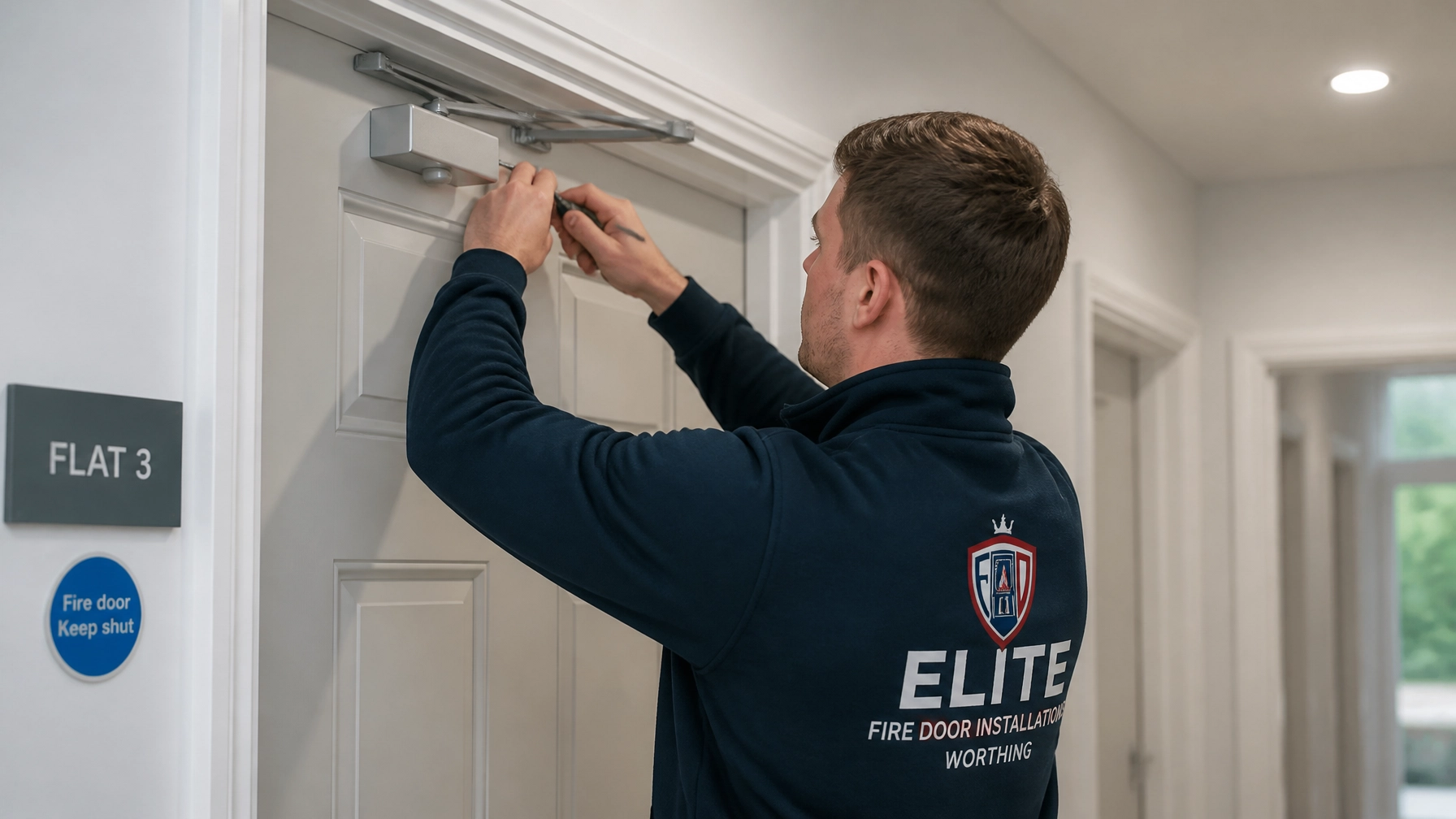
Fire doors are a critical component of building safety, particularly in the high-density rental market of Worthing. Whether you are managing a House in Multiple Occupation (HMO) near the seafront or a commercial property in the town centre, the integrity of your fire doors determines the safety of your occupants and your legal standing as a property owner.
However, a fire door is only as effective as its installation. Even a top-of-the-range FD30 or FD60 door leaf can fail to provide its rated protection if it is fitted incorrectly. In Worthing, where Adur & Worthing Council maintain stringent standards for property licensing, even minor installation errors can lead to failed inspections, heavy fines, or: most tragically: the loss of life.
Key Takeaways
- Precision Matters: Gap tolerances between the door and the frame must be maintained between 2mm and 4mm to ensure compliance.
- Hardware Compatibility: Every hinge, latch, and closer must be fire-rated and compatible with the specific door leaf.
- HMO Rigour: Worthing HMOs have specific licensing requirements that mandate certified fire door installations.
- Professional Certification: Using non-accredited installers is a leading cause of fire door failure and legal liability.
- Regular Maintenance: The coastal environment in Worthing can cause door warping; regular inspections are essential.
Table of Contents
- Mistake 1: Incorrect Gap Tolerances (The 4mm Rule)
- Mistake 2: Installing Non-Fire-Rated Hardware
- Mistake 3: Poorly Applied Intumescent Strips
- Mistake 4: Using Non-Certified Installers
- Mistake 5: Neglecting the Self-Closing Mechanism
- Mistake 6: Over-Trimming the Door Leaf
- Mistake 7: Ignoring Worthing’s Local HMO Licensing Standards
- Conclusion
Mistake 1: Incorrect Gap Tolerances (The 4mm Rule)
One of the most frequent errors we encounter during fire door repairs in Worthing is incorrect spacing. For a fire door to function, the gap between the door leaf and the frame at the top and sides must be between 2mm and 4mm.
If the gap is too narrow, the door may bind against the frame as the building settles or as humidity fluctuates: a common issue in coastal Worthing. Conversely, if the gap is wider than 4mm, fire and smoke can breach the opening before the intumescent strips have time to expand and seal the void.
The Fix: Use a gap gauge during every installation. If your existing doors have gaps exceeding 4mm, they are non-compliant. Professional adjustment or a replacement frame may be required to restore safety.

Mistake 2: Installing Non-Fire-Rated Hardware
A common misconception is that any heavy-duty hinge or lock is suitable for a fire door. This is false. All hardware: including hinges, handles, locks, and letter plates: must be fire-rated and tested as a complete system with the door leaf.
Using standard residential hinges on a fire door in a Worthing rental property is a high-risk error. Under the intense heat of a fire, non-rated hinges can melt or deform, causing the door to drop and allowing fire to bypass the protective barrier.
The Fix: Ensure all hardware carries a CE or UKCA mark and is compatible with the door’s fire rating (e.g., BS 476 or BS EN 1634). At Elite Fire Door Installations, we only use certified hardware that is documented to match the door leaf.
Mistake 3: Poorly Applied Intumescent Strips
Intumescent strips are the “active” ingredient of a fire door. These strips expand when exposed to heat, sealing the gaps and preventing the spread of fire. A major mistake is failing to install these strips continuously around the frame or door leaf, or worse, painting over them.
In Worthing, the salty sea air can sometimes cause adhesive failure on poorly fitted strips. If a strip is peeling, damaged, or interrupted by hardware that hasn’t been properly recessed, the door’s fire rating is compromised.
The Fix: Replace any damaged or missing seals immediately. Ensure that the grooves for the strips are cut with precision so the seals sit flush and remain effective.
Mistake 4: Using Non-Certified Installers
Many landlords in Worthing attempt to save costs by using general handymen for fire door fitting. However, fire door installation is a specialist skill that requires an understanding of “compartmentation”: the science of containing a fire within a specific area.
A non-certified installer may not be aware of the “Regulatory Reform (Fire Safety) Order 2005” or the specific requirements of “Approved Document B.” If a fire occurs and the doors are found to be incorrectly installed by an unaccredited individual, the property owner faces severe legal liability.
The Fix: Always hire certified fire door installers. Look for accreditations such as FireQual or UK Fire Door Training Approved Installers to ensure the work is legally compliant.

Mistake 5: Neglecting the Self-Closing Mechanism
A fire door is only a fire door when it is closed. In many Worthing HMOs, we see fire doors where the self-closing device (the “closer”) has been disconnected or incorrectly adjusted. If a door does not fully latch from any open position, it is non-compliant.
Common issues include:
- Closers being too weak to overcome the resistance of smoke seals.
- Incorrectly fitted overhead closers that pull the hinges out of the frame.
- The use of “perko” style closers on doors where they are not rated for the door’s weight.
The Fix: Test your closers monthly. The door must close firmly into the frame and engage the latch without human intervention. If it fails, immediate adjustment or replacement by a professional is necessary.
Mistake 6: Over-Trimming the Door Leaf
Every fire door has a “trimming allowance” specified by the manufacturer. This is the maximum amount of timber that can be removed from the edges to fit the frame. Over-trimming is a critical mistake that removes the solid core of the door, rendering its fire-resistance rating void.
In older Worthing properties with non-standard door frames, it is tempting to trim a door to fit. However, if you exceed the 3mm to 10mm allowance (depending on the brand), the door is no longer a certified fire door.
The Fix: Measure your frames accurately before ordering doors. If a frame is significantly out of square, it is often safer and more cost-effective to replace the frame than to over-trim a certified door leaf.
Mistake 7: Ignoring Worthing’s Local HMO Licensing Standards
Adur & Worthing Council have specific requirements for Houses in Multiple Occupation. These often include the requirement for FD30S doors (fire doors with smoke seals) on all bedroom and kitchen entrances.
Landlords often make the mistake of installing standard FD30 doors without smoke protection, or failing to provide the necessary certification paperwork to housing officers during a licensing inspection. This can result in a refusal of the HMO licence or a requirement for expensive remedial work.
The Fix: Work with HMO compliance specialists who understand the local Worthing regulations. Ensure you receive a certificate of compliance for every door installed.

How Elite Fire Door Installations Can Help
Navigating the complexities of fire safety regulations in Worthing can be daunting. At Elite Fire Door Installations, we specialise in taking that burden off your shoulders. We provide a comprehensive service that covers everything from initial surveys to final certification.
Our Expert Workflow:
- Assessment: We conduct a thorough inspection of your existing doors and frames to identify non-compliance.
- Tailored Specification: We provide a detailed quote for the exact doors and hardware required for your specific property type (HMO, commercial, or residential).
- Precision Installation: Our accredited team carries out the fire door installation in Worthing with meticulous attention to gap tolerances and hardware compatibility.
- Certification: We provide the necessary documentation to prove your compliance to local authorities and insurers.
Conclusion
Fire door installation is not a standard carpentry task; it is a life-saving safety installation. By avoiding these seven common mistakes: ranging from incorrect gap sizes to hiring uncertified installers: you protect your residents, your property, and your legal standing.
In Worthing’s competitive rental and commercial market, maintaining high safety standards is not just a legal obligation; it is a mark of professional property management. Whether you need a single repair or a full HMO upgrade, ensure the work is done right the first time.
Do you have concerns about the fire doors in your Worthing property? Don’t wait for an inspection failure to take action.
Contact Elite Fire Door Installations today to book your certified installation or repair.

Leave a Reply