

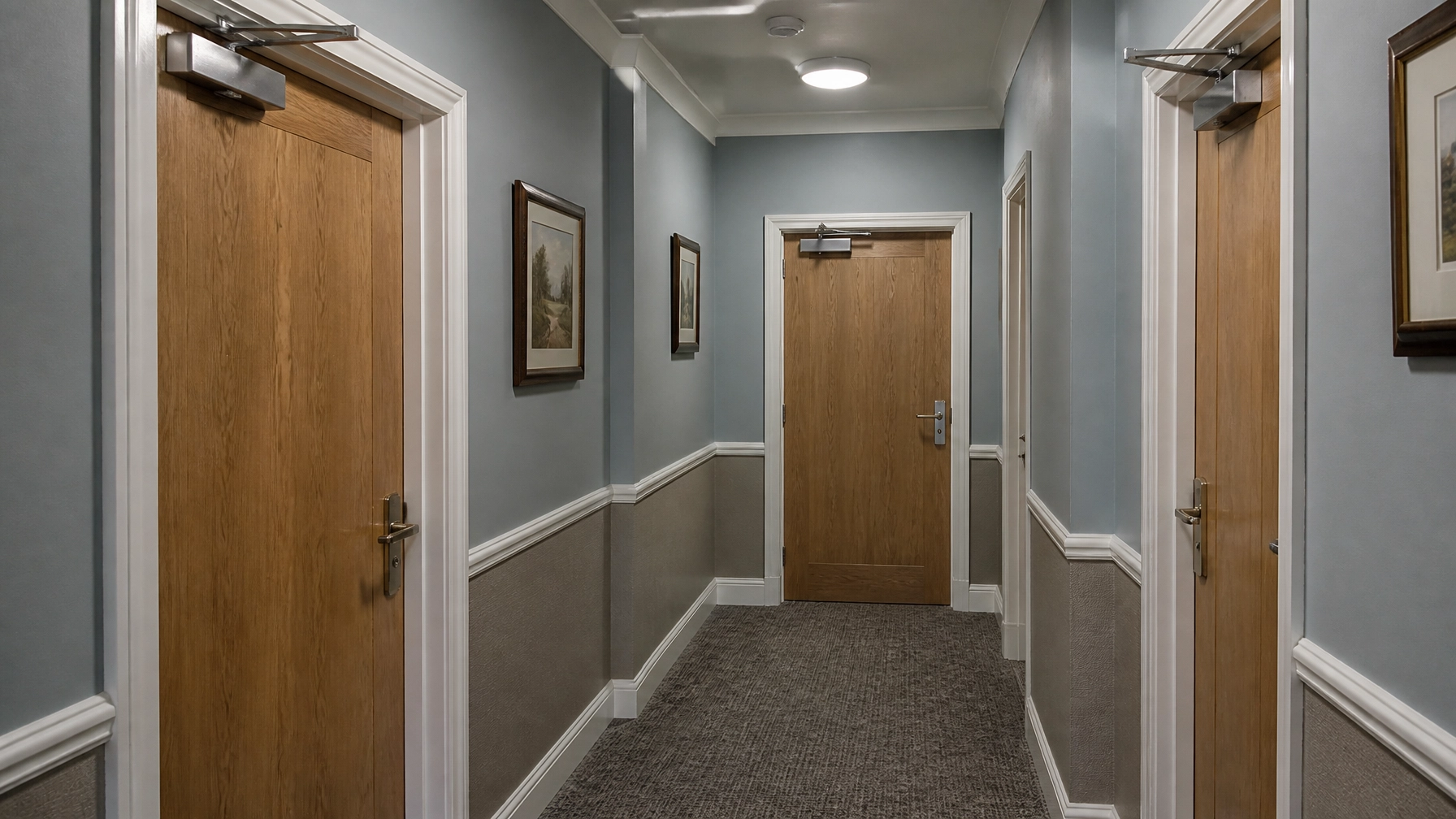
1. Establish a Reliable Fire Door Maintenance Routine
Fire doors play an important role in protecting guests, staff and escape routes within B&Bs and guest houses. When properly maintained, they help slow the spread of fire and smoke, support compartmentation and give occupants more time to leave safely.
For owners and managers, planned maintenance also makes property management more predictable. Regular professional reviews can identify problems before they become urgent, support a clear fire safety record and reduce the disruption associated with unexpected remedial work.
This guide explains the warning signs to discuss with a qualified professional and outlines a simple process for keeping fire door responsibilities under control.
Key Takeaways
- Maintain fire doors, closers, seals and hardware in effective working order.
- Treat doors that do not close correctly or show visible damage as matters for qualified professional review.
- Reassess fire doors after decorating, refurbishment or changes to the building layout.
- Keep clear records of surveys, quotations, repairs and completed works.
- Use proportionate repairs or upgrades where appropriate instead of assuming every door requires replacement.
- Arrange professional support through Fire Door Surveys for Quotations and Fire Door Maintenance services.
Table of Contents
- Establish a Reliable Fire Door Maintenance Routine
- Understand the Legal Stakes of Poor Maintenance
- Translate Your Fire Risk Assessment into Action
- Choose Proportionate Repairs or Replacement
- Prepare Guest Houses for Refurbishment and Ongoing Use
- Follow a Clear Professional Maintenance Process
- Answer Common B&B Fire Door Questions
- Arrange Professional Support and Documentation
- Conclude with a Practical Compliance Plan
2. Understand the Legal Stakes of Poor Maintenance
Under the Regulatory Reform (Fire Safety) Order 2005, the responsible person must take suitable measures to protect people from fire risks. For a B&B or guest house, this will usually involve the owner, operator or another person with control of the premises.
Fire doors form part of the building’s overall fire safety arrangements. They must be suitable for their location and kept in efficient working order. The associated fire risk assessment should identify relevant doors, escape routes, maintenance arrangements and the frequency of professional reviews.
The Fire Safety Act 2021 and subsequent fire safety legislation have reinforced the importance of responsible fire safety management. The exact duties will depend on the building’s construction, layout, use, height and occupancy. Owners should therefore avoid relying on a generic checklist or assumptions based on another property.
Poorly maintained doors can create several consequences:
- Compromise guest safety and escape route protection.
- Lead to adverse findings in a fire risk assessment.
- Create difficulties with insurers, licensing bodies or other authorities.
- Increase the likelihood of emergency remedial work.
- Leave the responsible person with incomplete evidence of suitable maintenance.
GOV.UK provides specific guidance for small paying guest accommodation, including B&Bs and guest houses. Owners should use that guidance alongside a property-specific fire risk assessment and qualified professional advice.
3. Translate Your Fire Risk Assessment into Action
A fire risk assessment may identify concerns such as damaged fire doors, ineffective self-closing devices, missing seals or unsuitable alterations. The report is an important starting point, but it may not provide the full physical scope needed for remedial work.
A professional fire door survey translates the findings into a practical action plan. The process should identify:
- The location and purpose of each relevant fire door.
- Whether the door protects a bedroom, corridor, staircase or service area.
- The condition of the door leaf, frame, seals and hardware.
- Whether previous works have affected the door’s performance.
- Which items require repair, upgrade or replacement.
- What documentation should be retained after the work.
Discuss Warning Signs with a Qualified Professional
Owners should arrange a professional review if they notice:
- A door that does not close fully into its frame.
- A door that catches on the floor, frame or surrounding finishes.
- Damaged, split, warped or heavily worn door edges.
- Intumescent or smoke seals that appear loose, incomplete or deteriorated.
- Hinges, latches, handles or closers that appear loose or damaged.
- A door that has been wedged, propped open or altered for convenience.
- New holes, glazing, letterplates or fittings added without documented approval.
- Changes made during decorating, flooring work or refurbishment.
These signs should be reported and recorded rather than dealt with through improvised adjustments. Fire door performance depends on the compatibility of the complete doorset, so repairs should be assessed and carried out by a qualified specialist.

4. Choose Proportionate Repairs or Replacement
A visible defect does not automatically mean that the entire doorset must be replaced. Equally, a simple repair is not always suitable. The correct decision depends on the door’s construction, condition, location, history and the requirements identified by the fire risk assessment.
Elite Fire Door Installations assesses each door carefully before recommending works. Where appropriate, a qualified professional may be able to:
- Repair damaged components.
- Re-lip suitable door edges.
- Upgrade compatible hardware.
- Restore effective closing and latching.
- Renew appropriate seals.
- Replace a door or frame where the existing assembly cannot provide dependable performance.
This proportionate approach can help B&B and guest-house owners control costs without compromising safety. It also reduces unnecessary disruption to bedrooms, reception areas and guest routes.
Where full replacement is required, a professional Fire Door Installation should be planned around guest bookings and property operations. Clear scheduling helps keep disruption to a minimum.
5. Prepare Guest Houses for Refurbishment and Ongoing Use
Decorating and refurbishment can unintentionally affect fire doors. New carpets may alter clearances. Additional paint may affect movement or seals. Replacement handles, locks, closers or vision panels may not be suitable for the existing doorset.
Before starting refurbishment, owners should include fire door requirements within the project brief and budget. This is especially important when converting, extending or reorganising guest accommodation.
Protect Safety During Property Changes
Plan for:
- A professional survey before major refurbishment begins.
- Confirmation of which doors protect escape routes and fire compartments.
- Compatibility checks for any proposed hardware or glazing.
- Review of door frames and thresholds after flooring changes.
- A post-work professional review before affected rooms return to use.
- Updated records showing what changed and why.
Although this article focuses on B&Bs and guest houses, the same principles apply to investors preparing buildings for different forms of accommodation, including HMOs. A property conversion budget should allow for HMO Fire Door Upgrades where the proposed layout and fire risk assessment require them.

6. Follow a Clear Professional Maintenance Process
A straightforward process helps owners make decisions confidently and avoid unnecessary delays.
Step One: Arrange a Survey
Begin with a professional Fire Door Survey for quotations. The qualified specialist reviews the relevant doors, surrounding conditions and available documentation.
Step Two: Receive Clear Recommendations
The findings should separate urgent concerns from planned improvements. Each recommendation should explain whether the appropriate response is repair, upgrade or replacement.
Step Three: Approve a Fixed-Price Scope
A clear quotation should set out the proposed works, affected doors, materials, expected timescales and any access requirements. This gives owners better control over budgets and guest-room availability.
Step Four: Complete Qualified Remedial Work
Professional work may involve carefully selected UK-standard components and specialist tools, including:
- Fire Door Gap Gauges.
- Intumescent Seal Routers.
- Hinge Jigs.
- Fire-Rated Packers.
- Digital Inclinometers.
- Force Gauges.
- Laser Levels.
- Suitable intumescent mastic or sealant.
These tools support precision, but they must be used by appropriately qualified professionals who understand fire door assemblies and the relevant requirements of BS 476-22 and BS 8214.
Step Five: Receive the Compliance File
After completion, retain a signed compliance file containing the survey findings, quotation, completed works, product details, photographs where appropriate and any recommendations for future maintenance.

7. Answer Common B&B Fire Door Questions
How often should fire doors in a guest house be reviewed?
The suitable frequency should be determined by the fire risk assessment, the building’s use and the level of traffic through each door. Sleeping accommodation normally requires consistent planned attention. A qualified professional can recommend a proportionate schedule and identify which records should be kept.
What should I do if a bedroom fire door no longer closes properly?
Remove the issue from informal maintenance arrangements and arrange a professional review promptly. A door that fails to close may not provide the intended protection to an escape route. Do not adjust, wedge or modify the door without qualified advice.
Can a fire door be repaired instead of replaced?
Sometimes. A qualified specialist should assess the complete doorset before making a recommendation. Suitable repairs, re-lipping or hardware upgrades may be possible, but replacement may be necessary where damage, alteration or incompatibility prevents dependable performance.
Do decorating works affect fire doors?
They can. Paint build-up, new flooring, altered frames and replacement hardware may affect closing, clearances or seals. Include fire doors in the refurbishment plan and arrange a professional review before the affected areas return to normal use.
What records should a B&B owner keep?
Keep the current fire risk assessment, professional survey reports, quotations, invoices, repair details, product information and signed completion documents. A simple maintenance log should also record dates, findings, reported defects and actions taken.
8. Arrange Professional Support and Documentation
A planned maintenance routine gives owners a practical way to protect guests, manage costs and demonstrate responsible fire safety arrangements. Elite Fire Door Installations provides professional Fire Door Repairs, Fire Door Installations and surveys for quotations across East Sussex and the wider South East.
The service is designed around review, clear quoting, proportionate repair or upgrade, minimal disruption and the provision of a signed compliance file.
For general information about fire safety responsibilities in small paying guest accommodation, refer to the relevant GOV.UK guidance.
9. Conclude with a Practical Compliance Plan
Well-maintained fire doors support safer guest accommodation and more dependable escape routes. They also help B&B and guest-house owners manage legal responsibilities through planned work and clear documentation.
The most effective approach is simple: review the property, record warning signs, obtain qualified recommendations, approve a clear scope and retain the completed compliance file. Do not leave damaged doors, worn seals or refurbishment changes until they become urgent problems.
To arrange a professional survey or discuss a planned Fire Door Upgrade, visit Elite Fire Door Installations. A calm, structured maintenance plan can provide lasting reassurance for owners, staff and guests.
Contact Elite Fire Door Installations
- Email: info@elitefiredoorinstallations.co.uk
- Specialist Support: +44 7514 898517
- Request a call back: +44 20 4511 9456
- Website: https://elitefiredoorinstallations.co.uk
Note: This information is intended as general guidance and does not constitute professional or legal advice. Always consult a qualified fire safety engineer for your specific property.
Leave a Reply