

For property owners and landlords in Brighton & Hove, fire safety is not merely a box-ticking exercise: it is a critical legal and moral obligation. With the city’s unique mix of historic Victorian conversions, modern coastal apartments, and a high density of Houses in Multiple Occupation (HMOs), ensuring your property meets the latest fire safety standards is paramount.
Fire door installation in Brighton & Hove requires more than just a skilled carpenter; it demands a deep understanding of the Regulatory Reform (Fire Safety) Order 2005 and local council licensing standards. In this comprehensive guide, we will explore everything you need to know about fire door installation, repairs, and maintenance to ensure your property remains compliant, safe, and fully insured.
Understanding Fire Door Regulations in Brighton & Hove
Navigating the landscape of fire safety regulations can be complex. In Brighton & Hove, landlords must adhere to several layers of legislation to ensure their buildings are safe for inhabitants and visitors.
The Regulatory Reform (Fire Safety) Order 2005 (FSO)
The FSO is the primary piece of legislation governing fire safety in non-domestic premises, including the communal areas of residential buildings. Under this order, the “Responsible Person” (usually the landlord or property manager) must ensure that fire doors are kept in efficient working order. Failure to do so can lead to severe penalties, including unlimited fines and, in extreme cases, imprisonment.
Brighton & Hove City Council HMO Licensing
Brighton & Hove has stringent HMO licensing requirements. The council’s standards specifically reference the LACORS Housing – Fire Safety guidance. This means that if you operate a shared house or bedsits, your fire doors must meet specific ratings: typically FD30s: to protect escape routes. These doors must provide 30 minutes of fire resistance and include cold-smoke seals to prevent the passage of toxic gases.
Building Regulations and British Standards
When undergoing renovations or conversions, compliance with Building Regulations Part B is mandatory. Furthermore, all installations should follow BS 8214:2016, the code of practice for fire door installation and maintenance. This standard ensures that the door, frame, and hardware function as a singular, effective fire-resisting unit.
Why Professional Fire Door Installation in Brighton is Essential
While a standard internal door might seem simple to install, a fire door is a life-saving piece of engineered equipment. Professional fire door installation in Brighton & Hove ensures that every component: from the hinges to the intumescent strips: is fitted with absolute precision.

Ensure Structural Integrity
A fire door is only as good as its installation. If the gap between the door and the frame is too large, or if the frame isn’t correctly fire-stopped against the wall, the door will fail prematurely during a fire. Professional installers use certified materials to seal these “linear gaps,” ensuring the fire rating is maintained.
Restore Compliance with Certified Hardware
Every piece of ironmongery on a fire door must be fire-rated. This includes hinges (typically grade 11 or higher to BS EN 1935), self-closing devices, and locks. At Elite Fire Door Installations, we ensure all hardware is compatible with the door’s specific test evidence. Using incorrect or non-rated hardware can invalidate the entire door’s certification.
Achieve Peace of Mind
By choosing an accredited installer, you receive the documentation necessary to prove compliance to local authorities and insurance providers. This documentation is vital during council inspections or if you are seeking to sell your property.
The Anatomy of a Compliant Fire Door
To “succeed” in your fire door project, you must understand the key components that make a door compliant. A standard fire door setup in a Brighton HMO or commercial property usually consists of:
- The Door Leaf: Usually an FD30 or FD60 rated solid-core door.
- Intumescent Strips: These expand when exposed to heat, sealing the gap between the door and the frame to block fire.
- Smoke Seals: Often combined with intumescent strips, these prevent smoke: the leading cause of death in house fires: from passing through.
- Self-Closing Device: Mandatory for HMO fire doors, ensuring the door closes automatically and securely into the frame.
- Fire-Rated Hinges: At least three hinges are required to prevent the door from warping under the intense heat of a fire.
Specific Requirements for HMOs in Brighton & Hove
Brighton & Hove’s high population of students and young professionals has led to a significant number of HMOs. These properties are subject to higher risks and, consequently, stricter rules.
Protecting the Escape Route
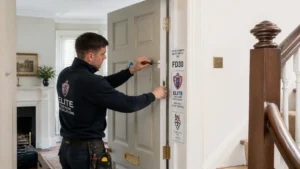
In most Brighton HMOs, every door opening onto the main escape route (the hallways and stairs) must be a fire door. This provides residents with a protected corridor to exit the building safely. Kitchens, which are considered high-risk areas, must always be fitted with compliant FD30s doors.
Maintenance and Inspections
The law requires that fire doors are regularly inspected. For HMOs, we recommend a professional inspection at least every six months. In buildings with high footfall, more frequent checks may be necessary. Our team provides detailed reports identifying issues such as worn seals, damaged closers, or excessive gaps.
Fire Door Repairs vs. Replacement: Making the Right Choice
Not every issue requires a completely new door. Fire door repairs in Brighton & Hove can often restore a door to full compliance at a fraction of the cost of replacement.

When to Repair
- Minor Gap Issues: If the gaps have shifted slightly due to building movement, they can often be adjusted.
- Faulty Hardware: Replacing a broken self-closer or a damaged hinge is a standard repair.
- Damaged Seals: Intumescent and smoke seals are easily replaced if they become peeled or worn.
When to Replace
- Structural Damage: If the door leaf is cracked, warped, or has holes drilled into it that compromise the core.
- Non-Compliant Core: Older doors that do not have a certified fire-resisting core must be replaced with modern FD30 or FD60 units.
- Excessive Trimming: If a door has been trimmed beyond the manufacturer’s allowed limits, it no longer carries its fire rating and must be replaced.
Our Process: From Survey to Certification
At Elite Fire Door Installations, we pride ourselves on a structured, professional approach that takes the stress out of compliance for Brighton landlords.
- Step One: Assessment: We conduct a thorough survey of your existing doors, checking against current Brighton & Hove council standards and national regulations.
- Step Two: Tailored Proposal: We provide a clear, itemised quote for necessary repairs or new fire door upgrades.
- Step Three: Expert Installation: Our certified technicians carry out the work with minimal disruption to your tenants, using professional-grade tools and certified components.
- Step Four: Certification: Once the work is complete, we provide the necessary documentation to prove your property is compliant.

Conclusion: Secure Your Property Today
Ensuring fire safety in Brighton & Hove is a continuous responsibility. Whether you are managing a single-occupancy rental or a large-scale HMO, the quality of your fire doors is the first line of defence against tragedy and legal liability. By investing in professional fire door installation and regular maintenance, you protect your residents, your investment, and your reputation.
Don’t leave your compliance to chance. Work with a certified partner who understands the local landscape and the technical intricacies of fire safety.
Ready to ensure your property is fully compliant?
Book your fire door survey or installation today via our client portal.
Leave a Reply