

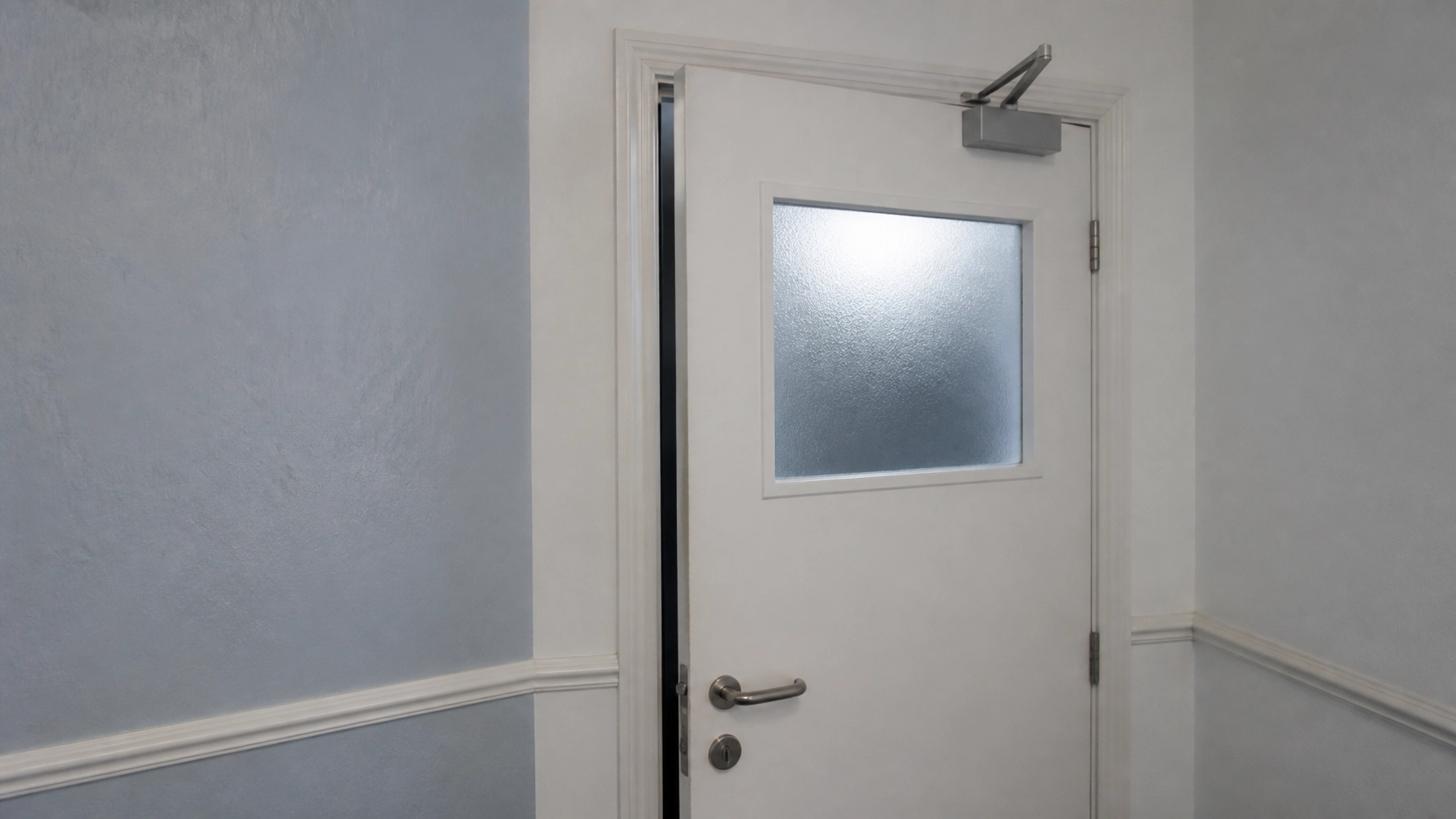
HHSRS fire-hazard guidance places significant emphasis on whether a rented property provides safe containment and escape during a fire. In an HMO, defective fire doors can allow smoke and flames to spread rapidly through communal areas, placing residents at serious risk and exposing landlords to enforcement action.
This guide explains five warning categories that should trigger professional action. HHSRS is risk-based and does not replace a property-specific Fire Risk Assessment (FRA). Fire door compliance should be assessed and remedied by qualified FRA assessors and Certified Installers.
Key Takeaways
- Treat doors that do not close, damaged seals, unsuitable hardware, compromised frames and obstructed escape routes as urgent warning signs.
- Understand that HHSRS assesses the likelihood and potential harm of a hazard rather than approving one universal fire door specification.
- Use a professional Fire Door Survey to translate FRA or HHSRS findings into a documented action plan.
- Do not attempt fire door repairs, hardware alterations or seal replacement without suitable competence and product evidence.
- Prepare HMO conversion budgets for surveys, certified Fire Door Installation, remedial work and compliance documentation.
- Choose qualified professionals who can work to BS 476-22 and BS 8214 standards.
Table of Contents
- 1. Understand the Legal Significance of HHSRS Fire Hazards
- 2. Identify Five Fire Door Warning Categories
- 3. Translate Findings into a Physical Action Plan
- 4. Choose Repair, Re-Lipping or Replacement
- 5. Prepare an HMO Conversion Budget
- 6. Follow a Certified Compliance Process
- 7. Answer Common HHSRS Fire Door Questions
- 8. Request Professional Support
- 9. Confirm Your Next Compliance Decision
1. Understand the Legal Significance of HHSRS Fire Hazards
Apply Risk-Based Guidance Correctly
The Housing Health and Safety Rating System considers hazards in residential properties by examining both the likelihood of an incident and the severity of its possible outcome. Fire is one of the hazards considered under the system.
For landlords, this means a fire door defect is not simply a maintenance issue. Its significance depends on the door’s position, the building layout, the number of occupants, the available escape routes and the likely consequences of failure.
The HHSRS Operating Guidance helps local authorities assess housing conditions. However, the guidance should not be treated as a replacement for a competent FRA or a detailed survey of individual fire doors.
Recognise the Difference Between HHSRS and an FRA
An FRA considers the overall fire strategy for a property. It may identify shortcomings involving compartmentation, alarms, escape routes, emergency lighting and fire doors.
HHSRS provides a broader housing-condition framework for assessing hazards. A local authority may use it when considering whether a rented property presents an unacceptable risk to occupants.
Neither process authorises a landlord to carry out technical remedial work without competence. Where a report identifies defective doors, engage qualified FRA assessors and Certified Installers to determine the correct solution.
2. Identify Five Fire Door Warning Categories
These five warning categories should prompt a professional response rather than informal maintenance.
Prioritise Doors That Do Not Close
A fire door that remains open, fails to latch or does not return reliably to its frame cannot provide dependable compartmentation. This is particularly serious when the door protects a bedroom, kitchen or communal route in an HMO.
A failed self-closing device may result from unsuitable hardware, misalignment, damage or previous alterations. The cause must be established by a competent professional. Do not wedge the door open, disable the closer or attempt to adjust it without the correct technical knowledge and manufacturer evidence.
The Fire Safety (England) Regulations 2022 guidance reinforces the importance of fire doors closing correctly and residents reporting faults.
Respond to Damaged or Missing Seals
Intumescent strips and cold smoke seals help a fire door resist the passage of fire and smoke. Warning signs include missing sections, torn seals, painted-over material, loose edges and visible gaps at corners.
A seal that appears present may still be unsuitable for the door-set, damaged by previous work or incompatible with the frame. Replacing it with an unverified product can undermine the door’s tested performance.
A professional survey should establish whether the seal arrangement remains appropriate and whether certified Fire Door Repairs are possible.

Replace Unsuitable Hardware Professionally
Hardware is part of the fire door assembly. Hinges, latches, locks, closers, handles and fixings must be suitable for use with the specific door-set.
Examples of concern include damaged hinges, missing fixings, incompatible locks, non-fire-rated components and hardware that prevents occupants from escaping quickly. A door may look modern and secure while still failing to provide the necessary fire performance.
Certified professionals can assess whether the existing hardware is suitable or whether a controlled upgrade is required. UK-standard products may include BS EN 1935 hinges and BS EN 1154 door closers, subject to the door manufacturer’s evidence and the building’s fire strategy.
Assess Compromised Frames
A fire door leaf cannot perform as intended if its frame is badly damaged, distorted, poorly aligned or unsuitable for the opening. Excessive or inconsistent gaps, damaged rebates and evidence of unauthorised alterations can all indicate a compromised door-set.
Frame problems may be concealed beneath layers of paint or previous repair work. They may also arise after building movement, repeated impact or alterations by other contractors.
A Certified Installer should assess the complete assembly rather than focusing only on the door leaf. Solutions may include a certified repair, re-lipping, frame remediation or full replacement.
Clear Obstructed Escape Routes
A compliant fire door cannot compensate for a blocked escape route. Furniture, refuse, bicycles, stored materials and other combustible items can delay evacuation and increase fire growth.
In an HMO, communal corridors and staircases should remain available for escape and should form part of the property’s planned fire strategy. Obstructions may also prevent fire doors from closing fully or cause residents to wedge doors open.
Landlords and property managers should treat a narrowed or obstructed route as an urgent management issue and obtain professional advice where the arrangement affects the protected escape route.

3. Translate Findings into a Physical Action Plan
FRA and HHSRS wording can be broad. A report may refer to inadequate fire separation, defective self-closers or doors requiring remedial action without identifying the most economical compliant solution.
Elite Fire Door Installations translates those findings into a structured plan through professional Fire Door Surveys. The process considers:
- The location and purpose of each door.
- The condition of the leaf, frame, seals and hardware.
- The relationship between the door and the property’s escape strategy.
- Whether suitable evidence supports repair or upgrade.
- Whether replacement is necessary to restore reliable compliance.
- The documentation required at handover.
This approach helps landlords control risk, prioritise urgent work and avoid commissioning unnecessary replacements.
4. Choose Repair, Re-Lipping or Replacement
A failed fire door does not automatically require complete replacement. In suitable cases, certified experts may be able to repair, re-lip or upgrade the existing door-set while retaining sound components.
However, repairability depends on the extent of damage, the construction of the door, the condition of the frame, the available certification and the compatibility of proposed components. A cosmetic repair is not enough.
Elite Fire Door Installations assesses each door individually before recommending Fire Door Installation or remedial work. All technical decisions should be made by Certified Installers with appropriate product knowledge and evidence.

5. Prepare an HMO Conversion Budget
Investors buying a property for HMO conversion should assess fire door requirements before exchange wherever possible. Defects discovered after completion can affect renovation budgets, licensing timescales and projected rental income.
Allow for:
- A property-specific FRA by a qualified assessor.
- A professional Fire Door Survey for quotations.
- Potential door-set repairs, re-lipping or replacement.
- Fire-rated hinges, closers, latches, seals and other hardware.
- Frame repairs and associated making-good.
- Protected escape route improvements.
- Installation records and compliance documentation.
- Additional work where the existing layout does not support the proposed occupancy.
Early assessment gives investors a clearer understanding of the property’s actual condition. It also reduces the risk of relying on a generic specification that does not suit the building.
6. Follow a Certified Compliance Process
Elite Fire Door Installations follows a structured process designed to provide precision, transparency and minimal disruption.
- Survey: Review the relevant doors, frames, hardware and escape-route context. Findings are recorded for quotation and remedial planning.
- Fixed-price quoting: Set out the recommended works clearly, distinguishing repair, upgrade and replacement requirements.
- Certified execution: Complete approved works using appropriate UK-standard equipment, including Fire Door Gap Gauges, Intumescent Seal Routers, Hinge Jigs, Fire-Rated Packers, Digital Inclinometers, Force Gauges, Laser Levels and certified Intumescent Mastic/Sealant. Work is undertaken by Certified Installers in line with BS 476-22, BS 8214 and relevant FireQual standards.
- Compliance handover: Provide the available installation, repair and product documentation needed for the landlord’s compliance records and future FRA review.
This controlled process supports legal adherence and gives property owners clearer evidence of what has been completed.
7. Answer Common HHSRS Fire Door Questions
Does HHSRS Specify One Universal Fire Door Standard?
No. HHSRS is risk-based. It considers the property, occupants, construction, escape arrangements and likely consequences of fire. Specific fire door requirements should be confirmed through a property-specific FRA and competent professional advice.
Can a Failed Fire Door Always Be Repaired?
No. Some doors can be repaired, re-lipped or upgraded, but others have damage, incompatible construction or insufficient evidence for safe remediation. A Certified Installer must assess the complete door-set before recommending a solution.
Who Should Assess Fire Doors in an HMO?
A qualified FRA assessor should consider the property’s overall fire strategy. A Certified Installer should assess physical door condition and carry out any authorised remedial works. These roles should not be replaced by unqualified maintenance.
How Do Escape Route Problems Affect Fire Door Compliance?
Blocked or narrowed routes increase the risk of delayed evacuation and may prevent fire doors from functioning correctly. Escape-route obstructions should be addressed promptly and considered alongside the property’s FRA.
What Documents Should an HMO Landlord Retain?
Keep the FRA, Fire Door Survey, quotation, product information, installation or repair records, photographs where appropriate and any handover documentation. Clear records support ongoing management and future compliance reviews.
8. Request Professional Support
If an HHSRS assessment or FRA has identified fire door hazards, act before the issue escalates into licensing delays, enforcement action or greater liability.
Book a professional survey or installation through Elite Fire Door Installations for a clear, tailored route towards compliance.
Email: info@elitefiredoorinstallations.co.uk
Specialist Support: +44 7514 898517
Request a call back: +44 20 4511 9456
Website: https://elitefiredoorinstallations.co.uk
9. Confirm Your Next Compliance Decision
Doors that do not close, damaged seals, unsuitable hardware, compromised frames and obstructed escape routes are all warning signs that deserve professional action.
HHSRS helps identify housing hazards, but it does not replace a competent FRA or a detailed fire door assessment. For HMO landlords and investors, the safest approach is to obtain qualified advice early, establish whether repair or replacement is appropriate, and retain clear evidence of the work.
Elite Fire Door Installations provides expert HMO Fire Door Upgrades, professional surveys and certified installations designed to restore safety, compliance and peace of mind.
Note: Summarised by artificial intelligence technology. This is not professional or legal advice.
Leave a Reply