

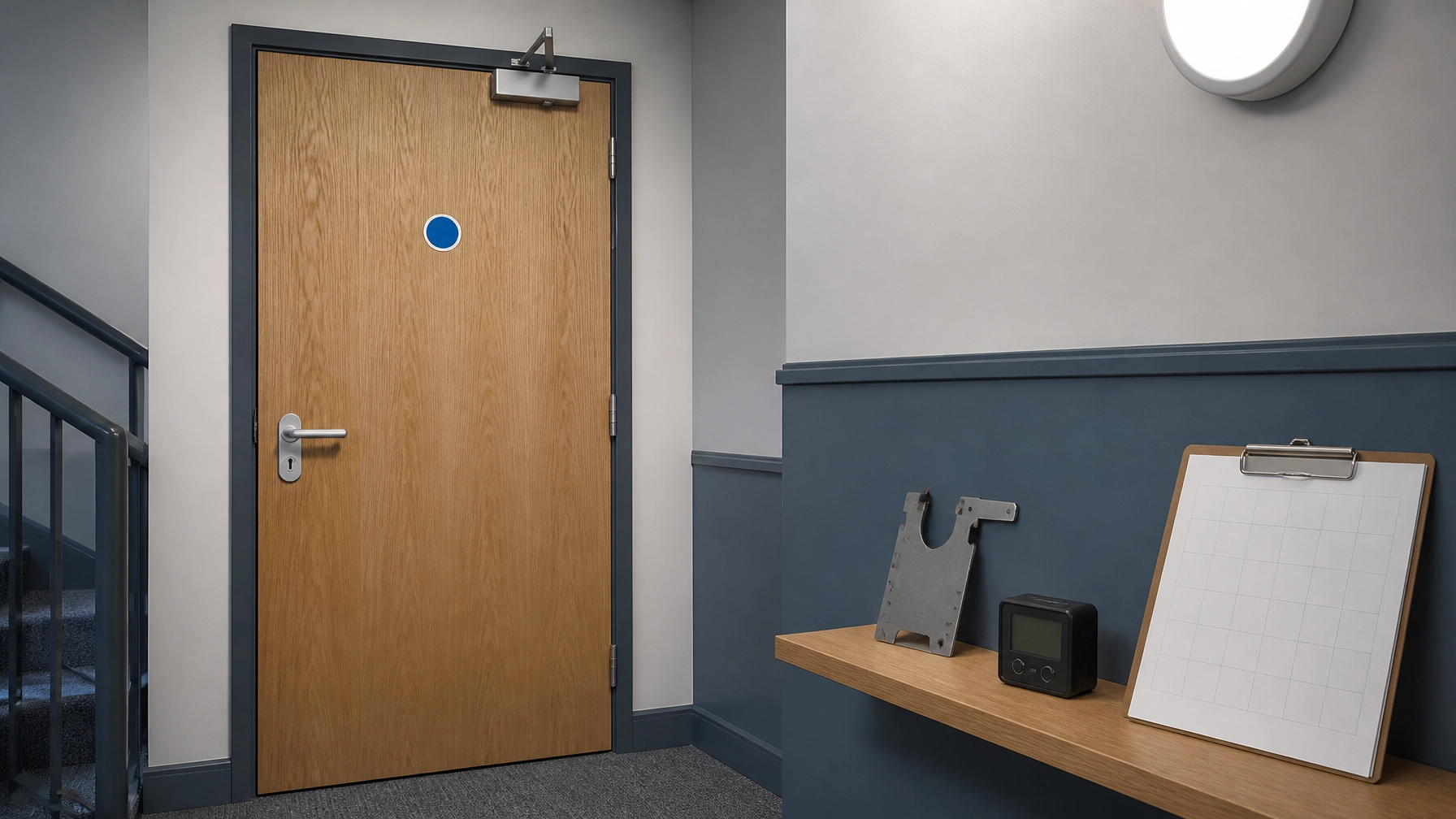
Stop Failed Fire Doors Before They Escalate
Regulation 10 fire door duties require responsible persons to plan, record and respond to routine fire door checks. For qualifying residential buildings, communal fire doors must be checked every three months, while responsible persons must use best endeavours to check flat entrance doors annually.
These checks do not replace a Fire Risk Assessment (FRA), planned maintenance or competent remedial work. They form part of a wider compliance system designed to identify faults before they compromise fire separation, resident safety or legal adherence.
If a check identifies a concern, arrange professional support promptly through Fire Door Surveys for Quotations, Fire Door Repairs or Fire Door Installations.
Key Takeaways
- Apply Regulation 10 where the legal criteria for the residential building are met.
- Schedule visual communal fire door checks at least once every three months.
- Use best endeavours to arrange annual checks of applicable flat entrance doors and their self-closing devices.
- Give residents clear information about keeping fire doors closed and reporting faults.
- Record every check, access attempt, fault, escalation and completed remedial action.
- Treat routine checks as an early-warning measure, not as a replacement for an FRA.
- Refer physical faults, adjustments and remedial decisions to qualified professionals and Certified Installers.
Table of Contents
- Understand the Legal Scope
- Build a Practical Compliance Calendar
- Translate Findings into Action
- Choose Repair or Replacement Professionally
- Prepare an HMO Investment Budget
- Follow a Certified Delivery Process
- Answer Common Regulation 10 Questions
- Request Professional Support
- Conclude with a Clear Compliance Plan
Understand the Legal Scope of Regulation 10
Regulation 10 forms part of the Fire Safety (England) Regulations 2022. It applies to residential buildings containing two or more sets of domestic premises and standing more than 11 metres in height. The exact application must be confirmed against the building’s structure, use and fire safety arrangements.
Where the regulation applies, the responsible person must:
- Arrange quarterly visual checks of fire doors in communal areas.
- Include the self-closing devices in those checks.
- Use best endeavours to check applicable flat entrance fire doors at least every 12 months.
- Include the self-closing devices serving those flat entrance doors.
- Provide residents with information about the importance of fire doors and the need to keep them closed.
The responsible person may be a landlord, freeholder, managing agent, resident management company or another party with control of fire safety arrangements. Duties can be delegated operationally, but accountability cannot simply be transferred to an unqualified contractor.
A failed fire door can increase the spread of smoke and fire, expose residents to danger and create evidence of inadequate management. Enforcement action may follow where responsible persons cannot demonstrate suitable arrangements, records and timely escalation.
Read the official Regulation 10 fire door fact sheet and the legislation itself.
Build a Practical Compliance Calendar
A calendar makes Regulation 10 duties visible and accountable. It should identify each relevant door, the person responsible for coordinating access, the date of each check and the status of any corrective work.
Schedule monthly administration
Monthly administration should support the formal quarterly and annual duties. Responsible persons should:
- Review open fault reports.
- Confirm that urgent issues have been escalated.
- Check that resident communications remain current.
- Update the fire door register when doors, residents or management arrangements change.
- Confirm that completed work has supporting documentation.
This is a management activity, not a substitute for a professional survey or FRA.
Complete quarterly communal checks
Set fixed dates for communal fire door checks in January, April, July and October, or use another consistent three-month cycle. The programme should cover doors serving corridors, stairways, lobbies, plant areas and other common parts.
The check should identify visible damage, apparent defects, missing or damaged seals, problems with closing and latching, insecure hardware, glazing concerns, unauthorised alterations and missing signage where required. It should remain a visual and functional check rather than an attempt to diagnose or repair complex defects.
Do not ask unqualified occupants or caretakers to adjust closers, remove seals, alter hinges or make other physical changes. Record the concern and refer it to qualified professionals.
Arrange annual flat entrance door checks
For applicable buildings, schedule annual checks of flat entrance doors and their self-closing devices. Start the access programme well before the due date. Write to residents, offer reasonable appointments and keep evidence of every attempt.
Best endeavours means more than sending one letter. Maintain records of:
- Notices issued.
- Dates and times offered.
- Alternative appointments.
- Follow-up messages.
- Missed appointments.
- Refusals or access restrictions.
- Further escalation through the appropriate management or legal process.
Where access remains unavailable, the documented evidence of reasonable efforts becomes important.

Translate Findings into Action
Routine checks should produce a clear record, not an ambiguous note such as “door needs attention”. Describe the location, door reference, visible concern, date identified, immediate risk and action taken.
A practical escalation sequence is:
- Record the concern in the fire door register.
- Assess urgency through the responsible person’s fire safety management arrangements.
- Restrict or manage the risk where appropriate, without undertaking unauthorised alterations.
- Arrange a professional survey when the defect requires technical evaluation.
- Obtain a defined quotation for repair, upgrade or replacement.
- Complete remedial work through Certified Installers.
- Collect handover evidence and close the record only when the action is properly documented.
A professional survey can help establish whether a door is suitable for repair, re-lipping, hardware upgrades or full replacement. It can also identify whether the frame, seals, hinges, closer and surrounding construction require coordinated attention.
Elite Fire Door Installations works to relevant standards, including BS 476-22 and BS 8214, while recognising that the correct solution depends on the evidence available for the individual door set.
Choose Repair or Replacement Professionally
A failed fire door does not automatically require complete replacement. Some door sets may be capable of physical repair, re-lipping or compliant upgrading. Others may have damage, incompatibility or missing evidence that makes replacement the more responsible option.
The decision should be based on:
- The door leaf and frame condition.
- The fire performance information available.
- The compatibility of existing hardware.
- The condition of intumescent protection.
- The extent of damage or unauthorised modification.
- The findings of the FRA and professional survey.
- The cost, disruption and risk of each option.
This evaluation must be performed by qualified professionals. A low-cost alteration that compromises the door’s tested performance can create greater financial and legal exposure than a properly specified replacement.
Our Fire Door Repairs focus on restoring functionality and compliance where a suitable repair is technically justified. Where a new door set is required, our Fire Door Installations provide a controlled route to specification, fitting and documentation.
Prepare an HMO Investment Budget
Property investors converting a building into an HMO should treat fire door compliance as a core renovation cost, not an afterthought. Initial licensing or FRA findings may identify doors that need replacement, upgrading, improved self-closing performance or supporting evidence.
Before exchange or before starting works, budget for:
- A professional fire door survey across the proposed accommodation.
- Communal and bedroom entrance door requirements.
- Suitable frames, hinges, closers, latches and intumescent protection.
- Fire-rated glazing or other specialist components where applicable.
- Remedial work to damaged or altered door leaves.
- Coordination with compartmentation and escape route works.
- Resident or tenant access arrangements.
- Completion records, product information and handover documentation.
- Contingency for concealed or previously undocumented defects.
An early HMO fire door upgrade assessment can prevent a purchase budget from being undermined by unplanned remedial costs. It can also help investors programme works before occupation, reducing disruption and avoiding delays to licensing or letting.
Follow a Certified Delivery Process
Elite Fire Door Installations applies a structured process for landlords, property managers and responsible persons.
Step One: Complete a survey
We establish the condition, configuration and likely compliance requirements of the relevant door sets. Professional UK-standard tools may include Fire Door Gap Gauges, Intumescent Seal Routers, Hinge Jigs, Fire-Rated Packers, Digital Inclinometers, Force Gauges and Laser Levels.
Step Two: Issue a fixed-price quotation
We explain whether the evidence supports repair, re-lipping, upgrading or replacement. The quotation should define the proposed scope and identify any exclusions or further information required.
Step Three: Complete certified execution
Qualified Certified Installers carry out the agreed work with precision. Materials and methods are selected for compatibility, with attention to BS 476-22, BS 8214 and relevant FireQual standards. Certified Intumescent Mastic/Sealant and appropriate fire-rated hardware are used where specified.
Step Four: Handover compliance documentation
The handover should provide useful evidence of what was completed, where it was completed and what products or remedial measures were used. Retain this information with the FRA, fire door register and planned maintenance records.

Answer Common Regulation 10 Questions
Does Regulation 10 apply to every HMO?
No. Regulation 10 has specific criteria concerning the number of domestic premises and building height. However, HMOs remain subject to wider fire safety, housing, licensing and management duties. A competent fire risk professional should confirm the applicable obligations for the building.
Who carries the legal responsibility?
The responsible person retains legal responsibility for the building’s fire safety arrangements, even where a managing agent or contractor coordinates the work. Contractors should be suitably competent, and physical remedial work should be completed by qualified professionals and Certified Installers.
What should happen after a fault is reported?
Record the fault, assess its urgency within the fire safety management plan and escalate it to a competent professional. Do not ask residents or unqualified staff to adjust a closer, replace seals or alter the door. Arrange Fire Door Repairs or a professional survey where required.
Can routine checks replace an FRA?
No. Regulation 10 checks are limited routine checks. They supplement, rather than replace, the FRA, planned maintenance, compartmentation assessment and professional remedial decisions. A change in occupancy, building use or condition may require the FRA to be reviewed.
When is replacement more suitable than repair?
Replacement may be appropriate where the door set is extensively damaged, materially altered, incompatible with available components or unsupported by reliable performance evidence. Only a qualified professional should determine whether Fire Door Installations or a documented repair provides the safer compliant outcome.
Request Professional Support
A reliable Regulation 10 programme combines scheduled checks, resident communication, accurate records and prompt professional escalation. If your register identifies recurring faults, missing evidence or doors that cannot be confidently managed, arrange a professional survey before the issue becomes a larger compliance failure.
Book Fire Door Surveys for Quotations, discuss HMO fire door upgrades or request compliant Fire Door Installations through our website.
Conclude with a Clear Compliance Plan
Regulation 10 is best managed as a continuous calendar rather than a one-off task. Schedule quarterly communal checks, make documented best efforts to access flat entrance doors annually where required, keep residents informed and escalate physical defects to Certified Installers.
Routine checks provide early warning. Professional Fire Door Repairs, Fire Door Surveys for Quotations and Fire Door Installations provide the specialist response when a door’s condition or evidence is insufficient.
For responsible persons, landlords and HMO investors, disciplined preparation protects residents, supports legal adherence and provides stronger evidence of competent fire safety management.
Contact Elite Fire Door Installations
- Email: info@elitefiredoorinstallations.co.uk
- Specialist Support: +44 7514 898517
- Request a call back: +44 20 4511 9456
- Website: https://elitefiredoorinstallations.co.uk
Note: Summarised by artificial intelligence technology. This is not professional or legal advice.
Leave a Reply