

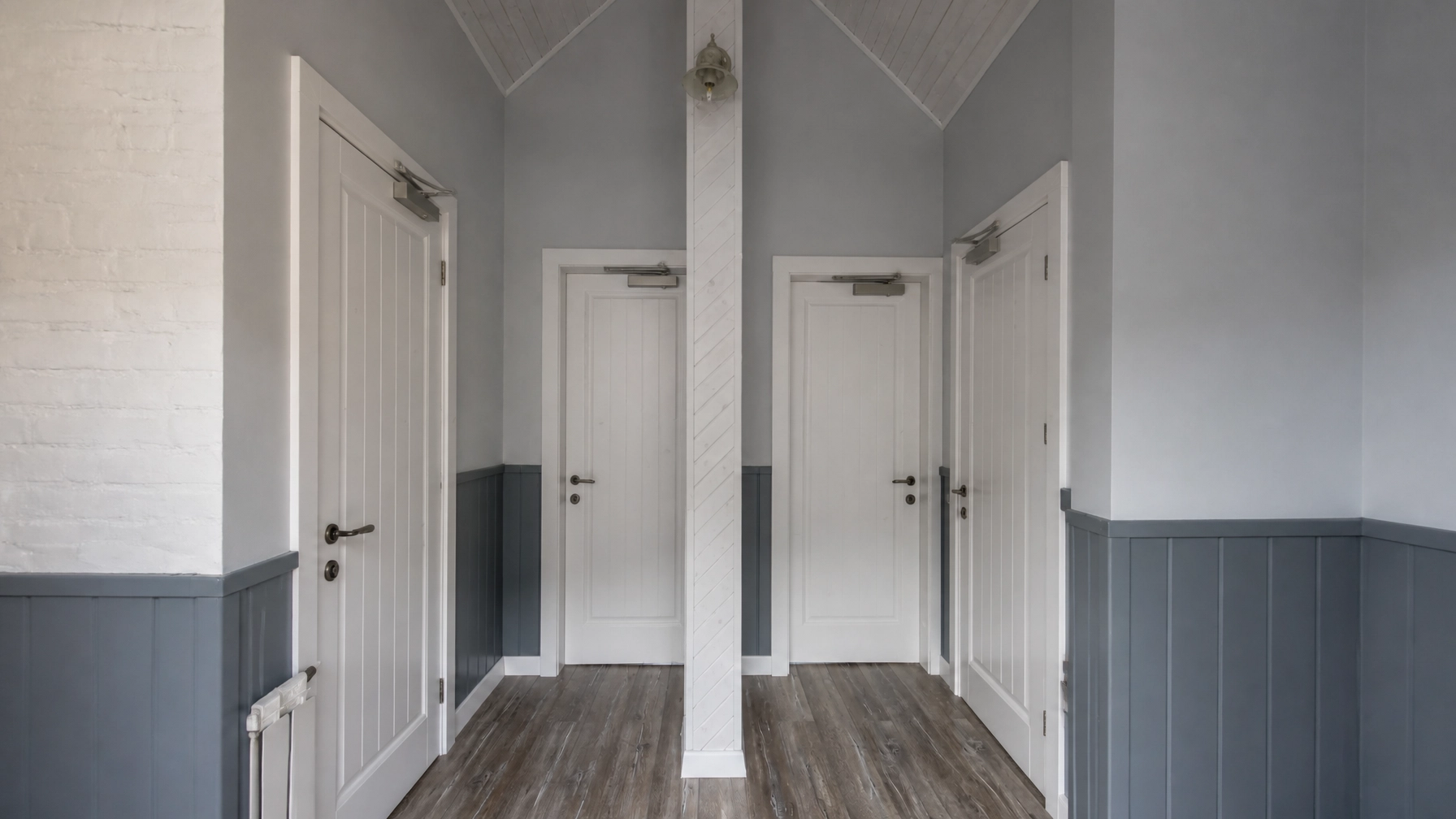
Buying a property for HMO conversion can be a valuable investment, but fire door compliance must be assessed before you exchange contracts. Existing doors may appear serviceable while lacking certification, suitable hardware, reliable documentation or compatibility with the property’s proposed layout.
A professional review before exchange gives you a clearer business plan, stronger negotiating position and greater confidence that the property can meet its licensing and fire safety obligations.
Key Takeaways
- Obtain the current Fire Risk Assessment (FRA) and check whether it includes a clear fire door schedule.
- Review HMO licence conditions and identify the doors required to protect bedrooms and escape routes.
- Treat missing documentation as a financial risk, not as evidence that the doors are compliant.
- Budget for professional repairs, upgrades or replacement doorsets before finalising your investment figures.
- Commission a professional Fire Door Survey for Quotations before exchange wherever possible.
- Use Certified Installers only for remedial work and new Fire Door Installations.
Table of Contents
- Protect the Purchase Before Exchange
- Understand the Legal Stakes
- Decode the Current FRA
- Choose Repair or Replacement
- Prepare the HMO Investment Budget
- Follow a Certified Compliance Process
- Resolve Common Investor Questions
- Secure Your Pre-Purchase Quote
- Conclude with a Safer Investment Decision
2. Understand the Legal Stakes
Review the responsible person’s obligations
Fire safety duties do not disappear when a property changes hands. Once you complete the purchase, responsibility for managing fire precautions and addressing identified defects will normally transfer to you or your appointed managing agent.
The Fire Safety Act 2021 and the Regulatory Reform (Fire Safety) Order 2005 form part of the wider legal framework governing fire safety in relevant premises. The Fire Safety (England) Regulations 2022 also introduce specific duties in certain multi-occupied residential buildings, including routine fire door checks in taller blocks.
The precise requirements for an HMO depend on its design, means of escape, occupancy, licensing conditions and current FRA. The government’s Fire Safety (England) Regulations 2022 guidance confirms that fire doors must remain suitable, effective and in good repair, with replacement work completed by a competent person where required.
Failure can result in:
- Enforcement action and improvement requirements.
- Delays to HMO licensing or occupation.
- Significant remedial costs after completion.
- Civil or criminal consequences where serious risk is created.
- Insurance and lender concerns if fire safety evidence is inadequate.
Do not assume that an existing HMO licence proves that every fire door is currently compliant. A licence may have been issued before later damage, alterations, wear or changes to the property.
3. Decode the Current FRA
Request the complete assessment
Before exchange, ask the seller or agent for the complete, current FRA rather than a summary page. Confirm:
- The assessment date and assessor details.
- The areas and floors included within its scope.
- Any outstanding fire door actions.
- The stated priority or risk rating for each action.
- The review date and any evidence of follow-up work.
- Whether the assessment reflects the property’s proposed HMO use.
A vague statement such as “fire doors require attention” is not enough to establish your likely costs. You need to understand which doors are affected, what the reported issue is and whether the recommended solution is repair, upgrade or replacement.
Compare the FRA with a door schedule
A useful door schedule should identify each relevant opening by location. It may include bedroom doors, kitchen doors, doors protecting stairways and landings, corridor cross-corridor doors, plant cupboards and other higher-risk rooms.
Compare the schedule with the property you are buying. Pay particular attention to:
- Every bedroom opening onto a shared escape route.
- Doors between communal areas and protected stairs.
- Kitchen and other higher-risk room doors.
- Doors to electrical, boiler or service cupboards.
- Any new openings created during previous alterations.
- Doors shown on plans but absent from the seller’s documentation.

A mismatch between the floor layout and the FRA may indicate that the building has changed without the fire safety documentation being updated. That issue should be resolved before you rely on the existing report.
4. Choose Repair or Replacement
Assess the complete doorset
A fire door is not simply a timber leaf. Its performance depends on the complete doorset, including the leaf, frame, hinges, closer, latch, seals, glazing where applicable and the surrounding construction.
Some failing doors may be suitable for professional repair, re-lipping or hardware upgrades. Others may have damage, unsuitable alterations, poor frames or no reliable evidence of fire performance. In those cases, a full Fire Door Installation may be the appropriate solution.
Only a qualified assessor and Certified Installer should make that decision. Do not accept an automatic replacement programme without understanding whether professional Fire Door Repair is possible. Equally, do not treat a low-cost repair as acceptable where the door’s fire performance cannot be established.
Identify missing evidence
Ask the seller for available:
- Manufacturer information and certification records.
- Door schedules and installation records.
- Product details for closers, hinges and seals.
- Records of previous remedial works.
- FRA action-closure evidence.
- HMO licensing correspondence relating to fire doors.
Missing records do not automatically mean that every door must be replaced. They do mean that you should obtain professional advice and allow for uncertainty in your purchase budget.
5. Prepare the HMO Investment Budget
Include fire doors from the beginning
Fire door costs should appear in your initial acquisition and conversion budget, not as an unexpected expense after completion. Allow for:
- A professional Fire Door Survey for Quotations.
- Repairable doors requiring seals, hardware or frame work.
- Doors that require re-lipping or controlled upgrading.
- Complete replacement doorsets where evidence or condition is inadequate.
- Fire-rated packers, certified intumescent mastic/sealant and associated materials.
- Access arrangements and tenant-ready scheduling.
- Compliance documentation and future maintenance planning.
- A contingency for defects concealed by decoration or previous alterations.
The number of bedrooms is only the starting point. The final cost depends on the number and condition of doors, the structure of the escape route, frame requirements, hardware and the standard required by the FRA and licensing authority.
Use the survey to test your business plan
A professional quotation survey can help you divide the property’s doors into three practical categories:
- Suitable subject to confirmation and ongoing maintenance.
- Potentially repairable or upgradeable by Certified Installers.
- Unsuitable for continued use and requiring replacement.
This classification gives you better information for negotiations. You may decide to request a price reduction, require works before completion or revise the projected refurbishment budget.
6. Follow a Certified Compliance Process
Complete Step One: Survey
Elite Fire Door Installations begins with a structured survey of the relevant doors and surrounding conditions. We interpret the FRA, review the available schedule and record the physical work required for a reliable quotation.
Specialist equipment may include Fire Door Gap Gauges, Intumescent Seal Routers, Hinge Jigs, Fire-Rated Packers, Digital Inclinometers, Force Gauges, Laser Levels and certified Intumescent Mastic/Sealant. These tools are used by qualified professionals; they are not a basis for self-certification.
Complete Step Two: Fixed-Price Quoting
You receive a clear quotation separating repairable items from replacement requirements. This helps you understand the likely cost before exchange and prevents important remedial works from being hidden inside a broad renovation allowance.
Complete Step Three: Certified Execution
Where work proceeds, Certified Installers complete the agreed FRA Remediation or Fire Door Installation to appropriate UK standards, including BS 476-22 and BS 8214. Our process also references FireQual standards and suitable fire-rated hardware, including BS EN 1935 hinges and BS EN 1154 door closers where specified.
Complete Step Four: Documentation Handover
At handover, request a clear compliance file containing the quotation, completed works, product information, photographs where appropriate and installation records. Retain this evidence with your FRA, HMO licence documents and ongoing maintenance records.

7. Resolve Common Investor Questions
Can I rely on the seller’s existing FRA?
Not without reviewing its date, scope, findings and action status. The FRA may not reflect recent alterations, changes in room use or deterioration. A professional survey provides a current physical basis for your quotation and investment decision.
Must every older fire door be replaced?
No. Age alone does not determine the correct outcome. A qualified professional may identify a suitable repair, re-lipping or upgrade. However, a door with serious damage, unsuitable alterations or unverified performance may require replacement.
What if the property has no door schedule?
Treat that as a documentation gap. Ask the seller to clarify the position, then commission a professional Fire Door Survey before exchange. Do not create or approve your own compliance schedule without qualified input.
Can a general builder complete the fire door works?
Fire door work requires specialist competence and appropriate product knowledge. HMO compliance should be managed by qualified FRA assessors and Certified Installers, particularly where doors, frames, seals and fire-rated hardware are being altered.
Should I exchange before obtaining a quotation?
That decision depends on your solicitor, lender, contract terms and risk appetite. From a fire safety perspective, obtaining a professional quotation before exchange gives you stronger cost certainty and may reveal an issue that changes the viability of the project.
8. Secure Your Pre-Purchase Quote
Do not finalise your HMO business plan around assumptions about existing fire doors. Send the current FRA, door schedule and available licensing documents to Elite Fire Door Installations so we can help translate the paperwork into a practical, costed action plan.
You can also visit Elite Fire Door Installations to learn more about professional surveys, certified repairs and HMO-focused Fire Door Installations.
9. Conclude with a Safer Investment Decision
Fire door due diligence belongs before exchange, not after tenants move in. Obtain the current FRA, compare the door schedule with the proposed HMO layout, review licensing conditions, identify missing evidence and obtain a professional quotation for repairs or replacement.
This approach protects your investment assumptions while prioritising resident safety and legal adherence. Elite Fire Door Installations provides tailored Fire Door Surveys for Quotations, professional Fire Door Repairs and certified Fire Door Installations for HMO landlords and property investors.
Elite Fire Door Installations
- Email: info@elitefiredoorinstallations.co.uk
- Specialist Support: +44 7514 898517
- Request a call back: +44 20 4511 9456
- Website: https://elitefiredoorinstallations.co.uk
Note: Summarised by artificial intelligence technology. This is not professional or legal advice.
Leave a Reply