

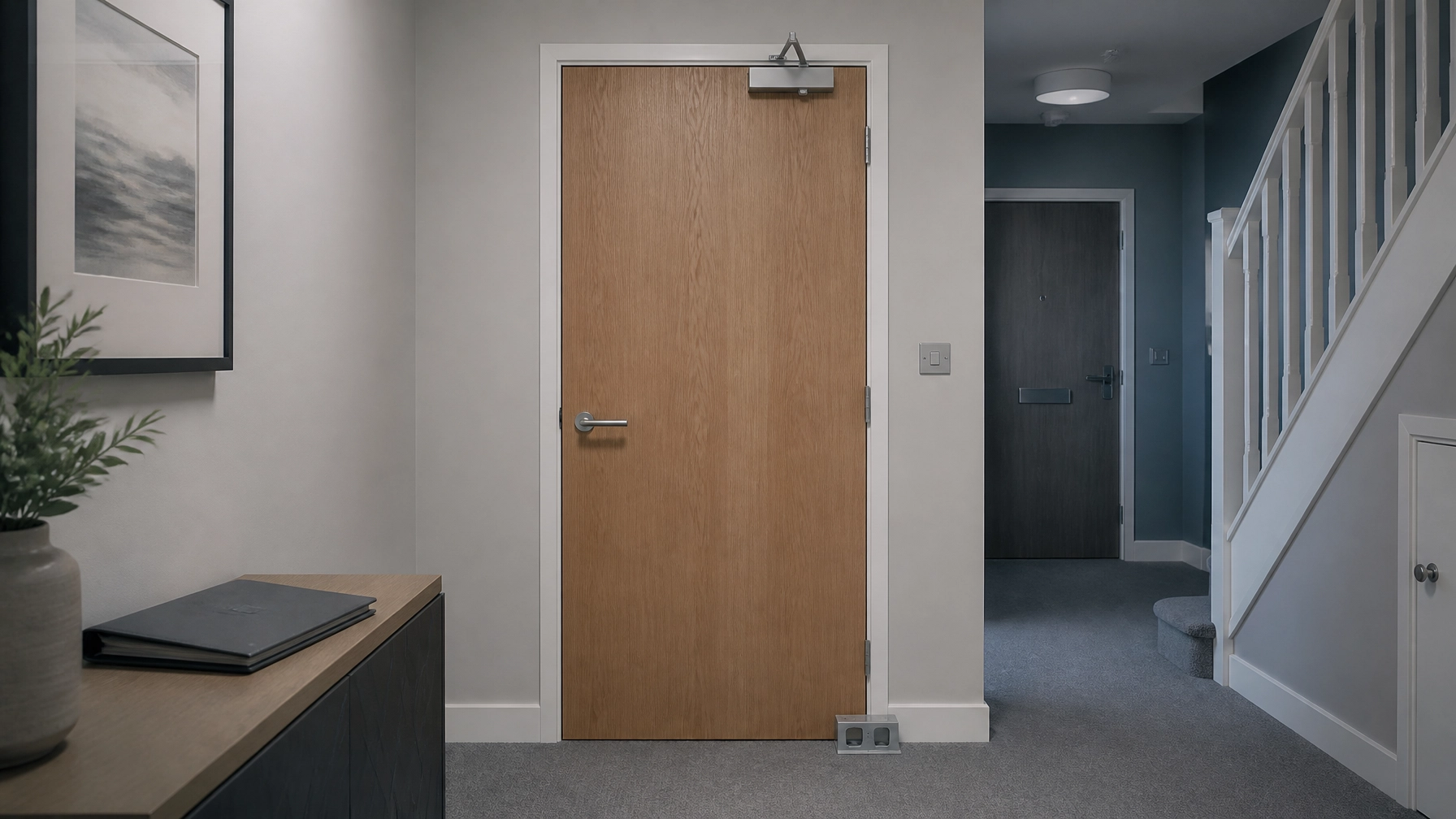
A professional fire door survey can help sellers identify the location, condition and supporting evidence for relevant fire doors before marketing a property or entering conveyancing. It can also clarify whether proportionate repairs, upgrades or new installation work may be required.
A fire-door query does not automatically stop a sale. However, unresolved issues can create avoidable questions, delays or uncertainty. Early technical information gives sellers, landlords and property investors a clearer route to action. This article provides general guidance only and is not conveyancing advice.
Key Takeaways
- Arrange a professional Fire Door Survey for Quotations before marketing where the property includes loft accommodation, third-storey routes, flat entrance doors, communal areas or commercial premises.
- Review the complete fire-rated doorset, including the leaf, frame, hinges, closer, latch, seals, glazing and surrounding construction.
- Establish whether the doorset is tested, assessed or classified to the relevant British Standard or supported by other appropriate technical evidence.
- Do not assume that every concern requires full replacement. Qualified Certified Installers can identify proportionate repair, re-lipping, upgrade or replacement options.
- Retain a signed compliance file to support future owners, managing agents, insurers and professional advisers.
- Treat HMOs, guest houses, restaurants and mixed-use buildings as early-planning projects rather than waiting for queries after a sale has started.
Table of Contents
- Understand the Legal Stakes Before Selling
- Translate the FRA into a Sale-Ready Action Plan
- Resolve Defects Through Repair or Replacement
- Prepare an HMO or Mixed-Use Property Properly
- Follow a Certified Professional Process
- Answer Practical Pre-Sale Questions
- Take Final Action Before Marketing
- Conclude With Clear Next Steps
2. Understand the Legal Stakes Before Selling
Fire doors form part of a building’s passive fire protection. When correctly specified, installed and maintained, they help restrict fire and smoke movement, protect escape routes and support compartmentation.
For relevant non-domestic premises and common parts, the Regulatory Reform (Fire Safety) Order 2005 places duties on the responsible person. The Fire Safety Act 2021 and the Fire Safety (England) Regulations 2022 also affect fire safety responsibilities in multi-occupied residential buildings.
Government guidance explains that flat entrance doors and communal fire doors must remain adequate for the risks identified through the building’s Fire Risk Assessment. In buildings where the top storey is more than 11 metres above ground level, specific routine checks apply to communal fire doors and flat entrance doors. Sellers should therefore establish who holds responsibility for the common parts and whether the appropriate records are available.
A sale does not automatically require a special fire door survey by law. Nevertheless, buyers, lenders, managing agents and solicitors may ask questions where fire doors are relevant to:
- Loft conversions and third-storey escape routes
- Flat entrance doors opening onto communal corridors
- Stairway, lobby and corridor doors
- Plant rooms, service cupboards and risers
- Commercial kitchens and other higher-risk areas
- HMOs, guest houses, restaurants and mixed-use buildings
The existence of a query does not mean that a transaction must fail. It means that the seller may benefit from reliable evidence and a clear plan.
3. Translate the FRA into a Sale-Ready Action Plan
A Fire Risk Assessment may identify a door as damaged, poorly fitting, unable to close correctly or lacking adequate supporting evidence. It may not, however, provide a detailed physical schedule for every individual door.
A specialist Fire Door Surveys for Quotations service translates the wider FRA findings into a prioritised action plan. The survey should consider:
- Where fire doors are located and what risk they address
- The condition of each door leaf and frame
- The compatibility and condition of hinges, latches and closers
- Intumescent seals, smoke seals and glazing
- The operation and closing performance of the complete doorset
- Signs of warping, splitting, impact damage or unsuitable alterations
- Available manufacturer information, test evidence or classification records
- Whether the door is appropriate for its location and escape strategy
The relevant evidence may include a fire-rated doorset tested, assessed or classified to the relevant British Standard or other appropriate technical evidence. Testing, assessment and classification are related but different forms of evidence and should not be treated as interchangeable.
Relevant references may include BS 476-22, BS EN 1634-1, BS EN 13501-2 and BS 8214, depending on the doorset, building type and information available. The correct outcome depends on the complete specification rather than a standard reference written on its own.

4. Resolve Defects Through Repair or Replacement
A failed fire door is not automatically a replacement project. The appropriate solution depends on the physical condition of the complete doorset and the evidence supporting its intended performance.
Restore Suitable Doors Through Professional Repair
Fire Door Repairs may be appropriate where the leaf and frame remain structurally suitable. A qualified Certified Installer may identify issues involving:
- Damaged or unsuitable hinges
- A defective or incompatible self-closing device
- Worn latches or keeps
- Deteriorated or missing seals
- Localised frame damage
- Poor closing or latching performance
- Damage that can be professionally re-lipped or restored
No repair should be assumed suitable merely because a component fits. Fire-rated hardware, sealants and other materials must be compatible with the relevant doorset evidence.
Upgrade or Replace Where Evidence Requires It
A Fire Door Installation may be appropriate where the existing door cannot provide sufficient assurance for its location. This may result from significant distortion, deep damage, unsuitable openings, weakened fixing points or a lack of reliable technical evidence.
A proportionate review can distinguish between doors that can be restored and those requiring a new fire-rated doorset. Where an FRA identifies wider remedial action, FRA Remediation can help coordinate the physical work and compliance records.
5. Prepare an HMO or Mixed-Use Property Properly
Property investors selling or refinancing an HMO should address fire door requirements early. The same applies to owners of guest houses, restaurants and mixed-use buildings where residential and commercial areas share the same structure.
Before marketing, identify:
- Bedroom doors and doors serving escape routes
- Third-storey or loft-conversion routes
- Flat entrance doors and communal corridors
- Stairway, lobby and compartmentation doors
- Doors serving plant rooms, cupboards and risers
- Doors separating kitchens or commercial areas from escape routes
- Existing doors that may need HMO Fire Door Upgrades
The design and condition of the whole doorset matter. A door leaf cannot be considered separately from its frame, hardware, seals and surrounding wall construction.
Apply the Quick Compliance Cheat Sheet Carefully
Flats in buildings under seven storeys and below 18 metres tall are generally suitable for review by a specialist fire door contractor, provided the arrangement meets the Fire Risk Assessment, specification, insurer and contract requirements.
This is a screening guide, not a legal determination. Building height, communal arrangements, construction, fire strategy and the responsible person’s duties must still be considered.

6. Follow a Certified Professional Process
Elite Fire Door Installations follows a structured process to help sellers obtain clear information without unnecessary disruption.
Step One: Survey the Property
A professional survey records relevant doors, locations, complete doorset condition and available technical evidence. It can cover houses, flats, HMOs, guest houses, restaurants and mixed-use buildings.
Step Two: Provide Clear Quotation
The quotation should separate recommended repairs, upgrades and new Fire Door Installations. This gives the seller a prioritised programme before marketing or conveyancing progresses.
Step Three: Complete Certified Work
Certified Installers carry out agreed Fire Door Repairs or installation work using suitable UK-standard components and professional equipment. This may include Fire Door Gap Gauges, Intumescent Seal Routers, Hinge Jigs, Fire-Rated Packers, Digital Inclinometers, Force Gauges, Laser Levels and certified Intumescent Mastic or Sealant.
Step Four: Handover the Compliance File
The final handover should identify the doors addressed, work completed, relevant products and supporting records. A signed compliance file can assist future owners, landlords, property managers and professional advisers.

7. Answer Practical Pre-Sale Questions
Does a fire-door query automatically stop a property sale?
No. A query may require clarification or remedial action, but it does not automatically prevent a sale. The result depends on the property, the nature of the concern and the requirements of the buyer, lender and relevant professionals.
Should every seller arrange a Fire Door Survey?
Not necessarily. However, a survey is particularly useful where the property includes a loft conversion, third-storey route, flat entrance door, communal area, HMO layout, guest accommodation, restaurant or mixed-use arrangement.
What evidence should a seller gather?
Useful records may include the FRA, previous survey reports, door schedules, product information, relevant test or classification evidence, records of completed work and a signed compliance file. The evidence required will vary by property and transaction.
Can an older flat entrance door remain suitable?
Possibly. Government guidance makes clear that an existing flat entrance door does not automatically need to meet every requirement applicable to a new building. Its adequacy depends on its condition, location, fire risk and available evidence. A qualified specialist should provide the physical assessment.
Who should carry out remedial work?
Repairs, upgrades and installation should be completed by suitably qualified Certified Installers with appropriate knowledge of fire-rated doorsets. Sellers should avoid relying on general maintenance work where the task affects fire resistance or smoke control.
8. Take Final Action Before Marketing
Arrange a professional Fire Door Surveys for Quotations service before launching the property or progressing conveyancing where fire doors may form part of the buyer’s enquiries.
Elite Fire Door Installations can help identify the issue, provide clear quoting, complete proportionate repair or upgrade work and prepare a signed compliance file.
You can also learn more about Fire Door Installation, Fire Door Repairs and HMO Fire Door Upgrades through the Elite Fire Door Installations website.
9. Conclude With Clear Next Steps
A fire door query should be handled calmly and with reliable evidence. It does not automatically stop a sale, but uncertainty can make a transaction more difficult where doors form part of the property’s fire strategy or legal compliance arrangements.
A pre-sale survey gives sellers a clearer understanding of door locations, complete doorset condition, missing documentation and appropriate remedial options. Whether the outcome is professional repair, re-lipping, an upgrade or a new installation, the work should be determined by qualified specialists and relevant evidence.
By acting before marketing or conveyancing, property owners and investors can support safer buildings, clearer communication and greater peace of mind.
Note: This information is intended as general guidance and does not constitute professional or legal advice. Always consult a qualified fire safety engineer for your specific property.
Contact Elite Fire Door Installations
- Email: info@elitefiredoorinstallations.co.uk
- Specialist Support: +44 7514 898517
- Request a call back: +44 20 4511 9456
- Website: https://elitefiredoorinstallations.co.uk
Leave a Reply