

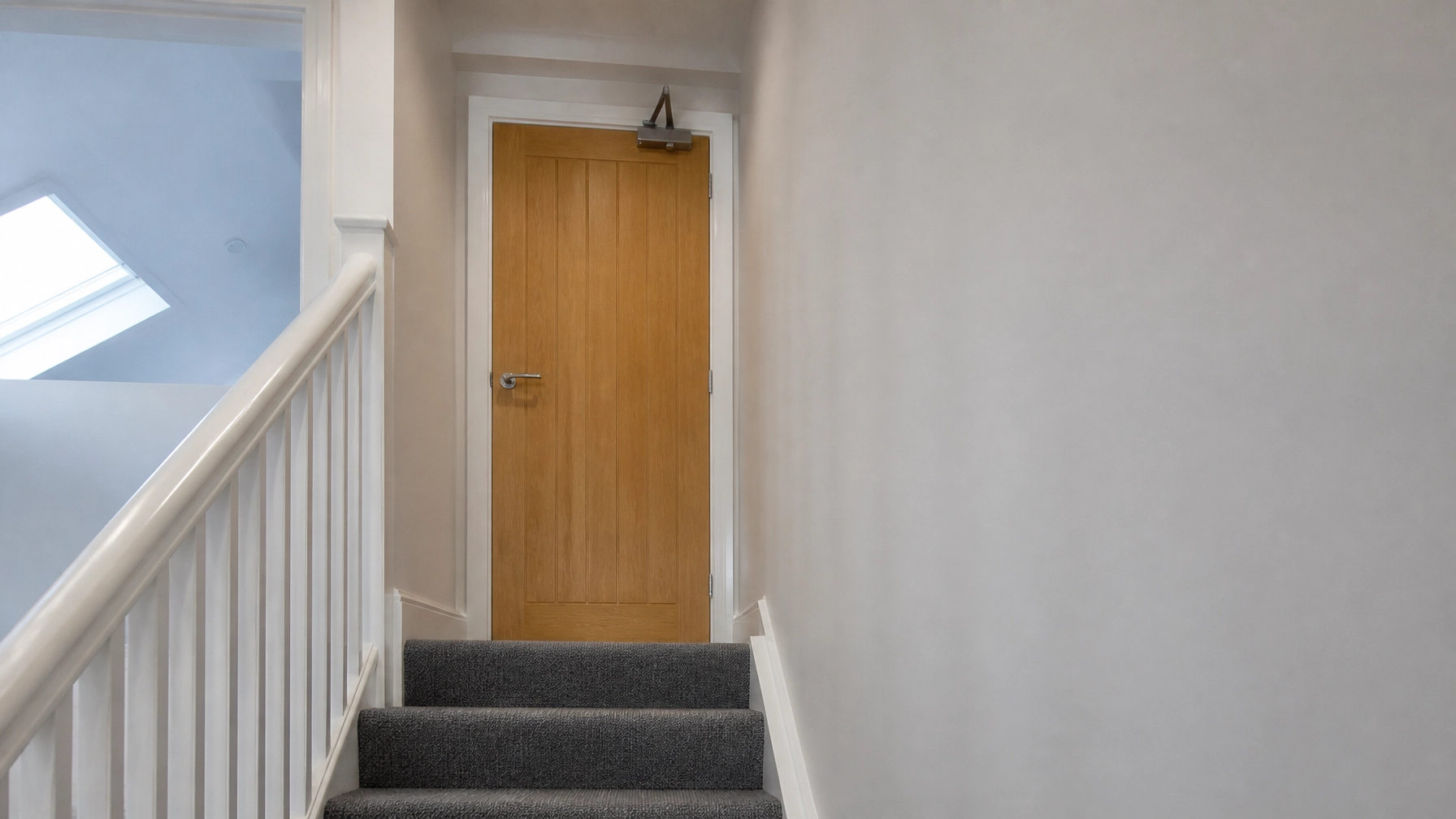
A buyer’s survey does not automatically require a formal fire door review. However, fire doors may become an important point during a property sale where the home includes a loft conversion, third storey, integral garage, altered escape route, flat entrance, or HMO arrangement.
A query does not necessarily stop a sale. A professional review can establish whether proportionate repair, upgrade or new Fire Door Installation work is appropriate. It can also provide useful records for your solicitor, buyer, mortgage lender or insurer.
Table of Contents
- Identify Why Fire Doors May Be Raised
- Understand the Legal and Conveyancing Position
- Translate the Buyer’s Survey into an Action Plan
- Choose Repair, Upgrade or Replacement Proportionately
- Prepare an Investment Property for Sale or Letting
- Follow a Professional Compliance Process
- Answer Common Fire Door Sale Questions
- Arrange Your Professional Review
- Conclude with Greater Compliance Confidence
Key Takeaways
- Recognise that fire doors may be raised during a buyer’s survey where the property has unusual layout or conversion features.
- Understand that a standard homebuyer’s survey is not the same as a specialist fire safety assessment.
- Obtain professional advice before assuming that every internal door must be replaced.
- Use qualified FRA assessors and Certified Installers for any compliance decision or remedial work.
- Keep clear documentation showing the scope of the review, completed works and ongoing compliance position.
- Address concerns calmly before exchange of contracts wherever possible.
1. Identify Why Fire Doors May Be Raised
A typical single-dwelling house does not usually require fire-rated doors throughout the property. The position can change when alterations create additional risk or when a property is operated as a rental, HMO or multi-occupied building.
A buyer’s surveyor may comment on visible concerns where the property includes:
- A loft conversion that creates a third storey.
- A staircase serving additional bedrooms or living accommodation.
- An integral garage opening directly into the house.
- Altered partitions, doors or escape routes.
- A flat entrance door opening onto a shared corridor.
- A property being sold as an established or proposed HMO.
- Commercial or guest accommodation connected to residential areas.
The surveyor may not be determining formal compliance. They may simply recommend that the buyer obtains further advice, confirms Building Regulations documentation or asks the seller to clarify the work.
That distinction matters. A survey comment is often a request for evidence or specialist review rather than a declaration that the property cannot be sold.

2. Understand the Legal and Conveyancing Position
The legal position depends on the property’s layout, use, construction history and occupation.
For an ordinary single dwelling, the main questions often relate to Building Regulations compliance and whether previous alterations were properly approved. The Fire Safety Act 2021 and the Regulatory Reform (Fire Safety) Order 2005 are particularly relevant to non-domestic premises, HMOs and certain multi-occupied buildings rather than every private house.
A loft conversion may have required a protected escape route and fire-resisting doors, depending on its design and the regulations applicable when the work was carried out. An integral garage may also require suitable separation from the home.
Your solicitor may therefore request:
- Building Regulations approval and completion documentation.
- Details of loft conversion works.
- Evidence relating to structural or escape-route alterations.
- Information about previous fire safety work.
- Confirmation of the property’s use as a dwelling, HMO, guest accommodation or mixed-use premises.
Where the property is an HMO or investment property, the responsible person’s duties are more extensive. A landlord may need to demonstrate that fire precautions are suitable, maintained and supported by appropriate records.
No single document can answer every question. The correct approach is to consider the survey findings alongside conveyancing information, Building Regulations records, the Fire Risk Assessment and the property’s intended use.
3. Translate the Buyer’s Survey into an Action Plan
A buyer’s survey can identify an issue without specifying the correct technical solution. For example, it may refer to a door that appears unsuitable, does not close properly or lacks evidence of a fire-resisting specification.
Do not assume that the answer is immediate replacement. Ask a qualified professional to translate the finding into a clear action plan.
Clarify the Scope
A professional Fire Door Survey for Quotations can consider:
- The location and purpose of each relevant doorset.
- The surrounding frame, wall and escape-route arrangement.
- The condition and suitability of the hardware.
- Whether the existing doorset may be suitable for proportionate remedial work.
- Whether the property needs an upgrade or complete Fire Door Installation.
- What documentation should be retained for the sale or future occupation.
The outcome should be written clearly. It should distinguish between an urgent life-safety concern, a documentation gap, a maintenance issue and a situation requiring further Building Regulations advice.
Coordinate the Relevant Professionals
A fire door specialist may need to work alongside:
- The conveyancing solicitor.
- The buyer’s surveyor.
- A qualified fire risk assessor.
- Building Control or a building regulations consultant.
- The mortgage lender or insurer, where further evidence is requested.
This coordinated approach helps prevent unnecessary remedial work and gives all parties a clearer understanding of the property’s position.
4. Choose Repair, Upgrade or Replacement Proportionately
Not every door raised during a sale requires complete replacement. Some doors may be suitable for professional Fire Door Repairs, re-lipping, hardware upgrades or other carefully specified remedial work.
Elite Fire Door Installations assesses the physical condition and intended performance of the doorset before recommending a solution. Where appropriate, a failing door may be repaired, re-lipped or upgraded rather than removed entirely. Where the doorset cannot provide the required protection, a new installation may be the safer and more appropriate answer.
All decisions must be made by qualified FRA assessors and Certified Installers. Fire doors are tested systems. The leaf, frame, hinges, closer, seals, gaps and surrounding construction must work together. An isolated alteration can affect the performance of the complete doorset.
Our work is specified with reference to relevant UK requirements, including BS 476-22 and BS 8214, where applicable to the property and project. The aim is a precise, proportionate solution that supports safety, legal adherence and a smoother conveyancing process.

5. Prepare an Investment Property for Sale or Letting
Property investors selling a house, purchasing an investment property or preparing an HMO conversion should consider fire door requirements before marketing or letting the premises.
A conversion can alter the risk profile of a building. New bedrooms, shared corridors, additional storeys and changes to the escape route may require a revised fire strategy and additional fire-resisting doors.
Before completion or letting, investors should arrange a professional review of:
- Bedroom doors opening onto shared escape routes.
- Doors serving kitchens, plant rooms, storage areas and utility spaces.
- Entrance doors to flats or self-contained units.
- The route from upper floors to the final exit.
- Doors separating an integral garage from living accommodation.
- Any doors affected by new partitions or layout changes.
- The records required for licensing, insurance and property management.
Apply the Quick Compliance Cheat Sheet
- Review: Obtain a current Fire Risk Assessment where the property’s use requires one.
- Confirm: Check that the specification matches the building’s layout, occupancy and escape strategy.
- Coordinate: Discuss relevant requirements with the insurer, landlord, managing agent or contract administrator.
- Clarify: Flats in buildings under 7 storeys and below 18 metres tall may generally be suitable for a specialist review, provided they meet FRA, specification, insurer and contract requirements.
- Document: Retain the signed compliance file and records of completed works.
This preparation is especially useful where the property will be sold as an HMO or marketed with existing licensing arrangements. Clear records can help the buyer understand what has been reviewed and what work has been completed.
6. Follow a Professional Compliance Process
Elite Fire Door Installations uses a structured process designed to keep property owners informed.
Step One: Complete the Survey
We review the relevant doorsets, layout and available documentation. The survey focuses on the issue raised by the buyer’s surveyor while identifying connected fire door requirements that may affect the escape route.
Step Two: Provide a Clear Written Quotation
We explain the recommended scope in plain language. The quotation separates repair, upgrade and new installation requirements so that the property owner can make an informed decision.
Step Three: Complete Certified Works
Certified Installers use appropriate UK-standard equipment and materials, including:
- Fire Door Gap Gauges.
- Intumescent Seal Routers.
- Hinge Jigs.
- Fire-Rated Packers and shims.
- Force Gauges.
- Laser Levels.
- Certified Intumescent Mastic and sealant.
- Suitable fire-rated hinges, closers and intumescent strips.
These tools are used as part of a controlled professional process. We do not provide DIY repair instructions because incorrect alterations can compromise the doorset and create further uncertainty during conveyancing.
Step Four: Handover the Compliance File
On completion, we provide relevant documentation describing the work undertaken. A signed compliance file can support communication with the owner, solicitor, surveyor, insurer and future property manager.

7. Answer Common Fire Door Sale Questions
Will a fire door query automatically stop my house sale?
No. A query usually means that the buyer or professional adviser needs clarification. A specialist review can establish whether the concern relates to documentation, maintenance, repair, upgrade or new installation.
Does every house need fire doors throughout?
No. Requirements depend on the building’s design, use, storeys, escape route, alterations and applicable regulations. Loft conversions, integral garages, HMOs and flats require particularly careful consideration.
Can my estate agent or general surveyor confirm compliance?
They may identify visible concerns, but they are not normally responsible for providing a specialist fire door assessment. A qualified FRA assessor or Certified Installer should determine the appropriate technical response.
Should I replace a door mentioned in the buyer’s survey?
Not automatically. The correct solution may involve professional repair, re-lipping, hardware replacement, an upgrade or a new doorset. A specialist Fire Door Survey for Quotations can provide a proportionate recommendation.
What records should I provide to the buyer?
Provide relevant Building Regulations documents, Fire Risk Assessment information where applicable, specifications and records of professional fire door work. The precise documents will depend on the property and should be discussed with your solicitor.
8. Arrange Your Professional Review
If a buyer’s survey has raised a fire door query, early clarification can help keep the transaction organised.
Elite Fire Door Installations provides professional Fire Door Surveys for Quotations, Fire Door Repairs, Fire Door Upgrades and Fire Door Installation for property owners, landlords and investors across East Sussex and the wider South East.
Visit Elite Fire Door Installations to arrange a professional review or discuss the next stage of your sale, conversion or property compliance programme.
Note: This information is intended as general guidance and does not constitute professional or legal advice. Always consult a qualified fire safety engineer for your specific property.
Contact Elite Fire Door Installations
- Email: info@elitefiredoorinstallations.co.uk
- Specialist Support: +44 7514 898517
- Request a call back: +44 20 4511 9456
- Website: https://elitefiredoorinstallations.co.uk
9. Conclude with Greater Compliance Confidence
Fire doors may be raised before a property sale when a home includes a loft conversion, third storey, integral garage, altered escape route, flat entrance or HMO arrangement. That does not mean the transaction must fail.
The most reliable response is to obtain a professional review, understand the specific concern and complete only the work that the property requires. With clear quoting, proportionate repair or upgrade, certified installation where necessary and a signed compliance file, sellers and landlords can give buyers useful information and move forward with greater confidence.
Leave a Reply