

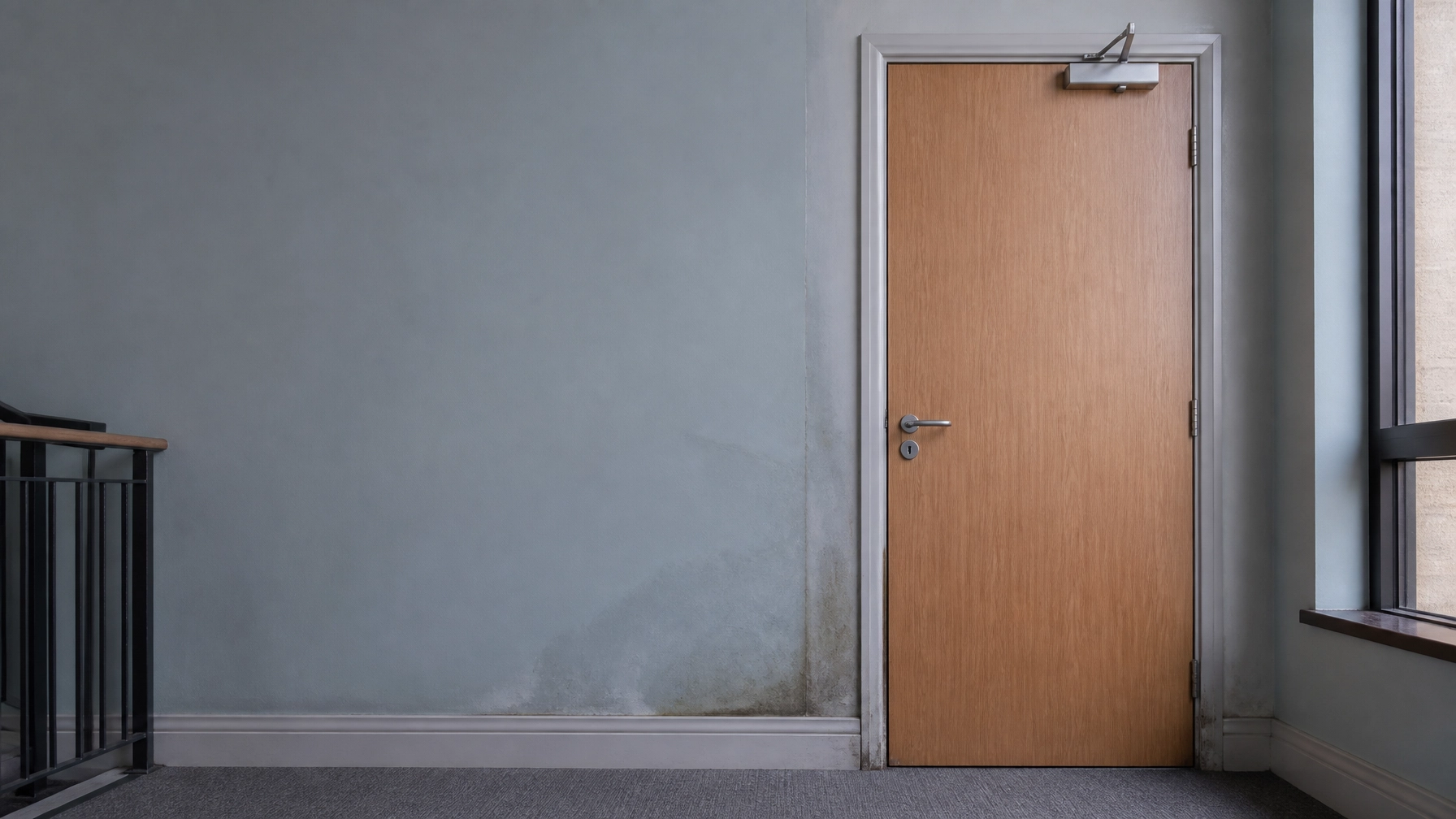
Leaks, damp, flooding, condensation and cleaning damage can affect more than the appearance of a fire door. Moisture may alter the door leaf, frame, seals, hinges, closer and surrounding wall, creating questions about fire performance and legal compliance.
Key Takeaways
- Treat swelling, staining, corrosion and seal damage as reasons to arrange a professional fire door Survey.
- Understand that visible damage does not automatically determine whether a door requires repair or replacement.
- Consider bathrooms, kitchens, utility areas, basements, restaurant back-of-house spaces and communal routes as higher-risk locations for moisture-related damage.
- Use qualified, certified fire door professionals to assess the complete door set against the relevant specification.
- Keep clear documentation to support a property sale, an insurance discussion or an organised maintenance plan.
- Rely on proportionate remedial work that follows the original fire performance requirements and recognised standards, including BS 476-22 and BS 8214.
Table of Contents
- Recognise How Water Affects Fire Doors
- Identify Damage Across the Complete Door Set
- Understand Why Appearance Alone Is Not Enough
- Protect Common Moisture-Exposed Areas
- Arrange a Professional Survey
- Restore Compliance Through Proportionate Action
- Answer Common Water-Damage Questions
- Document the Outcome Clearly
- Conclude with a Clear Next Step
1. Recognise How Water Affects Fire Doors
Water damage can develop gradually or occur suddenly. A leaking bathroom pipe, failed appliance connection, burst plumbing system or flood may expose a fire door to moisture. Condensation can also affect doors in poorly ventilated areas, while repeated cleaning with excessive water may damage lower door edges, frames and hardware.
Fire doors are tested as complete assemblies. The door leaf, frame, seals, hinges, latch, closer, threshold and surrounding construction all contribute to performance. When one element changes, the complete door set may need professional review.
This applies whether the property is:
- A home being prepared for sale
- A rented property managed by a landlord
- An HMO with shared corridors and facilities
- A block of flats with communal routes
- A B&B or guest accommodation
- A restaurant with customer, kitchen or back-of-house fire separation
A calm, prompt response helps property owners understand the issue before a small maintenance concern becomes a wider compliance question.
2. Identify Damage Across the Complete Door Set

A professional Survey should consider the complete installation rather than focusing only on the most visible mark.
Assess the door leaf
Moisture can cause timber-based door leaves to swell, warp, delaminate or develop soft areas. Staining may be superficial, but it may also indicate prolonged exposure or moisture movement through the material.
A swollen door may no longer sit correctly within its frame. Distortion can affect closing action, clearances and the way the seals engage. However, swelling alone does not automatically mean that the door must be replaced. A qualified assessment should establish whether the original fire performance can be reliably restored.
Review the frame and surrounding wall
Damp can loosen, distort or degrade the frame. Movement in the surrounding wall may also affect how securely the frame is fixed. This is particularly relevant after flooding, plumbing leaks or building movement in basements and utility areas.
The wall around a fire door may form part of the required fire-resisting construction. For that reason, a Survey should record any visible cracking, damp patches, damaged finishes or evidence that the wall has been affected by water ingress.
Check seals and hardware
Moisture may affect:
- Intumescent and smoke seals
- Hinges and hinge fixings
- Latches and locks
- Overhead closers
- Floor and drop seals
- Thresholds and surrounding finishes
Corrosion, swelling, detachment or contamination can prevent hardware and seals from performing as intended. Any remedial work must use suitable components and preserve the tested specification.
3. Understand Why Appearance Alone Is Not Enough
Visible staining often causes concern, but it does not provide a complete answer. A mark may be cosmetic, or it may be one sign of a deeper issue. Equally, a door that appears clean may still have affected seals, compromised fixings or a closer that no longer operates correctly.
A professional review should consider:
- The source and duration of moisture exposure
- Whether the door leaf has changed shape or structure
- The condition and suitability of the frame
- The operation of the closer and latch
- The condition of seals and hardware
- The available evidence for the door’s rating and specification
- The condition of the wall, floor and threshold around the door
This is why property owners should not make an automatic decision based solely on swelling or staining. A qualified professional may recommend proportionate repair, component replacement, a door leaf replacement or a complete door-set replacement, depending on the findings.
Elite Fire Door Installations can provide a professional Fire Door Survey to help establish the appropriate next step.
4. Protect Common Moisture-Exposed Areas
Bathrooms, kitchens and utility rooms commonly contain plumbing, appliances and cleaning processes that increase the possibility of water exposure. Basement routes may also be affected by groundwater, drainage problems or condensation.
In restaurants, back-of-house areas may experience steam, wash-down activity, temperature changes and frequent movement through service doors. Communal routes in flats and HMOs may be affected by leaks from neighbouring dwellings or shared building services.

Property owners and managers should pay particular attention where:
- A fire door is close to a sink, dishwasher, bathroom or laundry area
- A door opens onto a basement or plant area
- Cleaning teams regularly use water near the door
- Condensation forms on walls, frames or hardware
- A leak has affected the floor, skirting or surrounding wall
- A communal route has experienced flooding or plumbing failure
The purpose is not to create unnecessary alarm. It is to identify locations where a timely professional Survey can provide clarity.
5. Arrange a Professional Survey
A qualified, certified fire door professional should lead the review. This is not a suitable task for informal alterations or unqualified maintenance work because fire performance can be affected by changes that are not immediately obvious.
The process should follow clear stages:
- Record the event: Note whether the issue involved a leak, flood, condensation, cleaning activity or another source of moisture.
- Review the door set: Assess the leaf, frame, seals, hardware, threshold, floor and surrounding wall.
- Confirm the specification: Consider available documentation, fire rating, installation details and relevant manufacturer information.
- Classify the action: Establish whether proportionate repair, component replacement or full replacement is appropriate.
- Document the outcome: Provide a clear record of findings and recommended action.
A professional approach should reflect BS 476-22 and BS 8214 where applicable, alongside the specific tested performance of the door set.
6. Restore Compliance Through Proportionate Action

Water damage does not always require a complete replacement. In some cases, qualified professionals may be able to restore the installation through controlled remedial work using suitable fire-rated materials and hardware.
Possible outcomes may include:
- Repairing suitable non-structural damage
- Replacing damaged intumescent or smoke seals
- Replacing corroded hinges or other hardware
- Replacing a defective closer
- Addressing affected frame components
- Replacing the door leaf where its integrity cannot be reliably restored
- Replacing the complete door set where the frame and surrounding construction are compromised
The correct decision depends on the evidence. Elite Fire Door Installations can provide professional Fire Door Repairs or tailored Fire Door Installations following a qualified review.
Professional teams may use specialist tools, including Fire Door Gap Gauges, laser levels, digital inclinometers and force gauges, to support accurate assessment and documented work. These tools should be used by trained professionals rather than treated as a basis for DIY adjustment.
7. Answer Common Water-Damage Questions
Can a stained fire door remain in service?
Possibly. Staining does not automatically prove that the door has failed. A qualified fire door professional should establish whether the mark is cosmetic or associated with swelling, distortion, degraded materials or affected hardware.
Does swelling always mean the door must be replaced?
No. The appropriate action depends on the depth, location and effect of the swelling, as well as the condition of the frame and the door’s tested specification. Only a professional Survey can establish whether compliant performance can be restored.
Can damp damage the seals without damaging the door leaf?
Yes. Intumescent and smoke seals may deteriorate, detach or become unsuitable even where the door leaf appears acceptable. Seals should be assessed as part of the complete door set.
Should water-damaged fire doors be included in an insurance discussion?
They may be relevant where a leak, flood or building defect caused the damage. Clear documentation can help explain the event and the necessary remedial action. Property owners should review their own policy and seek appropriate advice rather than making an automatic claim.
Can a fire door be altered after water damage?
Any alteration should be considered and completed by qualified, certified professionals. Uncontrolled trimming, filling, hardware changes or seal replacement may affect the tested fire performance and create further compliance concerns.
8. Document the Outcome Clearly
Prompt documentation can support several practical property decisions. For a homeowner selling a property, a professional Survey and signed compliance record may help explain how a reported damp issue was reviewed. For a landlord or HMO manager, the record can support an organised maintenance plan. For a flat manager, it can provide a clear history for communal building records.
Documentation may include:
- The reported source of water exposure
- Photographs of the affected area
- The door and frame identification
- Findings from the professional Survey
- Recommended remedial action
- Details of completed work
- Relevant product and installation information
- A signed compliance file
This documentation does not replace legal, insurance or fire risk assessment advice. It provides a useful evidence trail showing that the issue was addressed responsibly.
9. Conclude with a Clear Next Step
Water damage should not be dismissed as a cosmetic matter, but it should not automatically lead to unnecessary replacement either. The reliable route is to arrange a professional review of the complete fire-door assembly.
Whether the property is being sold, rented, converted, managed or maintained, Elite Fire Door Installations can help establish the appropriate action through a clear Survey, proportionate remediation, professional installation and compliance documentation.
Book a professional Fire Door Survey or Installation through the Elite Fire Door Installations website for a calm, practical assessment of water-affected fire doors.
Contact Elite Fire Door Installations
- Email: info@elitefiredoorinstallations.co.uk
- Specialist Support: +44 7514 898517
- Request a call back: +44 20 4511 9456
- Website: https://elitefiredoorinstallations.co.uk
Note: This information is intended as general guidance and does not constitute professional or legal advice. Always consult a qualified fire safety engineer for your specific property.
Leave a Reply