

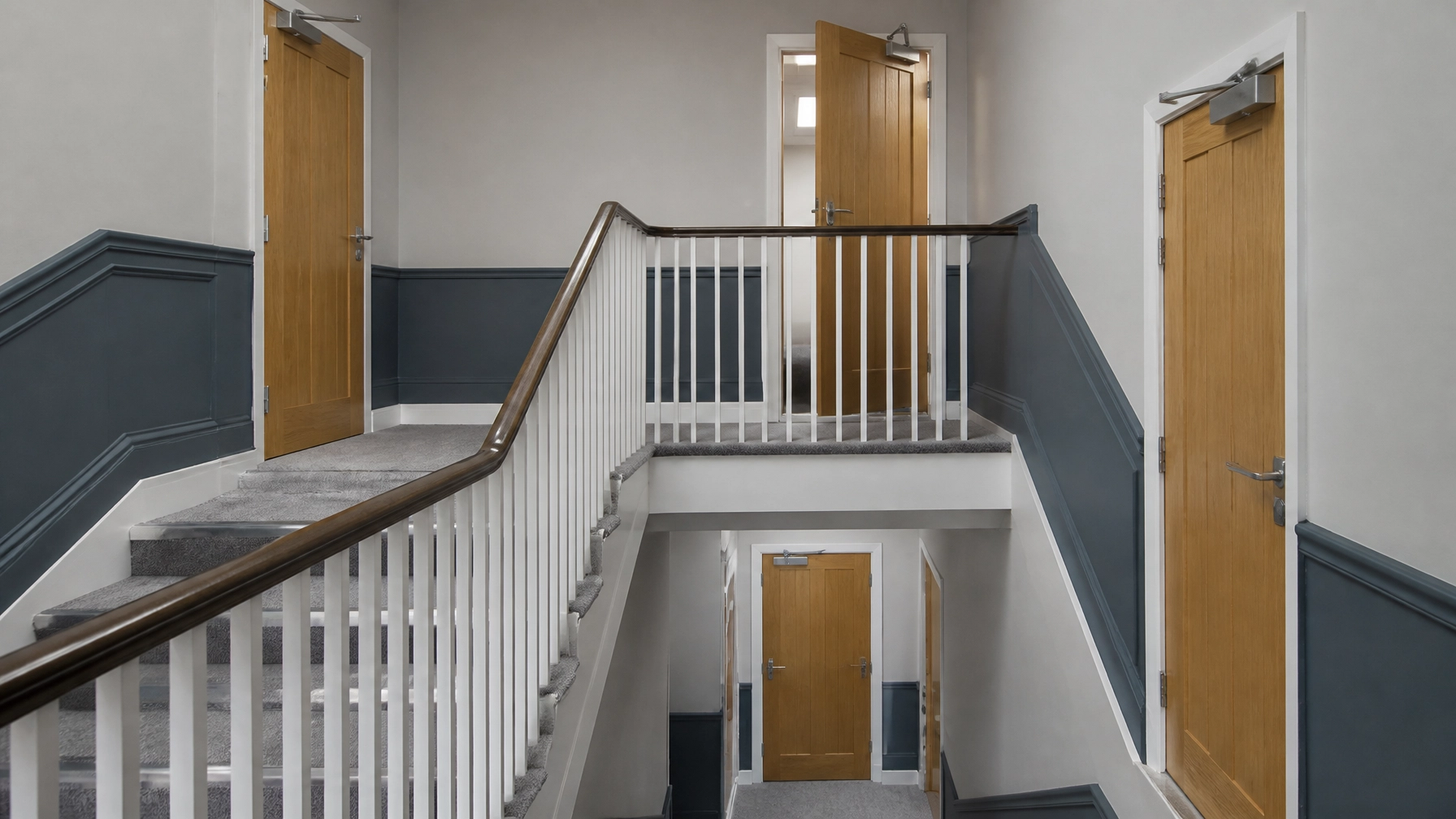
Day 1 of our seven-day fire door compliance series: why missing or defective fire doors can delay a sale, prompt insurance questions and create avoidable costs for property owners in Kent.
1. Understand the Fire Door Sale Trap
A property sale can appear ready to complete until a surveyor, conveyancer or mortgage lender raises one question:
Are the fire doors protecting the escape route properly specified, installed and documented?
This issue is particularly common in houses with loft conversions that create a third storey. It can also arise where an integral garage entrance, flat entrance or internal stair route lacks a suitable fire door.
The problem is rarely limited to the cost of a replacement door. A fire door concern can prompt:
- Additional questions during conveyancing.
- Requests for remedial work before exchange or completion.
- Delays to a mortgage offer.
- Buyer negotiations over price.
- Concerns about building regulation approval.
- Questions about whether insurance remains valid.
- Further professional surveys and documentation.
For a seller in Royal Tunbridge Wells or elsewhere in Kent, the timing can be disruptive. A buyer may be ready to proceed, but the transaction may be delayed while the parties establish whether the fire safety defect is real, how serious it is and who is competent to resolve it.
Key Takeaways
- Treat missing or non-compliant fire doors as a potential sale, lending and insurance issue: not merely a joinery defect.
- Pay particular attention to three-storey houses and loft conversions where habitable rooms open onto a central stair escape route.
- Recognise that an integral garage or flat entrance may require a properly rated fire door with compatible hinges, gaps and intumescent seals.
- Understand the difference between individual FireQual competence and company-level schemes such as BM TRADA Q-Mark.
- Use a qualified specialist to provide a professional Fire Door Survey, targeted remediation and a signed compliance file.
- Remember that FireQual supports evidence of individual competence, but no certificate alone guarantees legal compliance.
2. Navigate the Table of Contents
- Understand the Fire Door Sale Trap
- Understand the Legal and Financial Stakes
- Decode the Three-Storey and Loft Conversion Trap
- Resolve the Problem with a Survey and Targeted Remediation
- Prepare HMO and Investment Properties Before Completion
- Choose Competence Over Unnecessary Corporate Overheads
- Answer Common Fire Door Sale Questions
- Arrange Professional Support Before the Sale Stalls
- Conclusion: Resolve Fire Door Defects Before They Become Transaction Problems
3. Understand the Legal and Financial Stakes
A fire door is part of a life-safety system. It helps protect an escape route and delay the spread of fire and smoke. Its performance depends on the complete door assembly, including the leaf, frame, hinges, latch, closer, seals and installation details.
A missing door or visibly defective assembly may therefore raise concerns well beyond appearance.
Separate Building Regulations from Fire Safety Duties
For a private house sale, Building Regulations approval for alterations is often central to the conveyancing process. A loft conversion that creates a third storey should normally have appropriate Building Control documentation, including evidence that the protected escape route was addressed.
For HMOs, shared houses and other qualifying premises, the responsible person also has ongoing duties under UK fire safety legislation. The Regulatory Reform (Fire Safety) Order 2005 and the Fire Safety Act 2021 form part of the wider legal framework, although their application depends on the property type and its use.
The practical point is straightforward: property owners must be able to demonstrate that fire safety measures are suitable for the building. A defective fire door can become evidence that the wider arrangement requires professional attention.
Enforcement consequences may include:
- Formal notices requiring remedial work.
- Delayed licensing or occupation.
- Prosecution where serious breaches are identified.
- Significant financial penalties.
- Civil liability if a failure contributes to injury or loss.
- Insurance disputes where a material defect was known or not disclosed.
Recognise Why a Sale May Be Delayed
Mortgage lenders and insurers do not usually want to take an unnecessary risk with a property that has an unresolved fire safety defect.
A surveyor may report that fire doors are missing, damaged, incorrectly fitted or not supported by sufficient evidence. The lender may then ask for clarification before releasing funds. A conveyancer may request certificates, Building Control records or a professional report. The buyer may seek a price reduction or insist that work is completed before exchange.
The result can be a chain of uncertainty at a sensitive stage of the transaction. In many cases, however, the issue can often be resolved with a clear survey, appropriate remediation and supporting documentation.

4. Decode the Three-Storey and Loft Conversion Trap
One of the most common domestic fire door issues in this context involves three-storey houses and loft conversions.
A house may have started life as a conventional two-storey dwelling. Once a loft is converted into a bedroom, office or other habitable space, the building may effectively become three storeys. The main stair may then serve as the central escape route from the upper floor.
Protect the Central Stair Escape Route
Where the design requires a protected stairway, doors opening onto that route may need to provide appropriate fire resistance. In many domestic loft conversion arrangements, FD30 fire doors are used, subject to the approved design, Building Regulations guidance, the property layout and any specific advice from Building Control.
The concern is not simply whether a door looks solid. A suitable assembly may need:
- A fire-rated door leaf supported by appropriate test or assessment evidence.
- Compatible frames or linings.
- Suitable fire-rated hinges.
- Correctly specified latches, closers and other ironmongery.
- Intumescent and, where required, smoke seals.
- Installation consistent with the manufacturer’s instructions and BS 8214 principles.
Bathrooms and similar spaces may be treated differently in some arrangements, but the correct outcome depends on the actual layout and approved fire strategy. Property owners should not assume that every door can be categorised without professional advice.
Being below 18 metres does not automatically remove the need for fire doors in a three-storey house. The relevant issue may be the protected escape route and the height of the new storey, not the high-rise threshold.
Check the Supporting Paperwork
Before marketing a house with a loft conversion, sellers should locate:
- The Building Control completion certificate.
- Any planning or conversion documentation.
- Door-set information and product data where available.
- Previous professional survey records.
- Records of repairs, replacements or alterations.
- Insurance documents relating to the conversion.
If paperwork is missing, it is worth checking the position promptly rather than relying on informal assurances. A professional Fire Door Survey can help identify the physical position, while Building Control or a conveyancer can advise on the correct route for historic approval issues.
5. Resolve the Problem with a Survey and Targeted Remediation
A failed fire door does not always require full replacement. Equally, not every existing door can be made compliant through minor adjustment. The decision should be based on the condition of the assembly, available evidence, the required performance and the property’s fire strategy, with repair considered before replacement where appropriate.
Repair Where the Door Is Structurally Viable
A qualified specialist may identify a suitable route for professional Fire Door Repair or remediation where the door is fundamentally suitable.
Depending on the findings, the work may involve:
- Replacing incompatible or damaged hardware.
- Upgrading intumescent seals.
- Addressing damage to the leaf or frame.
- Re-lipping a structurally suitable door.
- Replacing unsuitable hinges or latching components.
- Improving the fit of the assembly in line with relevant requirements.
These are not DIY tasks. Altering a fire door without understanding its test evidence, compatible components and installation limitations can reduce confidence in the assembly while creating a misleading appearance of compliance. A qualified specialist can assess the options and explain the most practical route clearly.
Replace Where Evidence or Condition Is Inadequate
Replacement may be appropriate where the door is badly damaged, substantially altered, unsuitable for the location or unsupported by adequate evidence. Where the door is structurally viable, repair or upgrade can often be considered first.
A professional Fire Door Installation should consider the complete doorset rather than treating the leaf as an isolated product. A new door fitted into an unsuitable frame, with incompatible hinges or poorly matched seals, may still create problems during a future review.
Elite Fire Door Installations is a FireQual-certified sole trader. The service is intended to provide a direct, practical solution for property owners who need competent workmanship and clear documentation without automatically commissioning a large corporate contractor.
6. Choose Competence Over Unnecessary Corporate Overheads
UK fire safety duties require work to be carried out by people with suitable competence for the task. That means the person physically surveying, fitting or repairing the fire door must have the knowledge, training and practical ability to do the work properly.
This is the distinction between person and process.
Understand FireQual
FireQual demonstrates the technical competence of the individual specialist. It is relevant because the actual tradesperson on the tools is responsible for applying knowledge to the door, frame, hardware and surrounding construction.
Elite Fire Door Installations is FireQual-certified, but it is not a BM TRADA Q-Mark company. That distinction should be explained clearly rather than hidden.
FireQual is generally suitable for work in:
- HMOs and shared houses.
- B&Bs and guest houses.
- Small offices and shops.
- Small private schools.
- Residential flats in buildings under seven storeys and below 18 metres tall.
This suitability remains subject to the Fire Risk Assessment, specification, insurer, lender and contract requirements. A FireQual certificate is evidence of individual competence; it is not a stand-alone guarantee that every installation is legally compliant.
Understand BM TRADA Q-Mark
BM TRADA Q-Mark is a company-level third-party certification scheme. It may be relevant where a major contractor, public-sector body or commercial framework requires formal company registration, audited processes, traceability and ongoing organisational controls.
That can be appropriate for large commercial programmes, major public-sector procurement and complex high-rise work. It does not mean that a Q-Mark company automatically provides better hands-on workmanship on every domestic door, nor does the absence of Q-Mark mean an individual specialist lacks competence.
For a house, HMO, guest house or low-to-mid-rise residential project under 18 metres, the practical question is usually:
Is the person carrying out the work competent, and can the completed work be supported by appropriate evidence?
Follow a Controlled Professional Process
A responsible project should follow a structured workflow:
- Complete a Survey: Review the doors, frames, escape route, hardware and available records.
- Issue a Fixed-Price Quote: Separate essential remediation from optional improvement work.
- Complete Certified Work: Use compatible UK-standard components and professional equipment, including Fire Door Gap Gauges, Intumescent Seal Routers, Hinge Jigs, Fire-Rated Packers, Digital Inclinometers, Force Gauges, Laser Levels and certified Intumescent Mastic/Sealant where appropriate.
- Provide Compliance Documentation: Supply a clear handover file describing the completed work, relevant product information and any limitations.
Work should be considered against BS 476-22 and BS 8214 context, alongside manufacturer instructions, the applicable Building Regulations, the FRA and any requirements imposed by the insurer or lender.

7. Answer Common Fire Door Sale Questions
Can a missing fire door really affect my house sale?
It can delay a sale if the surveyor, conveyancer or lender considers the missing door evidence of wider building regulation or life-safety concerns. The parties may request professional remedial work and supporting documentation before proceeding, but the issue can often be resolved once a competent specialist has assessed it properly.
Does a loft conversion always require fire doors?
Not every layout is identical. However, where a loft conversion creates a third storey and rooms open onto a central protected stair route, fire-resisting doors are commonly required as part of the escape strategy. A qualified professional should assess the specific arrangement.
Can faulty fire doors invalidate home insurance?
A known or undisclosed material defect can create insurance questions. Depending on the policy terms and circumstances, an insurer may reduce, reject or dispute a claim, and the position is worth checking carefully. Seek advice from your insurer and arrange professional remedial work rather than relying on assumptions.
Do I need a BM TRADA Q-Mark company for a domestic property?
Not automatically. FireQual is generally suitable for individual specialists working on domestic properties, HMOs, B&Bs, guest houses, small offices, shops, small private schools and qualifying residential flats. Always check the specific contract, insurer, lender and FRA requirements.
Can an existing fire door be repaired instead of replaced?
Sometimes. A professional Fire Door Repair assessment may identify whether the door can be restored, re-lipped or upgraded. If the door’s condition or evidence is inadequate, a compliant Fire Door Installation may be the more defensible option.
8. Arrange Professional Support Before the Sale Progress Slows
If a surveyor has already raised a fire door concern, act before the issue reaches exchange of contracts. Early action gives you time to establish the actual defect, obtain a fixed-price quotation and prepare a signed compliance file.
Elite Fire Door Installations provides FireQual-certified support for property owners and landlords who need a practical response to fire door problems. Whether the requirement is a professional survey, targeted remediation or a complete replacement, the objective is to resolve the physical issue with precision and provide useful evidence for the property file.
For HMO investors, early planning is particularly important. Include fire door surveys, potential repairs, upgraded hardware and replacement doors in the acquisition and refurbishment budget before committing to a rental programme.
If you are a property owner in Kent, East Sussex or the wider South East and a sale may be delayed, contact Elite Fire Door Installations for rapid fire door upgrades, FRA Remediation, Fire Door Repair and signed compliance files. This support remains firmly subject to the FRA, specification, insurer, lender and contract requirements, and all physical works must be handled by a FireQual-certified specialist or other appropriately competent professional where the brief demands it.
You can also visit Elite Fire Door Installations to arrange professional support.
9. Conclusion: Resolve Fire Door Defects Before They Become Transaction Problems
A missing or non-compliant fire door can create practical complications during a sale. In a three-storey house or loft conversion, a defect on the central stair escape route may prompt questions about Building Regulations, the safety of the property and the reliability of the conversion.
An integral garage entrance or flat entrance with unsuitable hinges, excessive gaps or incompatible intumescent seals can raise similar concerns for insurers, lenders and future buyers. The result may be a delayed mortgage, a renegotiated sale or an insurance query, but these issues can often be resolved with the right professional assessment and documentation.
The cost-effective answer is not to select a contractor by logo alone. It is to appoint a competent specialist who understands the complete fire door assembly, works in line with BS 476-22 and BS 8214 principles, and provides clear documentation.
FireQual demonstrates the competence of the individual installer. BM TRADA Q-Mark may be appropriate for company-level procurement requirements and major commercial contracts. For many domestic, HMO and low-to-mid-rise projects, a FireQual-certified specialist offers a proportionate and practical route; subject to the FRA, specification, insurer, lender and contract conditions.
For sellers in Royal Tunbridge Wells and across Kent, the practical priority is speed with evidence. For local property owners in East Sussex and the wider South East, Elite Fire Door Installations can provide rapid upgrades, targeted remediation and signed compliance files to help keep a sale moving while keeping the existing compliance caveats, lender expectations and fire strategy requirements firmly in view.
Note: Summarised by artificial intelligence technology. This is not professional or legal advice.
Contact Elite Fire Door Installations
- Email: info@elitefiredoorinstallations.co.uk
- Specialist Support: +44 7514 898517
- Request a call back: +44 20 4511 9456
- Website: https://elitefiredoorinstallations.co.uk
Leave a Reply