

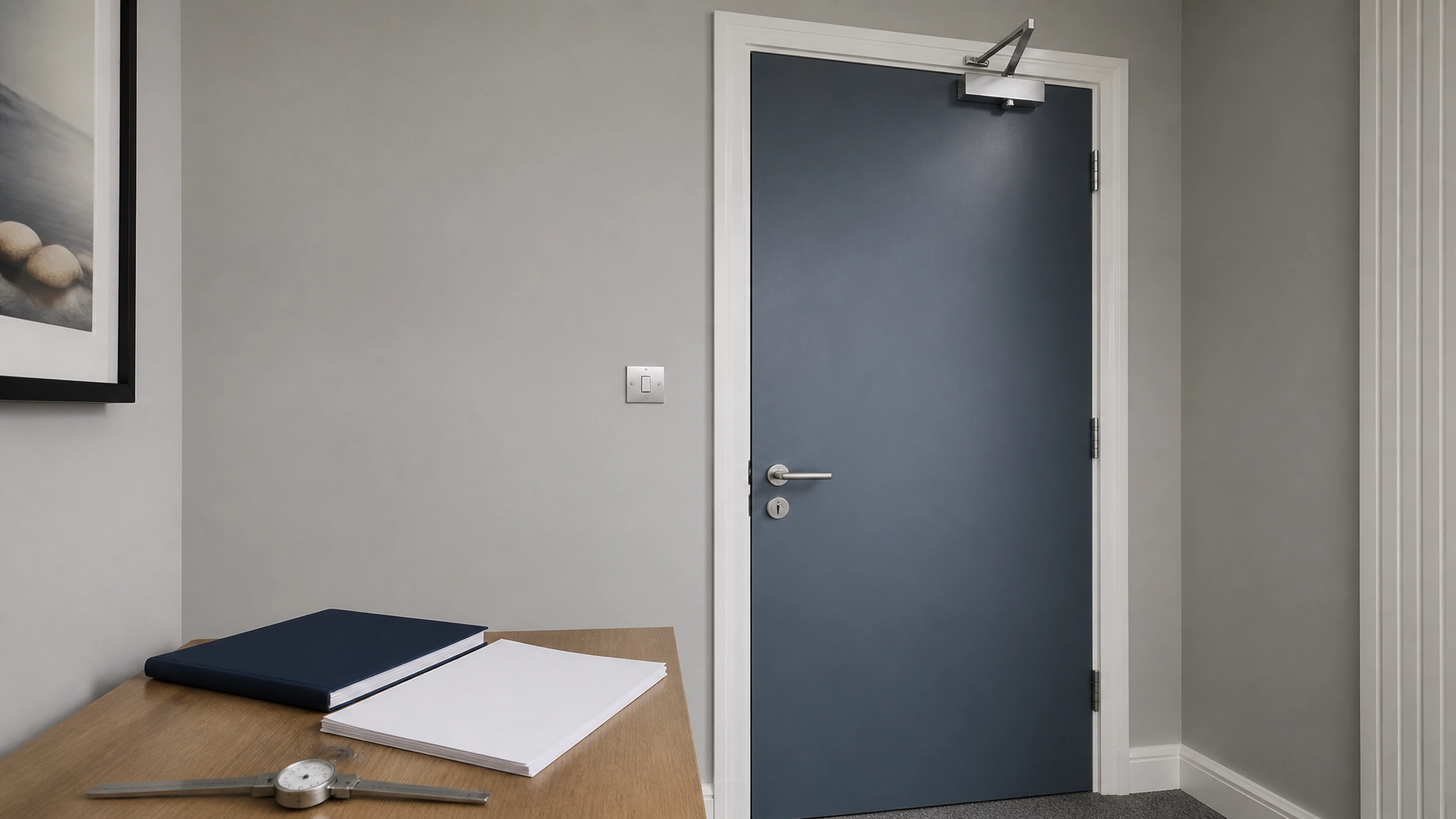
A faulty fire door does not automatically void every insurance policy. However, its condition may affect how an insurer assesses risk, responds to a claim or reviews policy conditions after a fire. Property owners, landlords, HMO operators, B&B owners and small businesses should therefore understand what their policy requires and retain clear evidence of responsible fire safety management.
Act Early to Protect Safety and Insurance
Fire doors form part of a building’s passive fire protection. When correctly specified, installed and maintained, they help restrict the spread of fire and smoke, support escape arrangements and protect separate compartments.
For property owners across East Sussex and the wider South East, the sensible approach is straightforward: identify concerns through a professional survey, obtain a clear quotation, arrange proportionate remedial work and retain a signed compliance file.
Key Takeaways
- Review your insurance policy for fire safety conditions, maintenance obligations and notification requirements.
- Do not assume that one defective door automatically invalidates your cover.
- Keep current Fire Risk Assessment information and professional Fire Door Surveys for Quotations together.
- Arrange suitable Fire Door Repairs before considering full replacement where the existing assembly can be technically restored.
- Use qualified fire safety professionals and competent installers for all remedial work.
- Retain signed completion information, product details, invoices and updated records.
Table of Contents
- Understand How Fire Doors Relate to Insurance
- Translate Your FRA Into a Practical Action Plan
- Choose Repair Before Replacement Where Appropriate
- Prepare HMO and Rental Properties Before Letting
- Follow a Documented Professional Process
- Answer Common Insurance and Fire Door Questions
- Request a Professional Review
- Conclude With a Clear Compliance Plan
Understand How Fire Doors Relate to Insurance
Insurance policies differ. A residential landlord policy, HMO policy, B&B policy and commercial policy may each contain different conditions relating to fire precautions, maintenance, occupancy and material changes to the premises.
Review Your Policy Wording
Look for clauses relating to:
- Fire safety arrangements and risk assessments.
- Maintenance of fire doors, alarms, emergency lighting and escape routes.
- Changes to the building’s layout, use or occupancy.
- HMO conversion works or other material alterations.
- Notification of significant defects or increased risk.
- Evidence required after a loss or claim.
A policy may require reasonable precautions rather than a particular brand, contractor or document. The wording is the starting point. If you are unsure whether a known defect or planned alteration is material, contact your broker or insurer before proceeding.
A faulty door may become more significant if it contributes to the spread of fire or demonstrates that required precautions were not being maintained. The insurer will usually consider the facts, the wording of the policy, the cause of the loss and the steps taken by the policyholder. It is inaccurate to suggest that every defect automatically voids cover.
Recognise the Importance of Evidence
The Regulatory Reform (Fire Safety) Order 2005 places duties on the Responsible Person for relevant non-domestic premises and certain shared residential settings. The Fire Safety Act 2021 also clarified responsibilities in multi-occupied residential buildings, including matters affecting flat entrance doors and the building’s structure.
Insurance decisions are separate from enforcement decisions, but both may examine whether the property owner acted reasonably. A dated audit trail can demonstrate that you:
- Arranged a competent Fire Risk Assessment.
- Commissioned professional surveys.
- Responded to identified defects.
- Approved suitable repairs or upgrades.
- Kept residents, staff or occupants safe during the work.
- Obtained completion evidence.
The official Fire Safety (England) Regulations 2022 guidance is also relevant for qualifying residential buildings.

Translate Your FRA Into a Practical Action Plan
A Fire Risk Assessment identifies fire safety risks across a property. It may not provide the detailed physical information needed to price every door accurately. This is where a specialist survey supports a practical next step.
Separate Risk Findings From Repair Scopes
A report may state that a door requires remedial work without identifying whether the problem relates to the door leaf, frame, hinges, closer, seals, glazing, threshold or surrounding structure.
Elite Fire Door Installations can review the available FRA information and arrange Fire Door Surveys for Quotations to establish a clearer scope. The objective is not to create unnecessary work. It is to identify what is required to achieve a suitable outcome under the relevant specification.
Works may need to consider BS 476-22, BS 8214, manufacturer requirements, the building’s fire strategy and the findings of the qualified FRA assessor.
Prioritise Proportionate Remedial Work
Not every failing door requires immediate replacement. A professional review can help establish whether the existing assembly is capable of being restored or upgraded.
The resulting action plan should distinguish between:
- Doors suitable for targeted repairs.
- Doors requiring hardware or sealing upgrades.
- Doors needing more substantial remedial work.
- Doors that cannot reasonably be restored and should be replaced.
This approach gives property owners better budget control while maintaining focus on safety and legal adherence.
Choose Repair Before Replacement Where Appropriate
Full replacement can be appropriate, but it should not be the automatic response to every defect. Where technically suitable, professional Fire Door Repairs may provide a more proportionate solution.
Restore Existing Doors Professionally
Qualified specialists may assess whether an existing door can be repaired, re-lipped or upgraded using appropriate fire-rated components. Depending on the findings, the scope may involve suitable intumescent seals, compatible hinges, a suitable self-closing device, approved hardware or certified intumescent mastic/sealant.
These are not general carpentry tasks. Altering a fire door without understanding the tested assembly and manufacturer limitations may reduce its performance and create further compliance problems.
Only qualified fire door professionals should determine whether repair is suitable and complete the work.
Replace When Restoration Is Not Suitable
Replacement may be necessary where the door is badly damaged, incorrectly specified, substantially altered or unsupported by adequate product information. A replacement should be selected for the actual application, including the required fire resistance, frame arrangement, hardware and surrounding construction.
A properly planned Fire Door Installation should also include appropriate handover records, so the owner can demonstrate what was supplied and how the work was completed.
Prepare HMO and Rental Properties Before Letting
Investors converting a property into an HMO should address fire doors before marketing rooms or accepting tenants. Fire safety costs are easier to manage when included in the acquisition and renovation budget rather than treated as an unexpected expense after licensing feedback.

Budget for Fire Door Compliance
Allow for professional review and possible works involving:
- Bedroom, communal and protected-route fire doors.
- Flat entrance doors where relevant to the building.
- Integral garage doors opening into a dwelling.
- Door frames, thresholds and surrounding linings.
- Intumescent seals and compatible hardware.
- Self-closing devices and suitable hinges.
- Glazed panels, letterplates or other installed features.
- Replacement doors where repair is not technically appropriate.
- Updated records and a signed compliance file.
An HMO’s final requirements depend on its layout, occupancy, escape strategy, construction, licensing conditions, FRA findings and insurer requirements. Early professional advice can help investors avoid delays between purchase, renovation and letting.
Apply the Quick Compliance Cheat Sheet
Flats in buildings under 7 storeys and below 18 metres tall may generally be suitable for a specialist, provided they meet the requirements of the Fire Risk Assessment, the door specification, the insurer and the relevant contract.
This is a general guide, not an exemption. A qualified professional must consider the actual building and its fire strategy. The same principle applies to integral garage doors and flat entrance doors: their suitability depends on the building design, location, specification and required performance.
Follow a Documented Professional Process
Elite Fire Door Installations follows a clear process designed to reduce uncertainty for property owners and managers.
Step One: Arrange a Survey
Provide the available FRA report, photographs or property information, then arrange a professional Fire Door Survey where further detail is needed. The survey establishes the physical scope without asking the owner to diagnose technical defects.
Step Two: Approve a Fixed-Price Quotation
You receive a clear quotation based on the available information and agreed scope. This may separate repair, upgrade and replacement options where appropriate.
Step Three: Complete the Agreed Works
Qualified installers complete the agreed HMO Fire Door Upgrades or remedial works using suitable UK-standard equipment, which may include Fire Door Gap Gauges, Intumescent Seal Routers, Hinge Jigs, Fire-Rated Packers, Digital Inclinometers, Force Gauges, Laser Levels and certified Intumescent Mastic/Sealant.
No unqualified alterations should be made to a fire door assembly.
Step Four: Receive the Compliance File
The handover should include relevant quotations, survey information, invoices, completion records and signed compliance documentation. Keep this file with the FRA and provide suitable information to your insurer or broker when required.
Answer Common Insurance and Fire Door Questions
Can one faulty fire door automatically invalidate my insurance?
No. A single defect does not automatically void every policy. The outcome depends on the policy wording, the nature of the defect, whether it contributed to a loss and whether reasonable precautions were taken. Discuss material concerns with your insurer or broker and arrange professional remedial work.
Should I tell my insurer about a defective fire door?
Review your policy and ask your insurer or broker when notification is required. This is particularly important for significant defects, material building changes, HMO conversions or work that changes the property’s use. Keep written records of the advice received.
Can an existing fire door be repaired instead of replaced?
Sometimes. A qualified specialist must assess the door, frame, hardware and available product information. Re-lipping or upgrading may be suitable in some cases, while severe damage, incorrect specification or unknown construction may require replacement.
Do HMO landlords need a separate fire door survey?
The need depends on the FRA, licensing requirements, building arrangement and the detail available in existing records. A specialist Fire Door Survey for Quotations can help translate general findings into a clear physical work scope. HMO compliance should be managed by qualified professionals.
What evidence may an insurer request after a fire?
An insurer or loss adjuster may request the policy, FRA, survey reports, records of remedial work, invoices, product information and maintenance history. A signed compliance file helps demonstrate a structured and responsible approach.
Request a Professional Review
If you are concerned about a fire door’s condition, do not rely on assumptions or informal alterations. Review the available information, arrange a professional survey and obtain a clear quotation for repair, upgrade or replacement.
You can also visit Elite Fire Door Installations to request a professional survey or discuss a planned installation.
Conclude With a Clear Compliance Plan
A faulty fire door may affect your insurance position, but it does not create an automatic answer in every case. The important steps are to understand your policy, maintain a suitable FRA, respond to defects through qualified professionals and retain clear evidence of the work.
For homeowners, landlords, HMO investors, B&B operators and small businesses, a proportionate repair or carefully specified replacement can restore confidence without unnecessary disruption. Elite Fire Door Installations provides professional surveys, Fire Door Repairs, installations, HMO upgrades and signed compliance documentation to support a safer, better-managed property.
Note: This information is intended as general guidance and does not constitute professional or legal advice. Always consult a qualified fire safety engineer for your specific property.
Contact Elite Fire Door Installations
- Email: info@elitefiredoorinstallations.co.uk
- Specialist Support: +44 7514 898517
- Request a call back: +44 20 4511 9456
- Website: https://elitefiredoorinstallations.co.uk
Leave a Reply