

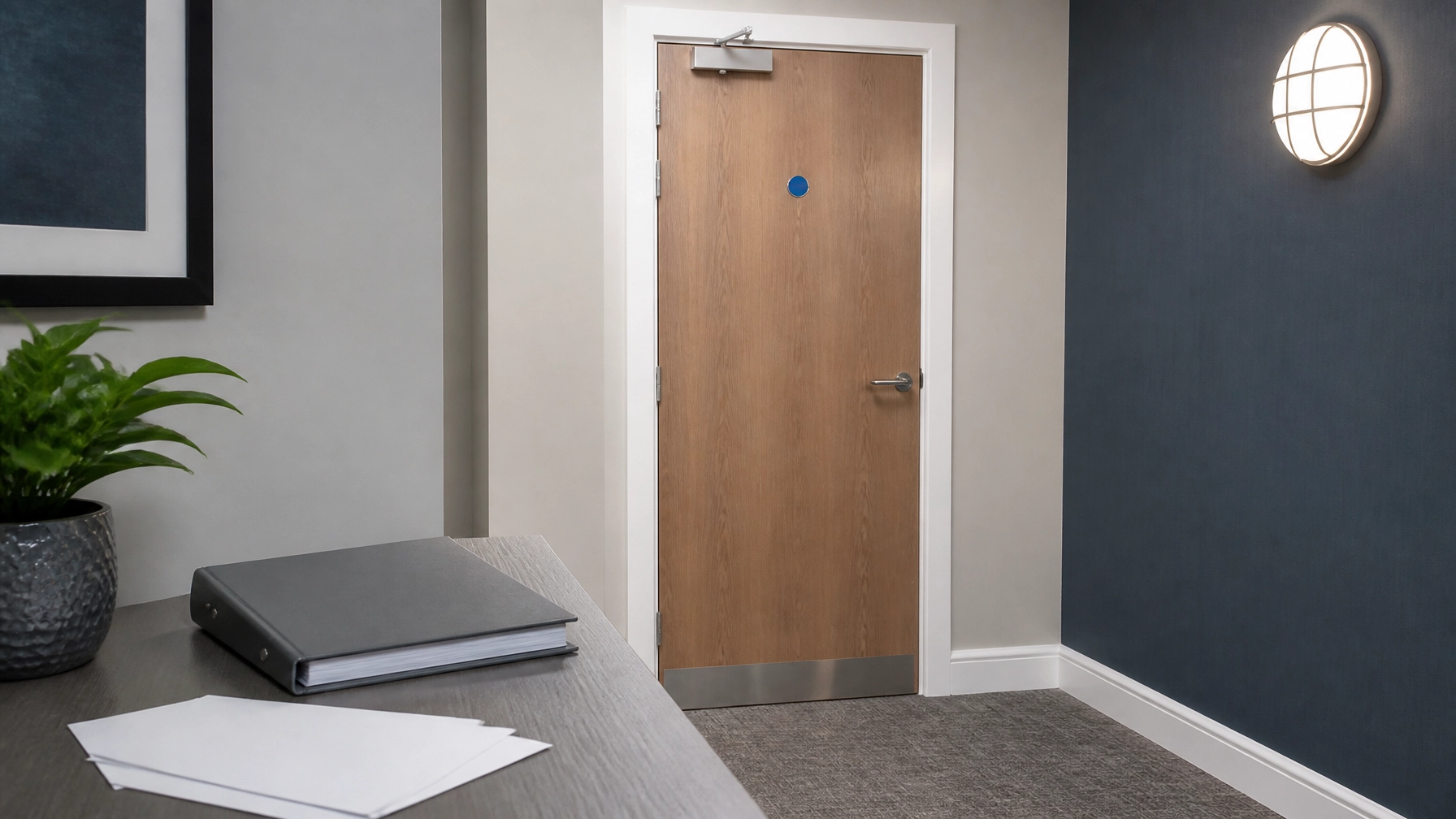
A well-organised fire-door compliance file gives landlords, property managers, HMO investors, B&B owners and small businesses a clear record of what was reviewed, what work was agreed and what was completed. It supports practical property management across East Sussex and the wider South East, while helping answer reasonable questions from managing agents, insurers, buyers and licensing teams.
Table of Contents
- The Legal Stakes of Incomplete Records
- Decode Your FRA Report Into Clear Actions
- Choose the Proportionate Repair or Upgrade
- Prepare Your HMO Investment Before Letting
- Follow a Simple Professional Process
- Answer Common Fire-Door Record Questions
- Request a Professional File Review
- Conclusion
The Legal Stakes of Incomplete Records
Fire safety duties apply to the person responsible for managing and maintaining a property. Depending on the building type, use and layout, this may include obligations under the Regulatory Reform (Fire Safety) Order 2005, the Fire Safety (England) Regulations 2022 and other relevant housing or building requirements.
Records matter because a responsible person may need to demonstrate that fire safety measures have been considered, maintained and addressed when problems arise. For qualifying multi-occupied residential buildings, specific duties can also apply to the recording of regular common-area door checks and attempts to review flat entrance doors.
However, paperwork is not a substitute for suitable physical fire doors. A complete file cannot make a defective door safe, and a dated form cannot replace proportionate professional work. The file should support the physical condition of the property rather than create a false sense of security.
Clear records can help you:
- Respond efficiently to questions from licensing teams.
- Give managing agents an accurate property history.
- Provide insurers with relevant maintenance information.
- Support due diligence when buying or selling a property.
- Demonstrate that identified actions were reviewed and progressed.
- Track follow-up work instead of relying on memory or informal messages.
The consequences of poor records can include delays, repeated surveys, disputes about responsibility and difficulty demonstrating a reasonable approach to fire safety management.
Decode Your FRA Report Into Clear Actions
A fire risk assessment (FRA) may identify concerns across a property without specifying every physical task needed to resolve them. The compliance file should translate the FRA into a practical action trail.
Record the Relevant FRA Information
Start with the current FRA and retain previous versions where they help explain the property’s history. Record:
- The assessment date and property details.
- The areas and doors covered by the assessment.
- Significant findings relating to fire doors and escape routes.
- Priorities, recommended timescales and responsible parties.
- Any changes to use, occupancy, layout or management arrangements.
- The date on which follow-up action was requested.
If the FRA refers to fire doors by location rather than by a unique reference, a professional Fire Door Survey for Quotations can create a clearer door schedule. This is particularly useful in HMOs with several bedrooms, communal areas and different door types.
Create a Door-by-Door Evidence Trail
A useful file should show how each concern moved from identification to resolution. Professional survey notes may record the door location, general condition, relevant hardware, frame information, seals, closer arrangements and any limitations affecting the assessment.
The file may also include:
- A fire-door register or location schedule.
- Professional survey notes and photographs where appropriate.
- A written quotation and agreed scope of work.
- Details of proposed products and replacement components.
- Completed Fire Door Repairs records.
- Completed Fire Door Installations records.
- Follow-up maintenance recommendations.
- A signed completion or handover record.
Photographs can be valuable when they clearly show the condition before and after work. They should be stored securely, dated where possible and linked to the relevant door or room. A photograph is supporting evidence, not proof on its own.

Choose the Proportionate Repair or Upgrade
A failed door does not automatically require full replacement. The correct decision depends on the door set, the nature of the defect, its history, the surrounding frame and the requirements identified by the FRA.
A professional review may identify a suitable route such as:
- Repairing damage where the door remains appropriate.
- Re-lipping a compatible door edge where professional assessment supports that approach.
- Upgrading suitable hardware, seals or closing arrangements.
- Replacing a door leaf, frame or complete door set where repair is not proportionate.
- Completing wider HMO Fire Door Upgrades as part of a planned renovation.
All work should be completed by suitably qualified professionals with the correct knowledge, products and equipment. Elite Fire Door Installations works to the relevant requirements of BS 476-22 and BS 8214, with the scope recorded clearly so that the property owner understands what has been done and why.
This approach can reduce unnecessary expenditure while maintaining a responsible focus on safety, legal adherence and long-term property management.
Prepare Your HMO Investment Before Letting
Investors converting a property into an HMO should allow for fire-door preparation before finalising the renovation budget. Fire doors should not be treated as a last-minute item after decorating, furnishing and marketing have been completed.
Your budget may need to account for:
- A professional Fire Door Survey for Quotations at an early stage.
- A review of bedroom, communal-area and entrance doors.
- Repairs to suitable existing doors.
- Replacement of unsuitable or damaged door sets.
- Compatible hinges, latches, closers, handles and intumescent seals.
- Frame repairs, adjustment or associated remedial work.
- Professional photographs and a structured door schedule.
- Follow-up maintenance and future review arrangements.
- A signed compliance file for the property records.
Planning early gives you greater control over cost and programme. It also allows physical fire-door work to be coordinated with electrical, alarm, compartmentation and general refurbishment requirements identified by the FRA.
Do not rely on a previous owner’s paperwork without checking that it relates to the current layout and condition. A property can change significantly during conversion, and old records may no longer describe the building accurately.
Follow a Simple Professional Process
Step One: Review the Property
Begin with the FRA, available drawings, existing records and the intended use of the property. A professional survey then considers the relevant fire doors and identifies where further information or action may be required.
Step Two: Agree the Scope and Price
You should receive a clear quotation that separates repair, upgrade and replacement options where appropriate. The scope should explain the work proposed, the products involved, any exclusions and the expected handover information.
Step Three: Complete the Work Professionally
Once approved, the agreed work is completed without relying on improvised alterations. Professional equipment may include Fire Door Gap Gauges, Intumescent Seal Routers, Hinge Jigs, Fire-Rated Packers, Digital Inclinometers, Force Gauges, Laser Levels and suitable Intumescent Mastic/Sealant.
These tools are used by trained professionals as part of controlled work. They are not a DIY checklist, and fire-door alterations should not be attempted by landlords or occupants.

Step Four: Retain the Signed Compliance File
After completion, retain the quotation, scope, work record, product details, photographs where appropriate and follow-up maintenance information together. The file should be easy to find and simple for an authorised person to understand.
Digital copies can be stored alongside the property’s wider fire safety records, with sensible backups and access controls.
Answer Common Fire-Door Record Questions
What Should a Fire-Door Compliance File Contain?
It should contain the relevant FRA information, professional survey notes, the agreed quotation and scope, completed repair or installation records, suitable photographs, product details and follow-up maintenance recommendations.
The exact content will depend on the property and work completed. A small commercial unit may need a different record structure from a multi-bedroom HMO.
Does Paperwork Alone Prove Compliance?
No. Records support the management process, but they do not make an unsuitable door compliant. The physical condition, specification, installation and ongoing maintenance must all be considered by appropriate professionals.
What Should HMO Investors Budget For?
Investors should budget for an early professional survey, proportionate repairs, possible replacements, compatible hardware, associated frame work, follow-up maintenance and preparation of an organised compliance file.
Allowing for these items before purchase or conversion helps avoid unexpected delays before letting.
Can Existing Fire Doors Be Repaired?
Some doors may be suitable for professional repair, re-lipping or upgrading. Others may require replacement because the damage, specification or history makes repair inappropriate.
Only a suitably qualified professional should determine the correct option. Avoid assuming that a visual improvement will resolve a fire-safety defect.
When Should the File Be Updated?
Update it after a new FRA, a change of use, refurbishment, a professional survey, completed remedial work or a change in property management. Regular fire safety checks and maintenance should also be recorded in the property’s ongoing log.
Request a Professional File Review
A clear file can make property management more efficient, but it must be based on accurate information and professionally completed work. Elite Fire Door Installations can review your existing records, arrange a professional survey and provide a clear quotation for proportionate repair, upgrade or replacement.
Whether you are preparing an HMO, managing a rental property or updating a commercial premises file, take the next step through the Elite Fire Door Installations website.
Conclusion
A practical fire-door compliance file brings together the information needed to understand a property’s fire-door history. It can include FRA details, professional survey notes, agreed quotations, completed work records, product information, photographs and future maintenance recommendations.
The process is straightforward: review the property, agree the work, complete it professionally and retain the signed file. Good records support communication with managing agents, insurers, buyers and licensing teams, but they should always reflect the real physical condition of the fire doors.
For landlords, HMO investors, B&B owners and small businesses, early organisation provides greater clarity, better budget control and lasting peace of mind.
- Email: info@elitefiredoorinstallations.co.uk
- Specialist Support: +44 7514 898517
- Request a call back: +44 20 4511 9456
- Website: https://elitefiredoorinstallations.co.uk
Leave a Reply