

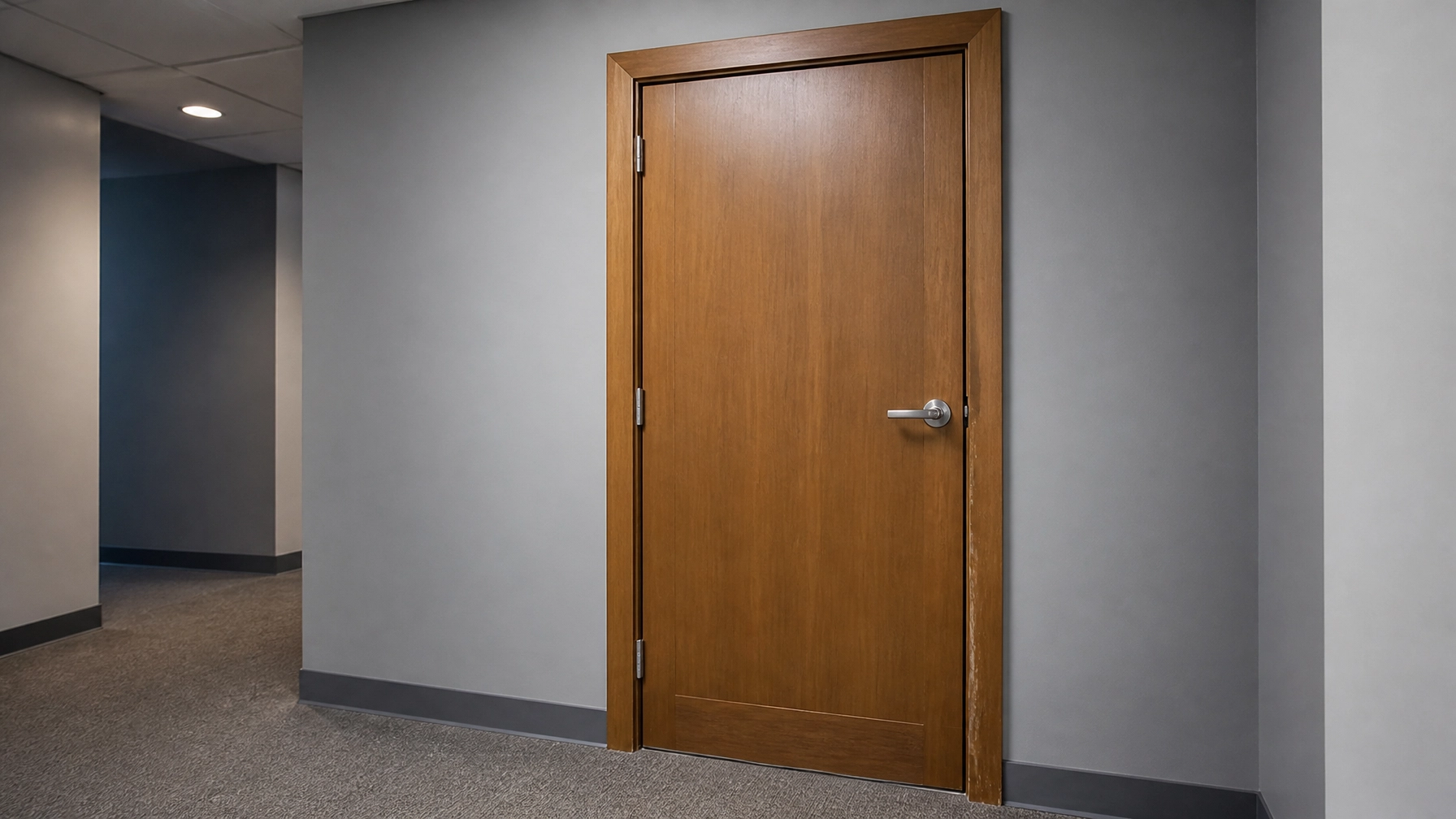
For landlords, property managers, HMO owners, B&B operators and small businesses, a damaged fire door raises an important question: should it be repaired, upgraded or replaced?
The correct answer depends on the condition of the complete doorset, the original specification, the type of damage and the outcome required by the property’s Fire Risk Assessment (FRA). A professional review helps identify the proportionate solution, avoid unnecessary expense and create a clear compliance record.
Day 2: Review the Door Before You Replace It
Key Takeaways
- Assess the complete doorset: The leaf, frame, hinges, closer, latch, seals and surrounding construction must work together.
- Choose proportionate remedial work: Some faults may be suitable for repair or upgrade, while serious damage may require replacement.
- Avoid assumptions: A door that looks acceptable may still fail to close, latch or provide the required fire resistance.
- Protect your budget: A professional Fire Door Survey for Quotations can help prevent unnecessary full replacements.
- Use competent professionals: Fire door repairs and upgrades should be completed by suitably qualified specialists using appropriate materials and evidence.
- Keep documentation: A signed compliance file provides a useful record for property management, future reviews and HMO licensing requirements.
Table of Contents
- Understand the Legal Responsibility
- Decode the FRA Report
- Compare Repair, Upgrade and Replacement
- Prepare an HMO Budget Properly
- Follow a Clear Professional Process
- Answer Common Fire Door Questions
- Take the Next Step
- Reach a Practical Conclusion
Understand the Legal Responsibility
Fire doors are part of a building’s passive fire protection. They are intended to help restrict the movement of fire and smoke, protect escape routes and support compartmentation when correctly specified, installed and maintained.
Under the Regulatory Reform (Fire Safety) Order 2005, the responsible person must take reasonable steps to ensure that relevant fire safety measures are maintained. The Fire Safety Act 2021 also clarified responsibilities in multi-occupied residential buildings, including matters relating to flat entrance doors and the structure of the building.
For HMOs, fire door condition can also affect licensing, housing standards and the outcome of wider fire safety reviews. A failed door may create:
- A recorded action within an FRA
- Delays to an HMO licence or property handover
- Concerns from insurers or managing agents
- Additional remedial costs if defects are left unresolved
- Potential enforcement action where serious risks remain
The aim is not to replace every older door automatically. The aim is to establish whether the existing doorset can be brought back to an appropriate standard through qualified professional work.
Decode the FRA Report
An FRA may identify concerns such as damaged doors, poor closing, excessive gaps or missing seals. However, the report may not always explain the most suitable physical solution for every door.
This is where a specialist Fire Door Survey for Quotations adds value. The survey translates general FRA findings into a practical action plan by considering:
- The condition of the door leaf and frame
- The security and compatibility of hinges, latches and closers
- The presence and condition of intumescent seals
- Whether the door closes and latches reliably
- Whether gaps appear consistent with the doorset’s specification
- Signs of warping, impact damage, splitting or unauthorised alterations
- The available evidence for the door’s intended fire performance
Typical guidance refers to top and side gaps in the region of 2–4mm, often with approximately 3mm used as a practical target. However, this is not a universal replacement rule. The relevant specification, manufacturer’s information and professional assessment must be considered.
Compare Repair, Upgrade and Replacement

Consider Fire Door Repairs
Fire Door Repairs may be suitable where the main leaf and frame remain structurally sound and the problem is limited to a compatible component or correctable condition.
Common repair-related concerns include:
- A faulty or poorly adjusted door closer
- Loose or worn hinges
- A damaged latch or keep
- Missing, painted-over or deteriorated intumescent seals
- Minor frame movement or alignment concerns
- A door that does not close and latch consistently
Repairs must use suitable fire-rated components and follow the relevant doorset evidence. A general-purpose replacement part is not automatically appropriate simply because it fits.
Consider a Fire Door Upgrade
A Fire Door Upgrade may be appropriate where an existing door has a sound basis but requires several improvements to support its intended performance.
An upgrade might involve compatible hardware, improved seals, closer replacement, frame work or other proportionate remedial measures. The precise scope should be determined by a qualified specialist rather than assumed from the appearance of the door.
This approach can often help landlords control expenditure, particularly where several doors need attention but do not all require full replacement.
Consider Full Replacement
Replacement may be necessary where the door leaf or frame has substantial structural damage, serious distortion, extensive unauthorised alterations or no reliable supporting evidence.
Examples may include:
- Deep damage affecting the door’s core
- Large holes or unsuitable cut-outs
- Severe warping that prevents reliable closing
- Frames that cannot support the doorset correctly
- Hinge or closer fixing areas that are no longer secure
- Seal grooves or hardware preparations that cannot be restored appropriately
A professional review should confirm whether replacement is required and whether the frame, leaf or complete doorset needs attention.
Prepare an HMO Budget Properly

Property investors converting a building into an HMO should treat fire door provision as an early renovation budget item, not a final decoration task.
Before renting rooms, allow for:
- A professional review of existing doors
- New Fire Door Installations where existing doors are unsuitable
- Proportionate repairs and upgrades
- Compatible closers, hinges, latches and intumescent seals
- Frame and surrounding construction work where necessary
- Access arrangements for occupied or partially completed properties
- Compliance documentation and a signed handover file
Budgeting only for door leaves can lead to unexpected costs later. Hardware, frames, seals, making-good work and documentation may all affect the final programme.
A planned survey also helps investors distinguish between doors that need replacement and doors that may be suitable for proportionate remedial work. This supports a clearer conversion budget and reduces the likelihood of rushed work before an HMO licence application.
Follow a Clear Professional Process
Elite Fire Door Installations uses a straightforward process designed to keep decisions clear and proportionate.
Step One: Review the Property
A professional survey considers the doorset, frame, hardware, seals, operation and available documentation. It identifies the issue without assuming that every door requires the same treatment.
Step Two: Receive Clear Quotation
The quotation should separate repair, upgrade and replacement recommendations. This allows the property owner or manager to understand the scope, priorities and likely costs before work begins.
Step Three: Complete the Agreed Work
Qualified specialists carry out the approved Fire Door Repairs or Fire Door Installations using appropriate UK-standard products and methods. Professional equipment may include Fire Door Gap Gauges, Intumescent Seal Routers, Hinge Jigs, Fire-Rated Packers, Digital Inclinometers, Force Gauges, Laser Levels and certified Intumescent Mastic or Sealant.
These tools support precision. They do not replace professional judgement or the need to work within the relevant specification.
Step Four: Receive Compliance Documentation
At handover, the property owner should receive a clear record of the work completed, products used and doors addressed. This signed compliance file can support ongoing property management and future fire safety reviews.
Work should be considered against relevant standards, including BS 476-22 and BS 8214, alongside the doorset manufacturer’s evidence and the property’s FRA requirements.
Answer Common Fire Door Questions
1. Can every damaged fire door be repaired?
No. Some doors may be suitable for repair, while others may have damage that affects the leaf, frame or tested configuration. A qualified specialist must assess the condition before recommending repair or replacement.
2. Is a faulty closer a reason to replace the whole door?
Not necessarily. A closer may be a replaceable component where the door and frame remain suitable and the replacement is compatible. If the fixing area or door construction is damaged, a wider solution may be necessary.
3. What if the door has excessive gaps?
Excessive gaps require professional attention because they may affect the intended performance of the doorset. The correct response depends on the cause, the specification and whether the leaf and frame can be restored appropriately.
4. Can an HMO landlord replace hardware with standard products?
Standard hardware is not automatically suitable for a fire doorset. Hinges, latches, closers and seals must be compatible with the relevant doorset requirements. This work should be completed by qualified fire door professionals.
5. What documentation should follow the work?
The handover should record the doors addressed, the work completed, the products used and any relevant supporting information. A signed compliance file provides a clearer audit trail for landlords, managers and future reviewers.
Take the Next Step
If you are unsure whether a fire door needs repair, upgrade or replacement, start with a professional Fire Door Survey for Quotations. Elite Fire Door Installations provides practical advice, clear quoting and proportionate solutions for rental properties, HMOs, B&Bs and small commercial premises.
For more information about Fire Door Installations, Fire Door Repairs and Fire Door Upgrades, visit the Elite Fire Door Installations website.
Reach a Practical Conclusion
Repair, upgrade and replacement each have a role in maintaining fire door compliance. The most suitable option depends on the condition of the complete doorset, the available evidence and the requirements identified through professional review.
A calm, evidence-based approach can help property owners avoid unnecessary replacement while ensuring serious defects are not overlooked. By arranging a professional survey, obtaining a clear quotation and retaining a signed compliance file, landlords and property managers can make informed decisions that support safety, legal adherence and peace of mind.
Note: This information is intended as general guidance and does not constitute professional or legal advice. Always consult a qualified fire safety engineer for your specific property.
Contact Elite Fire Door Installations
- Email: info@elitefiredoorinstallations.co.uk
- Specialist Support: +44 7514 898517
- Request a call back: +44 20 4511 9456
- Website: https://elitefiredoorinstallations.co.uk
Leave a Reply