

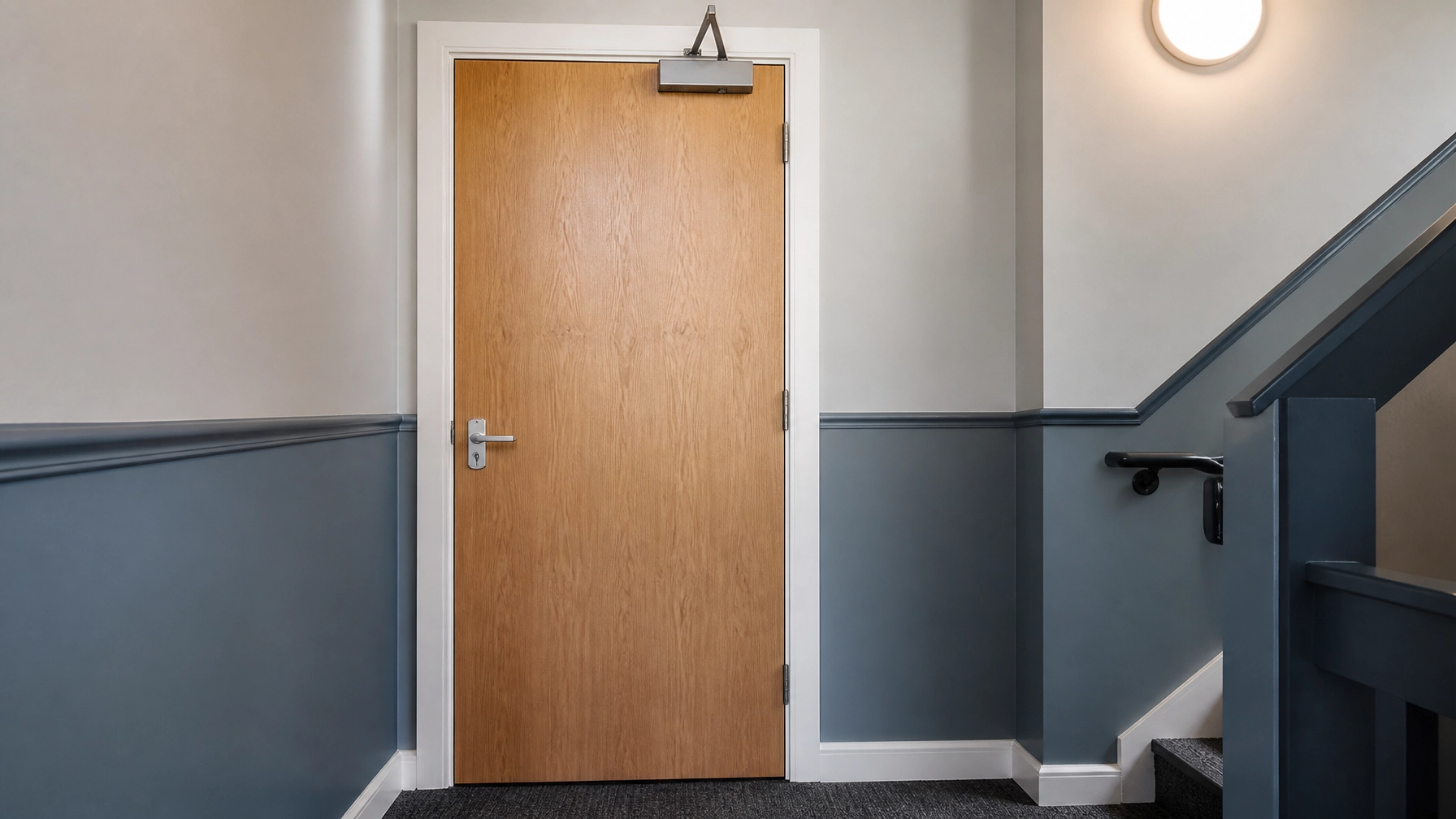
Understand the June 2026 supplementary guidance, identify fire door risks early, and prepare your HMO for a professional assessment with qualified specialists.
Alternative SEO-friendly title options:
- 2026 HHSRS Fire Guidance: A Landlord’s Guide to HMO Fire Doors
- HMO Fire Doors and the New HHSRS Part 3 Guidance Explained
- How the 2026 HHSRS Fire and Explosions Guidance Affects HMO Landlords
Key Takeaways
- The June 2026 HHSRS Part 3 guide provides supplementary technical guidance for assessing fire and explosion hazards in homes and HMOs.
- HHSRS is risk-based and property-specific. It does not impose one universal fire door specification for every HMO.
- Self-closing devices, fire-resisting doors, protected escape routes, signage and compartmentation must be considered together.
- Existing doors may be repairable, but decisions require a qualified FRA assessor and Certified Installer.
- Investors converting properties into HMOs should budget for surveys, doorsets, hardware, compartmentation works and compliance documentation before letting rooms.
Table of Contents
- 1. Understand the Legal Position
- 2. Translate Your FRA Report into Action
- 3. Choose Certified Repair or Replacement
- 4. Prepare an HMO Investment for Compliance
- 5. Follow a Controlled Certification Process
- 6. Answer the Key HMO Fire Door Questions
- 7. Secure Professional Remediation
- 8. Complete Your Compliance Plan and Request a Quote
- 9. Conclude with a Safer, Better-Documented HMO
1. Understand the Legal Position
The Housing Health and Safety Rating System (HHSRS) Operating Guidance Part 3 was published on 23 June 2026. It provides additional guidance for assessing the prescribed hazard of Fire and Explosions in residential properties, including HMOs.
The official guidance is issued under section 9 of the Housing Act 2004. Local authorities must have regard to it when assessing housing hazards. A Category 1 hazard requires enforcement action, while authorities have powers to act where a Category 2 hazard is identified.
However, HHSRS is not a simple pass-or-fail checklist. It considers the likelihood of harm and the likely outcome for occupiers. The assessment is therefore property-specific and depends on the building layout, occupancy, escape arrangements, construction, management and existing fire precautions.
The guidance should also be considered alongside other applicable requirements, including:
- The Regulatory Reform (Fire Safety) Order 2005, where applicable.
- The Fire Safety Act 2021 and associated duties.
- HMO licensing conditions.
- Building regulations applying to alteration or conversion work.
- The property’s fire risk assessment and fire strategy.
Landlords and property managers should not assume that installing a particular door automatically resolves every fire safety concern. A qualified FRA assessor must consider the whole risk profile.
2. Translate Your FRA Report into Action
A fire risk assessment can identify concerns such as defective self-closing devices, damaged doors, inadequate fire resistance, unprotected escape routes or weaknesses in compartmentation. The wording may be technically correct but still difficult to convert into a practical works schedule.
At Elite Fire Door Installations, we help property owners turn professional findings into a clear physical action plan through a Fire Door Survey for Quotations.
Assess the Door and the Building Together
The 2026 Part 3 guidance recognises that fire doors cannot be considered in isolation. A qualified professional may need to consider:
- Whether doors are positioned to protect the intended escape route.
- Whether doors are likely to resist fire and smoke for the required period.
- Whether self-closing devices operate effectively where required.
- Whether frames, stops, hinges, seals and hardware remain suitable.
- Whether compartmentation is continuous around rooms, corridors and service penetrations.
- Whether signage is necessary to support safe management and occupant awareness.
The guide indicates that original solid doors with substantial stops may normally be acceptable in some circumstances. That does not mean every older door is compliant. Condition, fit, damage, alterations and the overall fire strategy remain important.
Separate HHSRS from the FRA
An HHSRS assessment and a fire risk assessment are related, but they are not identical documents. The HHSRS considers potential harm to occupiers under a prescribed hazard. The FRA considers fire precautions, management arrangements and the responsibilities of the relevant duty holder.
Where the documents identify a fire door concern, only qualified professionals should decide whether the appropriate response is repair, upgrading or replacement.

3. Choose Certified Repair or Replacement
A failed fire door does not always require complete replacement. In many cases, a qualified Certified Installer can determine whether the existing doorset can be physically repaired, re-lipped, upgraded or returned to reliable operation.
Our Fire Door Repairs may provide a more proportionate solution where the door leaf, frame and associated components remain suitable. This can reduce waste, shorten disruption and help landlords control expenditure across multiple rooms.
Replacement may be necessary where:
- The door construction is unsuitable for its required position.
- Damage or previous alterations have compromised performance.
- The frame cannot provide the required support.
- Hardware is incompatible or beyond reliable repair.
- The existing doorset cannot be supported by appropriate evidence.
- The fire strategy requires a different performance level.
All decisions should be based on a professional survey and the relevant evidence. Repairing a door without confirming its suitability can create further liability and may leave a landlord with an expensive compliance failure.
Our Fire Door Installations are completed with attention to the requirements of BS 476-22 and BS 8214, where applicable to the project and product specification.
4. Prepare an HMO Investment for Compliance
Investors buying a property for HMO conversion should treat fire door compliance as a core project cost, not an afterthought. A property that appears suitable during a viewing may require substantial work before occupation or licensing.
Budget for the Complete Fire Door Scope
Before exchange or finalising a renovation budget, allow for a professional HMO Fire Door Upgrade survey covering:
- Bedroom and entrance fire doors.
- Communal corridors and protected escape routes.
- Fire-rated frames and door stops.
- Self-closing devices and fire-rated hinges.
- Intumescent strips and certified sealant.
- Door hardware, latches and furniture.
- Compartmentation around walls, ceilings and service routes.
- Relevant fire safety signage.
- Remedial works identified by the FRA assessor.
- Handover records and compliance documentation.
The final cost will depend on the property’s size, layout, existing construction and licensing expectations. A fixed-price quotation following a professional survey provides greater certainty than relying on an allowance based only on the number of bedrooms.
Allow for Access and Programme Constraints
Occupied HMOs create additional scheduling requirements. Investors should allow time for resident access, phased work, material availability and any coordination with electricians, builders or fire risk assessors.
Early planning reduces the risk of delayed letting, failed licensing appointments and rushed decisions that compromise legal adherence.
5. Follow a Controlled Certification Process
Elite Fire Door Installations follows a structured process designed to provide clarity from the first survey through to handover.
Step One: Complete a Professional Survey
We review the doors, frames, hardware and surrounding building conditions against the available FRA information and project requirements. This is not a DIY checklist. A qualified professional must interpret the findings and determine an appropriate scope.
Step Two: Issue a Fixed-Price Quotation
We explain whether each affected doorset is suitable for repair, upgrading or replacement. The quotation identifies the expected works and helps the landlord make an informed investment decision.
Step Three: Complete Certified Execution
Our Certified Installers use professional UK-standard equipment, including:
- Fire Door Gap Gauges.
- Intumescent Seal Routers.
- Hinge Jigs.
- Fire-Rated Packers and shims.
- Digital Inclinometers.
- Force Gauges.
- Laser Levels.
- Certified Intumescent Mastic and sealant.
These tools support precision and repeatability. Work is completed in accordance with the applicable product requirements, BS 476-22, BS 8214 and relevant FireQual standards.

Step Four: Handover Compliance Documentation
At completion, we provide appropriate records of the works undertaken. These documents can support the landlord’s compliance file, future surveys, property management and communication with relevant professionals.
6. Answer the Key HMO Fire Door Questions
Does the 2026 guidance require every HMO door to have the same specification?
No. HHSRS is risk-based and property-specific. The appropriate arrangement depends on the building’s design, escape strategy, occupancy, construction and other precautions. A qualified FRA assessor should establish what is required for the individual property.
Does an existing solid timber door automatically pass?
No. The Part 3 guidance explains that certain original solid doors with substantial stops may normally be acceptable for HHSRS purposes. That is not an automatic approval. Damage, poor fit, missing self-closing equipment, unsuitable alterations and defects in the surrounding compartmentation may still create significant risk.
Must every fire door have a self-closing device?
Not necessarily in every situation. Self-closing requirements depend on the door’s position, the fire strategy, HMO licensing expectations and the wider risk assessment. Where a door is intended to protect an escape route or compartment, an effective compatible device may be essential.
Can a landlord repair a failed fire door instead of replacing it?
Sometimes. A Certified Installer can assess whether the doorset is suitable for physical repair, re-lipping or upgrading. The decision must consider the door leaf, frame, hardware, seals and supporting evidence. Unqualified alterations can make the door less reliable and harder to certify.
What records should an HMO landlord retain?
Keep the FRA, professional survey, quotation, product information, installation or repair records, photographs where appropriate, maintenance information and handover documents. A clear compliance file helps demonstrate responsible management and supports future assessments.
7. Secure Professional Remediation
When a fire door issue appears in an FRA or HHSRS-related action plan, delay can increase risk. It can also affect licensing, insurance discussions, investment timetables and the ability to demonstrate reasonable management.
Elite Fire Door Installations provides a tailored route from FRA Remediation to documented completion. We prioritise proportionate solutions, precise workmanship and minimal disruption while maintaining the need for qualified professional oversight.
8. Complete Your Compliance Plan and Request a Quote
The June 2026 HHSRS Part 3 guide gives landlords and property managers an important reference point for fire and explosion hazards. It does not remove the need for professional judgement. It reinforces the importance of assessing fire doors as part of the entire building, escape route and compartmentation strategy.
If you are buying an HMO, responding to an FRA or preparing for a licensing review, arrange a professional survey before committing to remedial works.
For further information about our professional services, visit Elite Fire Door Installations.
9. Conclude with a Safer, Better-Documented HMO
The 2026 HHSRS Part 3 supplementary guide places fire and explosion hazards within a clearer, risk-based framework. For HMO landlords, the practical message is direct: fire doors, self-closing devices, escape routes, signage and compartmentation must work together.
Some existing doors may be repairable or upgradeable. Others may require replacement. Only a qualified FRA assessor and Certified Installer can make that decision responsibly for the property concerned.
Early professional advice gives investors better budget control, reduces disruption and supports legal adherence. Most importantly, it provides greater confidence that residents are protected by a properly considered and documented fire safety strategy.
Email: info@elitefiredoorinstallations.co.uk
Specialist Support: +44 7514 898517
Request a call back: +44 20 4511 9456
Website: https://elitefiredoorinstallations.co.uk
Note: Summarised by artificial intelligence technology. This is not professional or legal advice. No DIY instructions.
Leave a Reply