
Table of Contents
- Key Takeaways
- Hero Header & Introduction
- The Legal Stakes of Non-Compliance
- Decoding Your FRA Report
- The Elite Solution: Repair vs. Replace
- HMO Investor Preparation
- Our Certification & Process
- Frequently Asked Questions
- Final Call to Action & Conclusion
Key Takeaways
- Statutory Definition: UK fire safety legislation mandates that fire doors must be installed and maintained by a “competent person,” but it does not mandate specific brand logos or corporate accreditations by statute.
- Corporate vs. Individual Standards: While BM TRADA Q-Mark audits entire enterprise-level company quality systems, FireQual rigorously tests and certifies the personal technical competence of individual technicians and installers.
- Legal Liability: Property investors, landlords, and managing agents carry full personal and corporate liability under the Regulatory Reform (Fire Safety) Order 2005 if unverified installers cause compliance failures.
- Precision Execution: Elite Fire Door Installations delivers Fire Door Installations, Fire Door Repairs, and HMO Fire Door Upgrades to rigorous British Standards (BS 476-22 and BS 8214).
1. Hero Header & Introduction
GET A FREE QUOTE: Secure your property compliance today by requesting a rapid, fixed-price quotation at our secure portal.
When it comes to building compliance, property management, and tenant safety, there is zero room for guesswork. For property owners, landlords, and business managers across the UK, ensuring that fire doors are specified, hung, and maintained correctly is not merely a matter of operational best practice: it is an absolute statutory obligation.
When searching for qualified professionals to manage passive fire protection, you will frequently encounter industry acronyms and certification frameworks such as BM TRADA Q-Mark and FireQual. Many property investors ask: what is the actual difference between these frameworks, and which one truly matters for legal accountability in my building?
In this comprehensive guide, we examine the legal interpretation of the “competent person” requirement under UK fire safety legislation, contrasting corporate-level quality management systems with individual technical qualifications to help you protect your investment and satisfy enforcement authorities.

2. The Legal Stakes of Non-Compliance
The primary legislative framework governing fire doors in non-domestic premises and communal residential areas is the Regulatory Reform (Fire Safety) Order 2005 (RRO). Under this statute, the designated “Responsible Person”: whether that is a landlord, property investor, managing agent, or freeholder: has a strict legal duty to ensure that all fire safety measures are adequate, operational, and properly maintained.
Furthermore, the Fire Safety (England) Regulations 2022 introduced heightened scrutiny for multi-occupied residential buildings, mandating regular checks of flat entrance doors and communal fire doors. Crucially, legislation dictates that any replacement work, adjustments, or maintenance must be performed by a “competent person”.
However, what does the law actually state regarding certification? Interestingly, UK fire safety statutes do not legally mandate a specific branded logo or third-party corporate scheme. Instead, the legal burden rests entirely on the Responsible Person to prove that whoever carried out the work possessed the necessary knowledge, training, qualifications, and practical experience. If an unverified general handyman hangs a fire door that subsequently fails an audit, the financial penalties, unlimited fines, and potential custodial sentences fall squarely on the property owner.
3. Decoding Your FRA Report
When a Fire Risk Assessment (FRA) is completed on your property, the resulting document often outlines urgent remedial actions required for compartmentation barriers. Unfortunately, many professional fire risk assessors provide only high-level or vague notes: such as “fire door out of alignment” or “unacceptable gaps”: leaving landlords in the dark regarding the physical actions required.
Translating a failed FRA into a compliant physical action plan requires specialist expertise. Landlords cannot afford to treat these reports as mere administrative checkboxes. Every single millimeter of clearance, every intumescent strip, and every hinge rating matters when fire safety enforcement officers or local authority housing teams review your property licensing files. Partnering with certified specialists ensures that vague audit notes are converted into fully documented, certified compliance solutions.

4. The Elite Solution: Repair vs. Replace
At Elite Fire Door Installations, we frequently encounter properties where landlords have been told by general contractors that a failing fire door must be entirely ripped out and replaced at great expense. This often stems from a lack of specialist technical knowledge.
Our unique selling point is our ability to evaluate failing doors to physically repair, re-lip, and upgrade them in accordance with BS 476-22 and BS 8214 standards. By utilising precision techniques, we restore door functionality and compliance without imposing the massive capital expenditure of full replacements.
The fire safety industry uses different credentials depending on the scale of the business doing the work. Understanding these distinctions clarifies why our approach balances elite engineering with cost-effective value:
- BM TRADA Q-Mark (Corporate Scale): This is a company-level certification designed for massive construction firms with dozens of site workers. It audits corporate office processes, paperwork trails, and warehousing facilities. While highly respected, the immense administrative overhead results in premium corporate price tags.
- FireQual (Personal Competence): FireQual is the UK’s leading specialist awarding body for the fire safety sector. Rather than auditing a corporate office, FireQual rigorously tests and certifies the individual technician actually hanging your doors. This guarantees that the specialist on your site possesses precise technical knowledge, practical skills, and legal understanding.
5. HMO Investor Preparation
For property investors acquiring residential properties to convert into Houses in Multiple Occupation (HMO), fire door preparation is the single most critical hurdle to clear before securing a mandatory or selective HMO licence from local authorities.
Local council housing officers inspect HMO properties with extreme rigour. Before tenants move in, investors must ensure that:
- Every bedroom door and kitchen entrance door is an accredited FD30 or FD60 fire-resisting doorset.
- Self-closing devices (such as certified overhead closers complying with BS EN 1154) operate smoothly and reliably under all conditions.
- Perimeter gaps do not exceed strict tolerances (ideally maintaining a 3mm gap around the sides and top).
- Cold smoke seals and intumescent strips are continuous and undamaged.
Failing to budget for professional HMO Fire Door Upgrades during the acquisition and renovation phase can result in refused licences, costly project delays, and severe enforcement notices.

6. Our Certification & Process
To eliminate risk and guarantee compliance, Elite Fire Door Installations follows a strict, professional four-step process for every project across East and West Sussex:
- Detailed Surveys: We conduct comprehensive Fire Door Surveys for Quotations to assess every doorset against current building regulations.
- Fixed-Price Quoting: Providing transparent, itemised quotations with no hidden surprises.
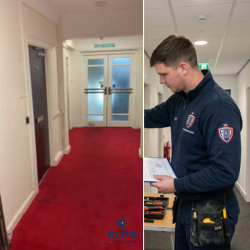
- Certified Execution: Our accredited technicians execute installations and repairs using specialised UK-standard compliance tools: including Fire Door Gap Gauges for precise 3mm gap measurements, Intumescent Seal Routers, Hinge Jigs, Fire-Rated Packers/Shims, Digital Inclinometers & Force Gauges (ensuring BS 8300 compliance), Laser Levels, and certified Intumescent Mastic/Sealant.
- Compliance Handover: We provide full documentation and certification records for your property compliance file.
7. Frequently Asked Questions
Are fire door installation certificates legally mandatory in the UK?
While UK fire safety statutes do not explicitly mandate specific brand schemes like BM TRADA Q-Mark, the law strictly requires that fire doors be installed and maintained by a “competent person.” Certified qualifications such as FireQual provide undeniable, legally robust evidence of that personal competence during regulatory audits.
Can a general carpenter or local joiner install my HMO fire doors?
A general joiner possesses valuable woodworking skills, but joinery expertise alone does not equate to fire door legal competence. Fire doors are heavily engineered life-safety systems that must be installed precisely according to the manufacturer’s tested doorset specification and relevant British Standards.
What is the difference between BM TRADA Q-Mark and FireQual?
BM TRADA Q-Mark is a company-level quality management system audit suited for large contracting corporations. FireQual is an individual-level professional qualification that rigorously assesses the practical and technical competence of the specific tradesperson working on your building.
How often should fire doors be inspected in a commercial or HMO property?
Under the Fire Safety (England) Regulations 2022 and general RRO guidelines, communal fire doors in high-risk residential buildings must be checked every 12 months, and flat entrance doors every 12 months. In standard HMOs, regular quarterly checks by a competent professional are strongly recommended.
Do you provide formal documentation for insurance and council audits?
Yes. Upon completion of any Fire Door Installations or Fire Door Repairs, we issue comprehensive compliance documentation verifying that your property meets all necessary building regulations and insurance stipulations.

8. Final Call to Action & Conclusion
Navigating the complexities of UK fire safety legislation does not have to be an overwhelming burden. By partnering with certified specialists who understand the precise legal definitions of competence, you safeguard your tenants, protect your investment, and ensure seamless approval from local housing authorities and insurers.
GET A FREE QUOTE: Book your professional survey and secure expert compliance today via our online booking portal.
Explore our core services or reach out directly using the official contact details below:
- Email: info@elitefiredoorinstallations.co.uk
- Specialist Support: +44 7514 898517
- Request a call back: +44 20 4511 9456
- Website: https://elitefiredoorinstallations.co.uk
9. Conclusion
In summary, achieving robust fire door compliance requires more than just buying a standard door leaf: it demands verified competence, meticulous attention to detail, and adherence to rigorous British Standards. Whether you are managing an established portfolio or preparing a new property for HMO conversion, trusting certified professionals is your strongest defence against legal liability and structural failure. Let Elite Fire Door Installations deliver the peace of mind your property deserves.
(Note: Summarised by artificial intelligence technology. This article is for informational guidance and does not constitute formal legal advice.)
Leave a Reply