

Managing a property in Worthing comes with a significant weight of responsibility, particularly when it involves life-saving equipment like fire doors. For many landlords and property investors, a failed Fire Risk Assessment (FRA) can feel like a sudden, expensive obstacle. However, the true danger lies not just in the report itself, but in how you choose to handle the remediation.
The complexity of fire safety means that a standard “handyman fix” is often a shortcut to legal liability. In the coastal stretches of West Sussex, from Goring-by-Sea to Broadwater, local authorities are tightening their grip on HMO compliance. If your Fire Door Repair isn’t executed by a certified professional, you aren’t just risking a fine; you are risking the safety of your residents and the integrity of your investment.
Key Takeaways
- Legal Urgency: Under the Fire Safety Act 2021, Worthing landlords face unlimited fines for non-compliant fire doors.
- Precision is Vital: Fire door gaps must be between 2mm and 4mm (ideally 3mm); anything else is a failure.
- Certification Matters: Only certified installers can provide the compliance documentation required to satisfy local council audits.
- Repair vs. Replace: Many failing doors can be physically repaired and re-lipped by experts, saving thousands in replacement costs.
- Professional Tools: Compliance cannot be achieved with basic household tools; it requires specialised equipment like digital force gauges and intumescent routers.
Table of Contents
- The Legal Stakes of Non-Compliance in Worthing
- Decoding Your FRA Report
- Mistake 1: The “Handyman” Hardware Trap
- Mistake 2: Ignoring the 3mm Gap Rule
- Mistake 3: Painting Over Intumescent Strips
- Mistake 4: Non-Fire-Rated Packers & Shims
- Mistake 5: Failing the Closing Force Test
- Mistake 6: Overlooking the Frame-to-Wall Seal
- Mistake 7: Lack of Compliance Documentation
- HMO Investor Preparation in Worthing
- The Elite Solution: Our Certified Process
- Local Area Coverage
- Frequently Asked Questions
- Conclusion
The Legal Stakes of Non-Compliance in Worthing
In recent years, the legal landscape for property owners in Worthing has shifted dramatically. The Fire Safety Act 2021 and the Fire Safety (England) Regulations 2022 have placed the “Responsible Person”, typically the landlord or property manager, under intense scrutiny. In West Sussex, local council enforcement officers are no longer issuing simple warnings; they are issuing Improvement Notices and Civil Penalties that can reach up to £30,000 per offence.
For owners of Houses in Multiple Occupation (HMOs), the stakes are even higher. A single non-compliant fire door can trigger a Rent Repayment Order (RRO), allowing tenants to claim back up to 12 months of rent. When you consider the density of HMOs in areas like Findon or the Worthing town centre, the financial risk of a “botched” repair far outweighs the cost of a Certified Fire Door Installation.

Decoding Your FRA Report
An FRA (Fire Risk Assessment) report is often a daunting document filled with technical jargon and “Category A” priorities. If your report highlights “remediation required” for your doors, it is essentially a physical action plan that requires immediate execution.
At Elite Fire Door Installations, we specialise in translating these reports into tangible results. Whether the report cites “excessive perimeter gaps” or “ineffective self-closing devices,” our role is to restore the physical integrity of the door set so that it meets BS 476-22 standards. We don’t just look at the door; we look at the entire “set”, the frame, the hardware, and the intumescent seals.
Mistake 1: The “Handyman” Hardware Trap
One of the most common mistakes we see in Worthing is the use of standard domestic hardware on fire doors. A fire door is only as strong as its weakest component. Using standard brass hinges or non-rated latches is a critical failure.
Every hinge must be BS EN 1935 certified, and every door closer must meet BS EN 1154 standards. If a repair involves replacing hardware, it must be like-for-like with certified components. Our technicians carry specialized Fire-Rated Hardware designed to withstand the extreme temperatures of a blaze, ensuring the door remains in its frame when it matters most.
Mistake 2: Ignoring the 3mm Gap Rule
A fire door’s primary job is to restrict the spread of fire and smoke. If the gap between the door leaf and the frame is too wide, the intumescent strip cannot expand sufficiently to seal the opening. Conversely, if it is too tight, the door may fail to close.
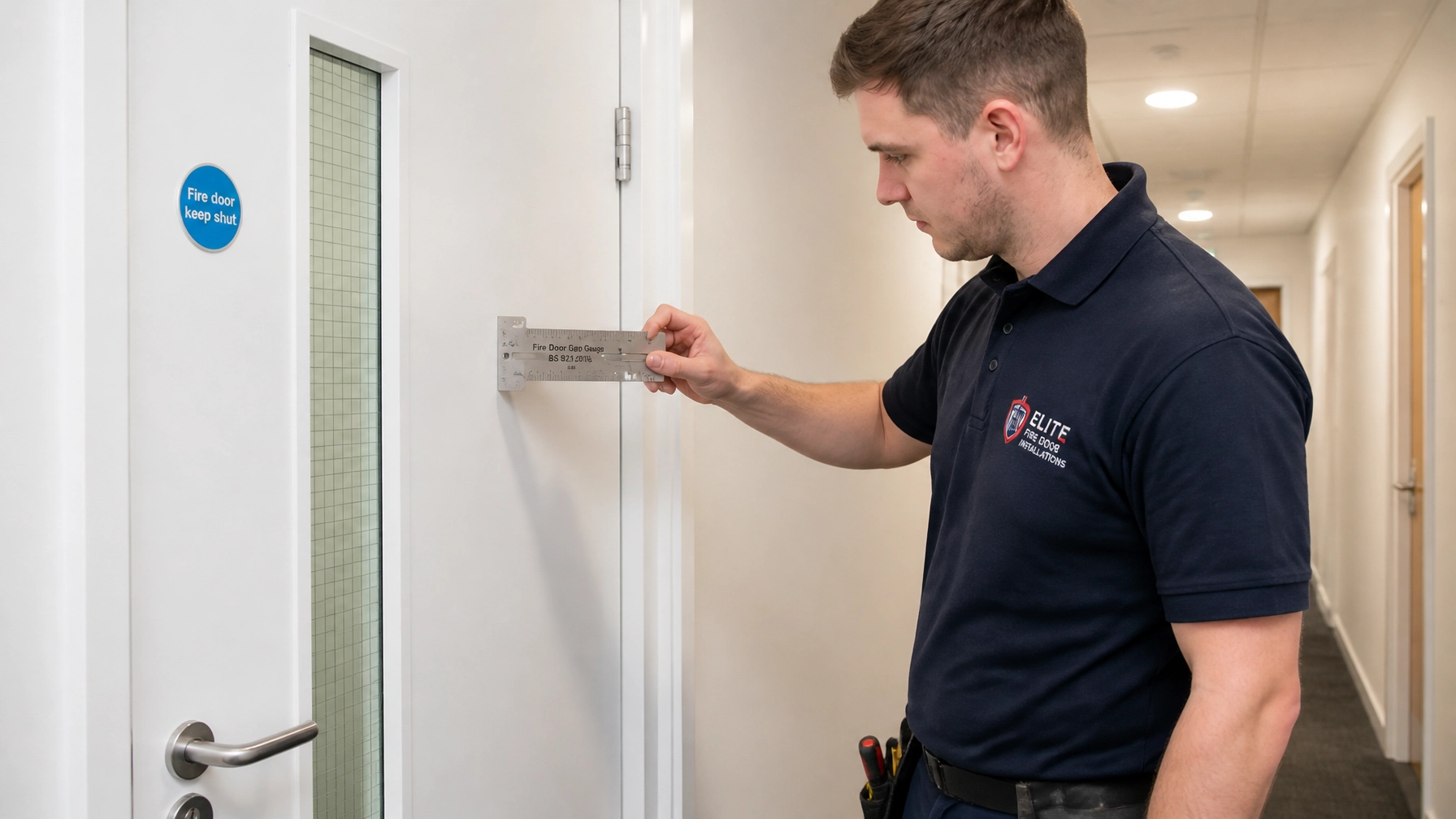
The industry standard is a gap of 2mm to 4mm. Achieving this level of precision is impossible with a standard tape measure. We utilize professional Fire Door Gap Gauges to ensure every millimetre is accounted for. If your current repair involves “shaving down” a door without recalibrating the gaps, you are likely invalidating its certification.

Mistake 3: Painting Over Intumescent Strips
During property renovations in Worthing, it is common for decorators to paint over everything, including the intumescent and smoke seals. This is a catastrophic error. Paint can prevent the chemical reaction required for the strip to expand during a fire, and it can also stiffen the smoke seal, rendering it useless.
If your seals are painted over, they must be professionally removed and replaced. We use Intumescent Seal Routers to create perfect grooves for new, high-performance seals, ensuring a seamless and compliant finish that blends with your interior design.
Mistake 4: Non-Fire-Rated Packers & Shims
When a door frame is being levelled, many installers reach for standard plastic or timber shims. In a fire door set, these can melt or burn away, causing the entire frame to shift and fail.
Certified remediation requires the use of Fire-Rated Packers. These are designed to remain stable under heat, maintaining the structural integrity of the door set. This is a detail often missed by non-specialists but is a primary focus during a Professional Installation.
Mistake 5: Failing the Closing Force Test
A fire door must close reliably from any angle, but it must also be easy enough for residents to open (BS 8300 compliance). In Worthing, we often find closers that are either too weak to shut the door against the air pressure of a hallway or so tight they pose an accessibility risk.
Our team uses Digital Inclinometers & Force Gauges to measure the exact Newton-metres of force required. This scientific approach ensures your doors are both safe and compliant with accessibility regulations, providing true peace of mind for property managers.

Mistake 6: Overlooking the Frame-to-Wall Seal
The gap between the door frame and the wall is a common “hidden” failure point. If this gap is filled with standard expanding foam or left hollow behind the architrave, smoke will bypass the door entirely.
We utilise Certified Intumescent Mastic and Sealants to provide a fire-stop between the frame and the building structure. This ensures that the entire aperture is protected, not just the door itself.
Mistake 7: Lack of Compliance Documentation
The final mistake is perhaps the most significant for your legal protection: failing to obtain a certificate of compliance. If you cannot prove that your Fire Door Repairs were carried out by a “Competent Person,” you are effectively un-insured in the eyes of the law.
Elite Fire Door Installations provides full handover documentation, including FireQual-standard certification, for every project. This is your “get out of jail free” card during a council inspection in Worthing.
HMO Investor Preparation in Worthing
For investors looking to convert properties into HMOs in Worthing, fire door preparation should be at the top of your renovation budget. The Worthing Borough Council has specific requirements for escape routes and bedroom doors (usually FD30S).
Before you even apply for your licence, you should factor in:
- A Professional Survey: To determine which existing doors can be upgraded and which must be replaced.
- Structural Integrity: Ensuring the walls can support the weight of a fire door set.
- Smoke Control: Factoring in the cost of integrated smoke seals from the start.
By engaging a Certified Specialist early in the renovation, you avoid the costly “re-work” that often follows a failed initial inspection.
The Elite Solution: Our Certified Process
We don’t believe in guesswork. Our process is designed to give Worthing landlords total certainty:
- Survey: A detailed physical assessment of every door.
- Fixed-Price Quoting: No hidden “renovation surprises.”
- Certified Execution: Our technicians use Hinge Jigs, Laser Levels, and specialized fire-rated materials.
- Handover: You receive a compliance file containing all technical data and certification.
Local Area Coverage
Elite Fire Door Installations is deeply committed to the Worthing community. We provide rapid response services to the following local neighbourhoods:
- Broadwater (BN14): Specialized HMO upgrades for period conversions.
- Goring-by-Sea (BN12): Certified fire door installations for coastal residential blocks.
- Findon (BN14): Fire safety compliance for managed estates and larger multi-occupancy properties.
If you are based in Shoreham-by-Sea or Lancing, our fleet is also operating daily in your area to ensure your properties remain safe and compliant.
Frequently Asked Questions
Q: Can I repair a fire door myself if it has a small crack?
A: Absolutely not. Any repair to a fire-rated door leaf must be done by a certified professional using tested methods and materials. A DIY fix using standard wood filler will fail under heat, potentially leading to a breach in the fire compartment and significant legal liability for the landlord.
Q: Does Worthing Council require FD30 or FD60 doors for HMOs?
A: Generally, FD30S (30-minute fire resistance with smoke seals) is the standard for internal HMO doors in Worthing. However, the exact requirement depends on your specific Fire Risk Assessment and the height of the building. Always consult a certified professional to ensure you are meeting local standards.
Q: How often should fire doors in a shared house be checked?
A: For buildings under 11m, we recommend a professional survey annually and visual checks by the landlord monthly. If the building is over 11m, the Fire Safety (England) Regulations 2022 mandate quarterly checks on communal doors and annual checks on flat entrance doors.
Q: My FRA says my gaps are 5mm. Is that really a failure?
A: Yes. A 5mm gap is a common failure point. In the event of a fire, the intumescent strip may not be able to bridge a 5mm gap quickly enough to prevent smoke and flames from bypassing the door. We use precision packers and re-lipping techniques to bring these gaps back to the 3mm standard.
Q: Why is my fire door slamming too hard?
A: This usually indicates an incorrectly adjusted door closer. If it slams, it can damage the frame or hinges over time; if it’s too slow, it might not latch. We use force gauges to calibrate the closer so it shuts firmly but safely, meeting BS 8300 standards.
Conclusion
Fire safety is not a “set and forget” task. In the vibrant and evolving rental market of Worthing, staying ahead of compliance is the only way to protect your tenants and your assets. By avoiding these 7 common mistakes and choosing a certified partner like Elite Fire Door Installations, you transform a complex legal requirement into a straightforward, professional process.
Don’t wait for a council inspection to find out your doors are failing. Protect your investment today.
Are you ready to secure your property’s compliance?
Upload your FRA Report here for a fixed-price remediation quote
Email: info@elitefiredoorinstallations.co.uk
Specialist Support: +44 7514 898517
Website: https://elitefiredoorinstallations.co.uk
Service Areas:
- East Sussex & Brighton: Brighton, Hove, Portslade, Lewes, Peacehaven, Newhaven, Seaford, Eastbourne, Bexhill, Hastings, Hailsham, Crowborough, Uckfield.
- West Sussex: Shoreham-by-Sea, Southwick, Lancing, Worthing, Littlehampton, Bognor Regis, Chichester, Crawley, Horsham, Haywards Heath, Burgess Hill, East Grinstead, Arundel.
- Surrey, Hampshire & Kent: Guildford, Redhill & Reigate, Woking, Epsom, Egham, Gatwick Area, Portsmouth, Royal Tunbridge Wells.
- Greater London: Croydon, Kingston, Twickenham, Richmond, Bromley, Sutton & Merton.
If you can’t see whether or not we service your area, please let us know so we can discuss more details.
Leave a Reply