

Fire safety is not a “set and forget” task, especially for landlords in the Worthing area. With local council enforcement tightening and the Fire Safety Act 2021 placing immense responsibility on property owners, a single oversight on your fire doors can lead to catastrophic legal and financial fallout.
Whether you are managing a block of flats in Goring-by-Sea or converting a Victorian terrace into an HMO in Broadwater, your fire doors are the most critical line of defence. However, many investors unknowingly make maintenance errors that void their certification and put lives at risk.
In this guide, we break down the seven most common (and dangerous) mistakes landlords make and how a professional Fire Door Installation or Fire Door Repair strategy can protect your investment.
Key Takeaways
- Compliance is Mandatory: Worthing Council and national law require strictly maintained FD30/S doors in HMOs.
- No DIY Allowed: Fire door maintenance must be performed by certified professionals to remain legally valid.
- Gap Precision Matters: Gaps exceeding 4mm are the leading cause of FRA failure in Sussex.
- Save via Repair: Not every failed door needs replacing; expert remediation can often restore compliance at a fraction of the cost.
- Urgency is Key: Failed audits require immediate physical action to avoid £30,000+ fines.
Table of Contents
- The Legal Stakes of Non-Compliance in Worthing
- Decoding Your FRA Report
- Mistake 1: Excessive Gaps and “Light Leaks”
- Mistake 2: Painted or Damaged Intumescent Seals
- Mistake 3: Using Domestic Ironmongery
- Mistake 4: The “Prop” Culture (Wedging Doors Open)
- Mistake 5: Faulty or Tampered Self-Closers
- Mistake 6: Uncertified DIY “Fixes”
- Mistake 7: Neglecting the Maintenance Schedule
- HMO Investor Preparation: Pre-Renovation Strategy
- The Elite Solution: Repair vs. Replace
- Our Certified Process and Professional Tools
- Local Area Coverage in Worthing
- Frequently Asked Questions
- Conclusion & Contact
The Legal Stakes of Non-Compliance in Worthing
For landlords in Worthing, the legal landscape has shifted dramatically. Under the Fire Safety Act 2021 and the Regulatory Reform (Fire Safety) Order 2005, you are the “Responsible Person.” This means you are legally liable for the condition of every fire door in the common parts and entrance points of your property.
Adur & Worthing Councils are known for their proactive enforcement. An HMO inspection that finds faulty doors can result in:
- Unlimited Fines: Courts no longer cap fines for fire safety breaches.
- Rent Repayment Orders (RROs): Tenants can claim back up to 12 months of rent if the property is deemed unlicensed or unsafe.
- Prohibition Notices: The council can effectively shut down your property, forcing tenants to vacate immediately.
In Worthing, your doors must provide a 30-minute protected escape route. If your maintenance is lacking, that protection disappears, and your legal cover goes with it.
Decoding Your FRA Report
Receiving a failed Fire Risk Assessment (FRA) can be overwhelming. The report might list “Category A” defects or “remedial actions required,” but it rarely tells you how to fix them to a certified standard.
At Elite Fire Door Installations, we act as the bridge between your FRA and a compliant building. We translate those technical failures into a physical action plan. Whether the report notes “insufficient cold smoke seals” or “excessive threshold gaps,” we provide the Fire Door Repairs necessary to tick every box on that audit. We don’t just “look” at the doors; we apply physical, measurable fixes that satisfy both the assessor and the local council.
Mistake 1: Excessive Gaps and “Light Leaks”
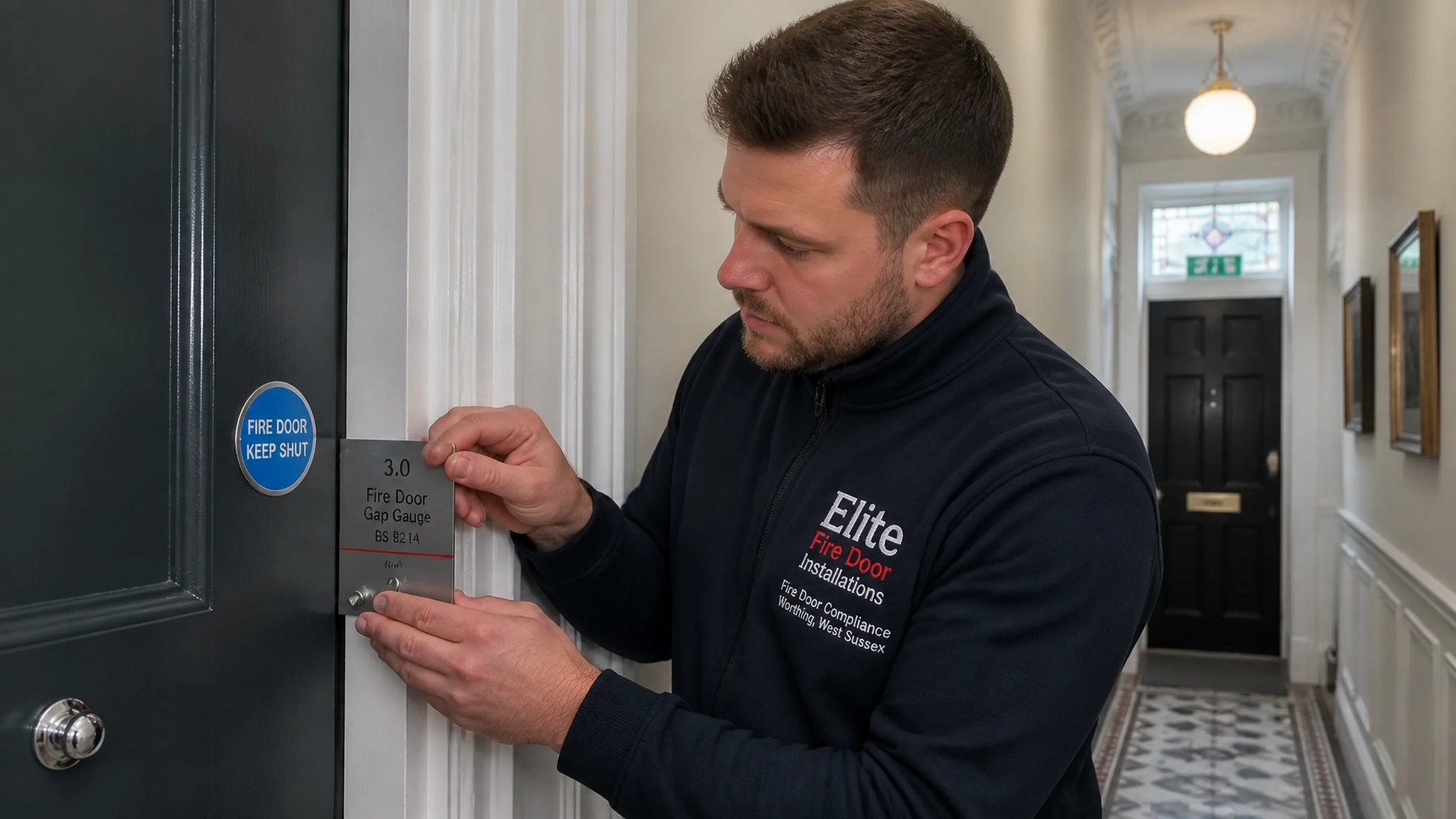
The most common reason for a failed Fire Door Installation in Worthing is incorrect spacing. A fire door is an engineered system; if the gaps are too wide, smoke and flames will bypass the door in minutes.
- The Rule: Gaps between the door and the frame (top and sides) must be between 2mm and 4mm. The threshold (bottom) gap must typically be 8mm or less.
- The Mistake: Many landlords ignore gaps where they can see light through the door. If you can see light, the door has already failed.
Mistake 2: Painted or Damaged Intumescent Seals
Intumescent strips are designed to expand when heated, sealing the gap between the door and the frame.
- The Mistake: During routine redecoration of HMOs in West Worthing, decorators often paint over these strips. This prevents the chemical reaction required for expansion.
- The Fix: These must be professionally routed out and replaced using specialized Intumescent Seal Routers to ensure a flush, compliant fit.
Mistake 3: Using Domestic Ironmongery
A fire door is only as strong as its hinges and latches.
- The Mistake: Swapping out a broken hinge with a standard domestic version from a local hardware store.
- The Reality: Fire doors require BS EN 1935 certified steel butt hinges. In Worthing, council inspectors look for the “Certifire” stamp on all hardware. If it’s not there, the door is non-compliant.
Mistake 4: The “Prop” Culture (Wedging Doors Open)
It is a common sight in shared housing: a fire door propped open with a fire extinguisher or a heavy box to “let some air in.”
- The Consequence: This is a direct breach of the Fire Safety Order. As the landlord, if a fire occurs and a door was wedged open, your insurance is likely void, and criminal negligence charges may follow. We install compliant, electromagnetic hold-open devices that release automatically when the alarm sounds.
Mistake 5: Faulty or Tampered Self-Closers
A fire door that doesn’t close isn’t a fire door.
- The Mistake: Tenants often find self-closers “too heavy” and adjust them or disconnect them entirely.
- The Standard: Every door must close firmly into the rebate from any angle, overcoming the resistance of the latch and smoke seals. We use Digital Inclinometers and Force Gauges to ensure your closers meet BS 1154 standards without being an obstacle to accessibility.
Mistake 6: Uncertified DIY “Fixes”
Attempting to repair a fire door yourself is the fastest way to a £30,000 fine.
- The Risk: Shaving the bottom of a door too much can expose the “egg-box” core (which is banned in Worthing HMOs) or void the fire rating.
- The Solution: Only a Certified Installer has the training to “re-lip” or adjust a door while maintaining its integrity.
Mistake 7: Neglecting the Maintenance Schedule
Maintenance isn’t a one-time event. For HMOs over 11 metres in height, you are now legally required to check communal fire doors every 3 months. Even for smaller properties, annual checks are the industry minimum.
- The Mistake: Waiting for the council to find a fault during an inspection. By then, it’s too late to avoid the “improvement notice” on your record.
HMO Investor Preparation: Pre-Renovation Strategy
If you are an investor purchasing a property for HMO conversion in Worthing, fire door compliance must be at the top of your budget.
Before you even apply for your license, you must factor in:
- FD30S Upgrades: Most standard internal doors in Victorian conversions will not meet the “substantial door” criteria. You will likely need full Fire Door Installation for every bedroom and kitchen.
- Protected Routes: The hallway must be a “fireproof tunnel.” This involves not just the doors, but Intumescent Mastic/Sealant around the frames and fire-rated packers to ensure no smoke leakage.
- Thumb-turn Locks: All bedroom doors must be openable from the inside without a key to ensure a rapid escape.
The Elite Solution: Repair vs. Replace
One of our core USPs at Elite Fire Door Installations is our ability to save landlords money. Many contractors will tell you a failed door must be binned. We disagree.
If the core of the door is sound, our certified experts can often perform FRA Remediation. We can:
- Re-lip edges to fix gap issues.
- Route in new intumescent and smoke seals.
- Replace non-compliant hardware with BS EN 1154 closers.
- Reinforce frames using Fire-Rated Packers.
This approach keeps you compliant for a fraction of the cost of a full replacement.
Our Certified Process and Professional Tools
When you hire us for Fire Door Repairs in Worthing, you aren’t just getting a handyman; you are getting a FireQual accredited specialist.
Our process is rigorous:
- Survey: We use Laser Levels to check for frame warping and Fire Door Gap Gauges for sub-millimetre precision.
- Fixed-Price Quoting: No hidden costs. You get a transparent breakdown of what is needed to pass your next audit.
- Certified Execution: We use Hinge Jigs for perfect alignment and Force Gauges to ensure compliance with BS 8300.
- Documentation: We provide a full handover pack, which is your “get out of jail free card” when the council inspector knocks.
Local Area Coverage in Worthing
We are deeply committed to the Worthing community. Our teams are frequently seen working in:
- Goring-by-Sea: Upgrading retirement living complexes and blocks of flats.
- Broadwater: Managing HMO compliance for student and professional lets.
- West Worthing: Restoring heritage fire doors in large seaside conversions.
We also provide rapid response services to neighbouring Lancing and Shoreham-by-Sea.
Frequently Asked Questions
1. Can I just use a standard carpenter for my fire door installation in Worthing?
No. Standard carpentry does not cover the stringent requirements of fire safety legislation. A standard carpenter may not understand the specific gap tolerances (2mm-4mm) or the necessity of using fire-rated shims and intumescent mastic. Only a certified professional can provide the compliance documentation required by your insurer and the local council.
2. What is the difference between FD30 and FD30S doors?
An FD30 door provides 30 minutes of fire resistance. An FD30S door provides 30 minutes of fire resistance plus a cold smoke seal. In Worthing HMOs, the “S” rating is almost always mandatory for doors leading onto the protected escape route, as smoke inhalation is the leading cause of fire-related fatalities.
3. How often does Worthing Council require me to check my fire doors?
While the law requires the “Responsible Person” to ensure doors are “fit for purpose” at all times, we recommend formal inspections every 6 months for standard HMOs and every 3 months for high-traffic communal areas. If your building is over 11 metres, quarterly communal checks are a legal mandate.
4. My FRA report says my gaps are 5mm. Is that really a fail?
Yes. The British Standard is clear: gaps above 4mm allow smoke to bypass the intumescent seals before they have a chance to expand. This is a common “Category A” fail in Worthing and must be remediated immediately.
5. Can I repair a fire door that has been damaged by a tenant?
In many cases, yes, but only if the repair is carried out by a certified professional. We can often “re-face” or “re-lip” a door, provided the internal integrity hasn’t been compromised. However, DIY repairs like using standard wood filler will void the door’s fire rating instantly.
Conclusion
Maintaining fire doors in Worthing is a complex, high-stakes responsibility. Between evolving national laws and strict local council enforcement, there is no room for error. Mistakes like DIY “fixes,” incorrect gaps, or missing seals aren’t just minor oversights: they are legal liabilities that can cost you your license and your livelihood.
Don’t wait for a failed inspection to take action. Whether you need a full suite of Fire Door Installations for a new HMO conversion or urgent Fire Door Repairs to satisfy an FRA auditor, Elite Fire Door Installations is your certified partner in Sussex.
Is your property compliant? Upload your inspection report now for a fixed-price remediation quote.
Leave a Reply